Talk-to-Listen Ratio on Sales Calls: What 326,000 Calls Show
Reps talk 60% of the time on average. See where the 43:57 benchmark comes from, why discovery calls need a tighter split and how to check yours.
TL;DR: After analyzing hundreds of thousands of recorded B2B sales calls, Gong has consistently found that the ideal talk to listen ratio in sales calls is close to 43% talking to 57% listening for the rep. The average rep is nowhere near that: across a 2025 analysis of 326,000 calls, reps talked 60% of the time on average, and the ones who lost deals talked even more. On discovery calls specifically, the winning ratio and the winning question count are both narrower than most reps assume, and getting them wrong is one of the most fixable, most overlooked reasons deals stall before they ever reach a proposal.
What the data actually says about talking versus listening?
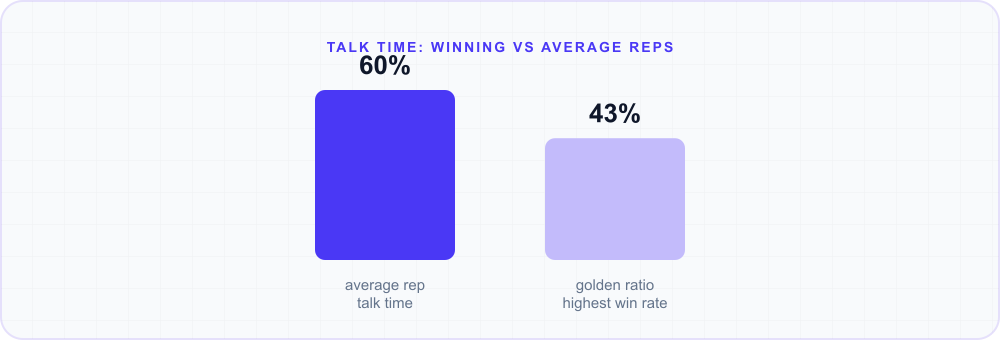
Sales has repeated "listen more than you talk" as a cliche for decades, but it wasn't until conversation intelligence platforms started recording and scoring hundreds of thousands of real calls that anyone could put a number on it. Gong's original research, later updated with fresh data, analyzed 326,000 sales calls that ran at least 10 minutes between reps and prospective customers. The average talk-to-listen ratio across all of those calls came out to 60% talking to 40% listening for the rep, and reps who closed deals talked a little less than that average while reps who lost deals talked a little more.
The gap that matters most, though, isn't the average, it's what separates winners from losers. Gong's research identified a "golden ratio" of 43% talking to 57% listening as the split most associated with sales success, and found that talking for more than 65% of a call was directly linked to lower conversion and win rates. That's not a small variance. It means the median rep is closer to the losing zone than the winning one, spending a majority of every call in transmit mode instead of receive mode.
The same 43:57 benchmark shows up again in Gong's broader "Keys to Winning Sales Conversations" research, which pulled patterns from hundreds of thousands of recorded calls to find that the highest performing B2B conversations hit that split, and that the longer a rep can keep a customer talking uninterrupted, the better the outcome tends to be. The pattern isn't about being passive. The best reps aren't quiet, they're asking sharper questions and creating a genuine back-and-forth instead of a monologue interrupted by the occasional prospect comment.
Why is the discovery-call bar even tighter?
Discovery is where this dynamic matters most, because it's the stage where a rep either learns enough to build a relevant pitch or doesn't. Gong's dedicated discovery call research, drawn from analysis of over 519,000 discovery call recordings, found the talk-to-listen ratio on winning discovery calls tightens slightly further to about 46% talk to 54% listen, still firmly on the listening side of the line. The same research found a clear, almost linear relationship between the number of questions a rep asks and how likely the call is to lead to a next step: top performers ask somewhere between 11 and 14 questions per call, roughly double what average reps ask.
Salesgenie's 2026 cold calling research backs this up from a different angle. Its analysis found that asking between 11 and 14 questions on a call produced a 70% success rate, reinforcing that there's a real, identifiable sweet spot rather than a vague "ask more questions" platitude.
Question count isn't the only variable. Gong's discovery data also found that the most successful reps spend the early part of a call on rapport, then dig deeply into three to four customer problems before wrapping up logistics and next steps. Push past four problems and deals start to slip; each issue feels less urgent when it's competing with too many others for the prospect's attention. And it isn't just about who's talking, it's about how often the conversation changes hands. The research found that a higher number of "speaker switches" per call, meaning the conversation naturally passes back and forth rather than sitting in long uninterrupted blocks from one side, correlates with a higher likelihood of securing a follow-up meeting.

Why this keeps happening even to experienced reps?
None of this is really a knowledge problem. Most experienced reps could recite "listen more than you talk" without hesitation. The gap between the 43:57 benchmark and the 60:40 average exists because silence on a call feels risky in the moment, so reps fill it, explaining the product, walking through the company overview, or restating value props the prospect already understands. Gong's research specifically flagged that reps who lose deals talk closer to 64 to 65% of the time on average, a pattern that usually means the rep started presenting before fully understanding what the prospect actually needed solved.
This is also why talk-to-listen ratio is such a durable coaching metric. It's observable in a single call, it doesn't require waiting weeks to see whether a deal closes, and it correlates with outcomes closely enough that a manager can flag it in real time. A rep who is consistently at 60% talk time on discovery calls isn't a personality problem to be solved with more confidence; it's a process signal that they're pitching before qualifying.
Where Pixelwand CRM fits in
Fixing a talk-to-listen problem starts with actually having the context to ask fewer, better questions instead of falling back on a generic pitch. Pixelwand CRM's native calling, built on Twilio for bring-your-own-carrier flexibility, puts click-to-call directly on the lead or deal record, so a rep dials in already looking at the account's full history instead of starting cold. Because every call, WhatsApp thread, email, and web form touchpoint funnels into the same unified pipeline automatically, a rep prepping for a discovery call can see exactly what's already been asked and answered rather than re-covering old ground and eating into the listening time that actually moves deals forward.
Google Calendar sync reinforces the same habit at the moment it matters most: right before the call starts, when a rep who has opened the record and knows the account's open questions and prior conversations is far more likely to walk in ready to ask the four or five sharp questions that count, instead of filling the first ten minutes with a company overview nobody asked for. Gmail and Outlook sync auto-logging every thread onto the record means that history persists for the next rep too, so the ratio problem doesn't reset with every handoff.
If your team's calls are running long on pitch and short on prospect airtime, the fix usually isn't a talk-track rewrite, it's giving reps the pre-call context to ask fewer, sharper questions and actually listen to the answers.
Plan availability: native WhatsApp messaging starts on the Growth plan. See pricing for details.
Curious how this looks with your own pipeline?
15-minute walkthrough, no pressure, cancel anytime.
Sources: Gong: Mastering the talk-to-listen ratio in sales calls, Gong: Keys to Winning Sales Conversations, Gong: 8 Things to Consider Before Your Next Discovery Call, Gong Discovery Call Training Deck, Salesgenie: Top 25 Cold Calling Statistics Sales Reps Must Know in 2026
Sales call prep stats: reps who research 15+ minutes win 50% more deals, yet only 49% of average sellers research consistently.
Clari's data on 10M opportunities shows the top 10% of sellers drive 65% of revenue. See what sets them apart and what moves a rep up.
Rep turnover stats: reps leave at 35% a year, nearly triple the average, and each departure can cost $115,000 to $150,000 in pipeline.
Frequently asked questions
What is a good talk-to-listen ratio in sales calls?
Across hundreds of thousands of recorded B2B sales calls, Gong has repeatedly found that the highest converting ratio sits at roughly 43% talking to 57% listening for the rep. That is often called the golden ratio. On discovery calls specifically, the winning split shifts slightly to about 46:54. The average rep, by contrast, talks around 60% of the time, well past the point where conversion rates start to drop.
How many questions should you ask on a discovery call?
Gong's analysis of more than 519,000 discovery call recordings found that top performers ask between 11 and 14 questions per call, roughly twice as many as average reps, and Salesgenie's 2026 cold calling research found that asking 11 to 14 questions produced a 70% success rate. Past that range, calls start to feel like an interrogation and success rates decline.
Why do most sales reps talk too much on calls?
Silence feels risky to most reps, so they fill it with pitching, feature explanations, and company background instead of letting the prospect talk. Gong's data shows reps who lose deals talk closer to 64 to 65% of call time on average, largely because they move to presenting before they've actually understood the prospect's problem.
Does the number of problems discussed on a call affect win rate?
Yes. Gong's discovery call research found that the most successful reps dig deeply into 3 to 4 customer problems per call. Once a rep tries to cover more than four problems, deals become less likely to advance, likely because each individual issue starts to feel less urgent when it's competing with too many others for attention.