Sales Call Prep: 15 Minutes Wins 50% More Deals
Sales call prep stats: reps who research 15+ minutes win 50% more deals, yet only 49% of average sellers research consistently.
TL;DR: Sales call preparation statistics keep landing on the same conclusion: reps who spend even 15 minutes researching a prospect before a call win dramatically more deals than reps who wing it, yet nearly half of average sellers skip that step entirely. Gong research puts the win rate lift at 50% for reps who prepare 15 or more minutes before a call. LinkedIn's State of Sales Report found 82% of top performers always research prospects first, compared to just 49% of everyone else. The gap is not effort, it is almost always fragmented data spread across email, notes apps, and spreadsheets instead of one place a rep can check in a few minutes.
How big is the prep gap for top performers?
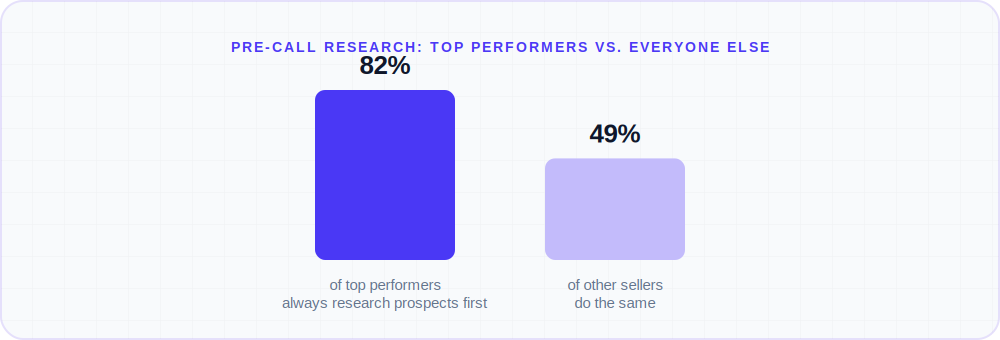
Sales leaders like to talk about talk tracks, objection handling, and closing techniques. The research says the deal is often decided before the call even starts. LinkedIn's State of Sales Report found that more than three quarters of top performers say they "always" perform research before reaching out to prospects, compared to just 49% of other sellers, a gap of over 30 points between the best reps and the rest of the team. That same report found top performing salespeople spend about 18% more time keeping their CRM records updated than average salespeople, which is not a coincidence. A rep who updates the record after every call has a head start the next time they prep for that account, while a rep who skips logging is stuck starting from zero every time.
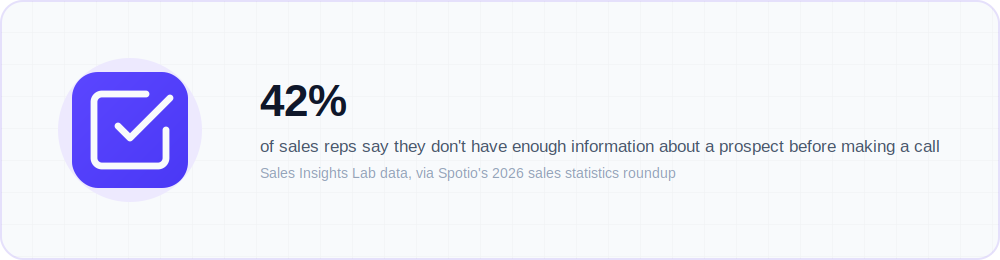
This is not a small-sample fluke. Sales Insights Lab data reported by Spotio found that 42% of sales reps say they simply do not have enough information about a prospect before making a call. Ask most of those reps why, and the answer is rarely "I didn't have time to Google them." It is that the last email thread lives in a personal inbox, the call notes from three months ago are in a different rep's head, and nobody wrote down that the buyer already mentioned a budget freeze. The information usually exists somewhere. It just is not sitting on the one record a rep opens before dialing.
Why 15 minutes of prep moves win rate so much?
The size of the effect is what makes this worth fixing. Research cited by Gong found that reps who prepare for 15 minutes or more before a call win 50% more deals than reps who go in cold. That is not a marginal coaching tweak, it is closer in magnitude to the kind of gap normally reserved for comparing a trained rep to a brand new hire. Part of the reason is that preparation changes what happens inside the call itself, not just how the rep feels walking in. RAIN Group found that 82% of buyers agree to a next step when a rep explicitly proposes one, compared to only 28% when the rep leaves it open and hopes the buyer will suggest a follow up. Proposing a specific next step is itself a preparation habit. A rep who has not reviewed the account beforehand rarely walks out with a concrete date, an attendee list, and an agenda, because they are too busy trying to remember basic context in real time.
Preparation also compounds. A rep who reviews the last email thread, the last call outcome, and any open questions before dialing tends to ask sharper follow up questions, which produces a better call, which produces a cleaner CRM record, which makes the next prep session faster. Skip the loop once and every subsequent call starts a little further behind. That is a big part of why the gap between top performers and everyone else widens over time instead of staying flat.
Curious how this looks with your own pipeline?
15-minute walkthrough, no pressure, cancel anytime.
What actually eats the 15 minutes?
None of this means reps need to block off an hour before every call. Several breakdowns of pre-call workflows put the ceiling on useful research at around 15 to 20 minutes for a standard discovery call, after which returns drop off fast. The problem most teams have is not that 15 minutes is too little, it is that 15 minutes of useful research often turns into 45 minutes of app-switching. A rep has to check email for the last thread, check a calendar tool for the last meeting, check a notes doc for what was discussed, and check a spreadsheet or a second CRM tab for deal stage, before they even start looking at the company itself. Multiply that friction across a full day of calls and the 15-minute prep window most reps aim for quietly becomes optional, which is exactly how you end up with a team where under half of reps research consistently.
Where Pixelwand CRM fits in
The fastest way to close the prep gap is to remove the app-switching, not to lecture reps about discipline. Pixelwand CRM unifies leads and deals from calls, WhatsApp, web forms, and email into a single pipeline automatically, so the last conversation with a prospect is sitting on the record instead of buried in someone's inbox. Gmail and Outlook sync auto-logs email threads and calendar events directly on the lead or deal, which means a rep opening a record fifteen minutes before a call sees the real history without hunting for it. Google Calendar sync adds meeting-prep summaries so the context shows up before the rep even has to go looking. Native two-way WhatsApp messaging and click-to-call through Twilio keep every touch attached to that same record too, so nothing from a prior conversation has to be reconstructed from memory. Custom fields and statuses let teams flag exactly what "ready for the next call" should include, so the 15 minutes of prep that actually moves win rate happens by default, not by heroics.
What is "good" call prep, and how do you know reps are doing it?
The honest answer is that most sales leaders do not know how much prep is actually happening, because it happens in browser tabs nobody can see. The fix is making the record itself the prep tool, so a rep who opens a lead has the last call, the last email, and the last WhatsApp thread in front of them without opening anything else. Teams that get this right are not asking reps to do more work before every call, they are removing the ten minutes of searching that used to come before the five minutes of actual thinking.
Sources: LinkedIn State of Sales Report 2022, Sendspark: Sales Call Preparation, Spotio: 140+ Sales Statistics, Salesgenie: Sales Productivity Statistics
Recorded calls show the ideal talk-to-listen ratio is 43:57, yet the average rep talks 60% of the time. Here's what wins conversations.
Clari analyzed 10M opportunities: the top 10% of sellers generate 65% of revenue while the bottom half contributes under 8%.
Rep turnover stats: reps leave at 35% a year, nearly triple the average, and each departure can cost $115,000 to $150,000 in pipeline.
Frequently asked questions
How much time should you spend preparing for a sales call?
Most benchmarks point to 15 to 20 minutes for a standard 30 minute discovery call. Sales research summarized by Gong found that reps who prepare for 15 minutes or more before a call win 50% more deals than reps who skip prep, and the first chunk of that research time produces most of the value. Spending an hour digging through LinkedIn, the company website, and old email threads usually means the CRM record was not doing its job, not that the rep needed more research time.
Does sales call preparation actually increase win rate?
Yes, and the effect shows up in more than one dataset. Beyond the prep-time to win-rate link, RAIN Group found that 82% of buyers agree to a next step when a rep explicitly proposes one, compared to just 28% when the rep leaves it open, which is itself a preparation habit. Reps who walk in with a plan close the loop on the call instead of hoping the prospect follows up.
Why do top sales performers research prospects more than average reps?
LinkedIn's State of Sales Report found that 82% of top performing sellers say they always research prospects before reaching out, compared to 49% of other sellers. Top performers also spend about 18% more time keeping their CRM records updated, which gives them a faster, more reliable starting point the next time they prep for a call with the same account.
Why do so many sales reps skip pre-call research?
The most common reason is not laziness, it is fragmentation. Sales Insights Lab data reported by Spotio found that 42% of sales reps say they do not have enough information about a prospect before making a call, usually because the relevant email threads, call notes, and prior conversations live in separate tools instead of one record they can open in under a minute.