SMS Response Rate: Texts Beat Email 4-to-1 in B2B
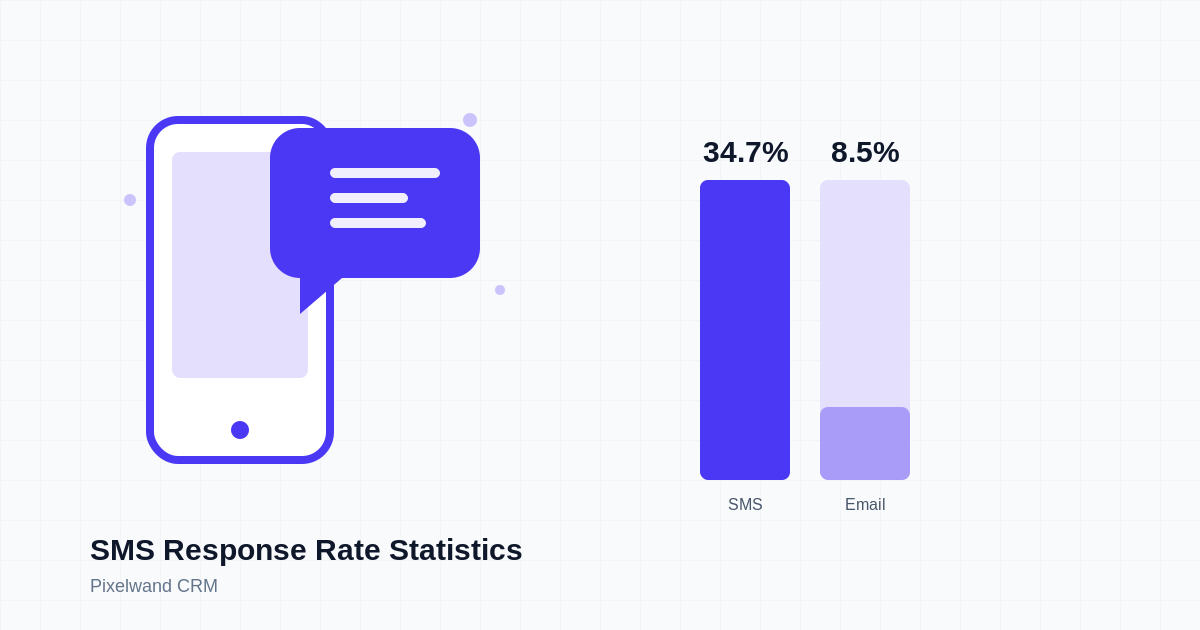
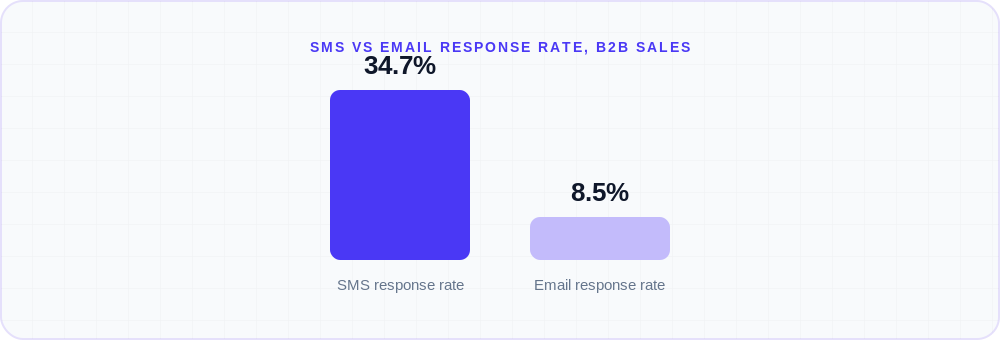
TextUs surveyed 763 revenue pros: SMS earns 34.7% response versus 8.5% for email, yet top texting funnel stages get used least.
TL;DR: TextUs's 2026 SMS Engagement + Benchmark Report, a survey of 763 revenue professionals, found SMS earns a 34.7% average response rate in B2B sales versus 8.5% for outreach email, a 4-to-1 gap. The twist is where that gap is widest: deal close and renewal, the two funnel stages with the biggest edge over email (up to 82.2% outperformance), are also the stages sales teams text the least, with adoption as low as 17.3%. Connecting SMS to the CRM instead of running it from a standalone app nearly triples response performance. Most of the upside sitting in this channel is going unclaimed, not because texting doesn't work, but because teams stop using it exactly where it works best.
How big is the SMS vs email response gap?
Text messaging has quietly become one of the highest-performing channels in B2B sales, and the 2026 data makes the size of the gap hard to ignore. TextUs surveyed 763 revenue professionals across software, financial services, recruiting, and customer service for its 2026 SMS Engagement + Benchmark Report and found an average 1:1 SMS response rate of 34.7% across all industries, against 8.5% for outreach email. That's not a marginal edge, it's roughly four replies for every one a comparable email campaign gets. Nearly one in four respondents (24%) report response rates above 56%, and another quarter land between 26% and 45%, meaning most teams running SMS programs are seeing meaningfully better numbers than a typical cold email sequence, not just an occasional top performer.
The pattern holds by industry too. Hospitality and real estate lead at 37.2%, recruiting and staffing sit at 37.0%, and software and technology, the segment most B2B sales teams belong to, average 34.5%, tracking closely with the overall benchmark. Separately, SimpleTexting's 2026 data on SMS performance puts response rates in a similar range, around 45%, with click-through rates of 21% to 35% on messages that include a link, both well ahead of the low single digits email typically manages.
Why are texts read in seconds, not hours?
Response rate is only half the story; speed is the other half, and it's where SMS separates itself most clearly from every other channel a sales team uses. Selling Power's reporting on business texting cites research showing it takes an average of 90 seconds for someone to respond to a text message, compared to 90 minutes for email, a sixty-fold difference in how quickly a rep can expect to hear back. TextUs's benchmark data backs this up from the sales side: more than 9% of SMS replies arrive within five minutes of being sent, and a quarter arrive within 30 minutes, a window where a lead's interest is still fresh and a rep can act on it immediately rather than picking the conversation back up hours later.
That speed compounds with preference. The same Selling Power reporting notes that roughly 90% of leads say they'd rather be contacted by text than by phone, which lines up with why unsolicited calls increasingly go straight to voicemail while a short, relevant text gets opened almost immediately. For a rep working a lead five minutes after it comes in, the channel that actually gets read in that window matters as much as the message itself.
Which SMS stages do teams skip most?
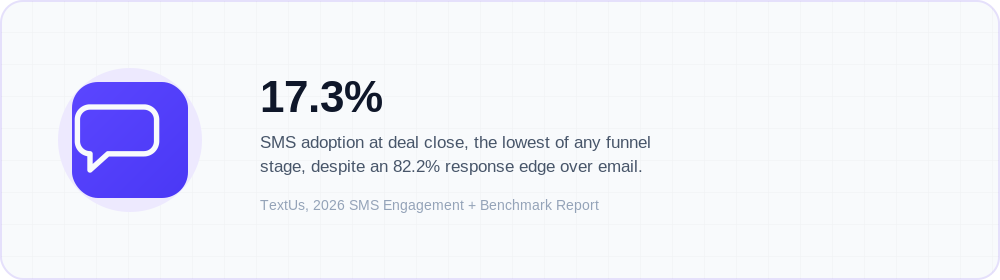
This is the part of the data that should reset how most sales teams think about SMS. TextUs found that deal close is the funnel stage where SMS shows its single biggest advantage over email, an 82.2% outperformance gap, with a 39.6% response rate at that stage specifically. And yet deal close is also the stage with the lowest SMS adoption of the entire funnel: just 17.3% of SMS users deploy it there. Renewals tell a nearly identical story. Only 18.8% of teams use SMS for renewal conversations, but 58.2% of the teams that do say it directly increases revenue at that stage.
The likely explanation is habit rather than strategy. Reps default to email or a phone call for anything that feels "official," like confirming final contract terms or checking in before a renewal, even though those are exactly the moments a prospect is most likely to be checking their phone for a quick answer rather than sitting down to compose an email reply. The channels teams reach for out of convention and the channels that actually perform best at each stage aren't the same, and that mismatch is where most of the unclaimed upside in this data is sitting.
What happens when SMS is tied to the CRM?
Where a text gets sent from changes how well it performs almost as much as the message itself. TextUs found that teams with their SMS platform connected to a CRM see response rates nearly triple compared to teams texting from a standalone tool with no lead or deal context attached. Conversation depth, a measure of how far a text exchange actually progresses rather than dead-ending after one reply, jumps from 8.9% in disconnected setups to 45.4% when SMS is tied to CRM data. Speed to reply follows the same pattern, improving from 10.1% to over 33%. The mechanism isn't mysterious: a rep who can see the full deal history, the last call outcome, and the open tasks on a lead the moment a text reply comes in writes a more relevant follow-up than one working from a bare phone number in a separate app.
Separately, Salesmsg's 2026 platform data shows outbound SMS performs best when it's timed around business hours, with the 10 AM to noon window producing the fastest replies, and when messages stay short rather than reading like a marketing blast. Frequency matters just as much as timing: TextUs found 57.7% of respondents have unsubscribed from a business's texts specifically because the business texted too often, a reminder that SMS earns its high response rates by being used sparingly for relevant, timely messages, not as a volume channel.
Curious how this looks with your own pipeline?
15-minute walkthrough, no pressure, cancel anytime.
Where Pixelwand CRM fits in
The CRM-connection effect in the TextUs data is essentially the argument for why texting shouldn't live in a separate app from the rest of the pipeline. Pixelwand CRM's Twilio integration includes automated SMS workflows and click-to-call alongside call recording, all logged directly to the contact timeline the moment they happen, so a text sent to a lead sits next to that lead's call history, deal stage, and open tasks rather than in a disconnected messaging tool. Two-way WhatsApp Business API messaging runs the same way, woven directly into the deal card with every chat logged automatically, which matters given how closely WhatsApp's open and response behavior tracks the same instant-read pattern SMS shows in this data. Because calls, WhatsApp, SMS, web form leads, and email all land on one pipeline automatically, a rep replying to a text at the deal-close or renewal stage, the two moments this data says matter most, is working from full context instead of a blank number, which is exactly the setup TextUs found nearly triples response performance.
Why is SMS beating email 4 to 1?
SMS isn't an underdog channel in B2B sales anymore, it's outperforming email by 4 to 1 on response rate and by an even wider margin at the exact stages, deal close and renewal, where a fast reply is worth the most. The gap between what the data says works and what most teams actually do comes down to habit and infrastructure: reps default to email and calls out of convention, and SMS gets treated as a bolt-on tool without CRM context instead of a channel wired into the same record as everything else. Closing that gap doesn't require a new strategy so much as using the channel where the data says it already wins, and giving it the same pipeline context that already makes calls and WhatsApp perform well.
Sources: TextUs: 2026 SMS Engagement + Benchmark Report, SimpleTexting: SMS Marketing Statistics 2026, Salesmsg: SMS Marketing Statistics 2026, Selling Power: The Six Reasons Texting Has a Higher Response Rate for Sales Teams
Sales email open rate statistics show real opens near 24%, while vendor benchmarks claim up to 42%. See why the gap exists and what to track instead.
Video prospecting statistics show video emails get 26% more replies and cut close time nearly in half. See the real data behind video outreach.
Studies disagree on the best time to send sales emails, but mid-week mornings beat Mondays and late evenings, lifting open rates by up to 30%.
Frequently asked questions
How much better does SMS perform than email in B2B sales outreach?
TextUs's 2026 SMS Engagement + Benchmark Report, based on a survey of 763 revenue professionals, found the average 1:1 SMS response rate across industries is 34.7%, compared to 8.5% for outreach email, a 4-to-1 margin. Top-quartile SMS programs see response rates above 56%, and nearly a quarter of respondents report hitting that tier.
Why don't more sales teams text at the deal-close and renewal stages?
It's not because texting performs worse there, it's the opposite. TextUs found only 17.3% of SMS users deploy it at deal close, the lowest adoption of any funnel stage, despite that stage showing a 39.6% response rate and the largest gap over email of anywhere in the data (82.2% outperformance). Renewals see similarly low adoption at 18.8%, even though 58.2% of teams that do text at renewal say it directly increases revenue.
Does connecting SMS to the CRM actually change response rates?
Yes, substantially. TextUs found that teams with their SMS platform connected to a CRM see response rates nearly triple compared to teams texting in isolation. Conversation depth jumps from 8.9% to 45.4%, and the share of replies arriving quickly improves from 10.1% to over 33%, because the rep has full context on the lead or deal the moment a reply comes in instead of texting from a disconnected app.
Is it legal to text B2B leads and customers in sales outreach?
The TCPA applies to business-to-business texting as much as consumer texting; a prospect's job title doesn't exempt a company from needing prior consent before sending marketing texts to a mobile number, and opt-outs have to be honored. Sales teams that use texting well tend to treat it as a permission-based channel for real conversations tied to a live deal or ticket, not a broadcast channel, which is also why it performs better.