Best Time to Send Sales Emails: Mid-Week Wins
Studies disagree on the best time to send sales emails, but mid-week mornings beat Mondays and late evenings, lifting open rates by up to 30%.
TL;DR: There is no single, universally correct answer to the best time to send sales emails, and the studies genuinely contradict each other on specifics. But strip away the noise and a pattern holds across most large B2B datasets: Tuesday through Thursday beats Monday and Friday, mornings now beat late evenings, and picking a good send window over a bad one can lift open rates by as much as 30%. Still, the gap between the best and worst day in some datasets is under 2 percentage points, which tells you timing is a lever worth pulling, not the whole machine.
Why the "best time to send" studies never agree?
Search "best time to send sales emails" and you'll find a dozen confident, contradictory answers. One report says Tuesday at 8 a.m. Another says Thursday evening. A third says the beginning of the month matters more than the day of the week. None of these sources are lying, they're usually just measuring different things.
Some studies pool consumer newsletter data from opted-in subscribers who already expect an email. Others isolate cold B2B outreach to people who never asked to hear from you, which is a completely different inbox psychology. Some optimize for opens, some for clicks, some for reply rate, and some for actual conversions, and those four metrics don't peak at the same time. Omnisend's own research illustrates this well: Tuesday leads for opens and clicks, while Friday leads for conversions, with the single best-performing slot in its dataset landing at Friday 7 a.m. with a 0.138% conversion rate. A team optimizing for "getting read" and a team optimizing for "getting a signed deal" can both be right and still recommend opposite send times.
Sample size and recency matter too. One consulting firm cited in a recent chrysales analysis tested the same cold email against 400 prospects split across four time blocks, Tuesday 10 a.m., Wednesday 2 p.m., Thursday 8 a.m., and Friday 4 p.m., and the Tuesday 10 a.m. batch, the "safe" conventional choice, actually produced the worst open rate at 11%. Received wisdom doesn't always survive contact with a real list.
Why is Tuesday the best day to send?
Despite the noise, Tuesday shows up as a top performer more often than any other day. Omnisend's large-scale dataset found Tuesday has the strongest top-of-funnel performance of the week, with a 31.27% open rate and a 0.81% click-to-sent rate. Separate B2B-focused research aggregated by Qualtir cites WarmySender data putting Tuesday at 4.8% replies (ahead of Wednesday's 4.5% and Thursday's 4.3%), and ReachIQ data placing Tuesday 8 to 10 a.m. local time at a 5.6% median reply rate, the highest hour bucket in that dataset. The logic behind Tuesday's edge is consistent across sources: by Tuesday, most professionals have cleared the Monday backlog but haven't yet mentally checked out for the week.
Could Wednesday or Thursday beat Tuesday?
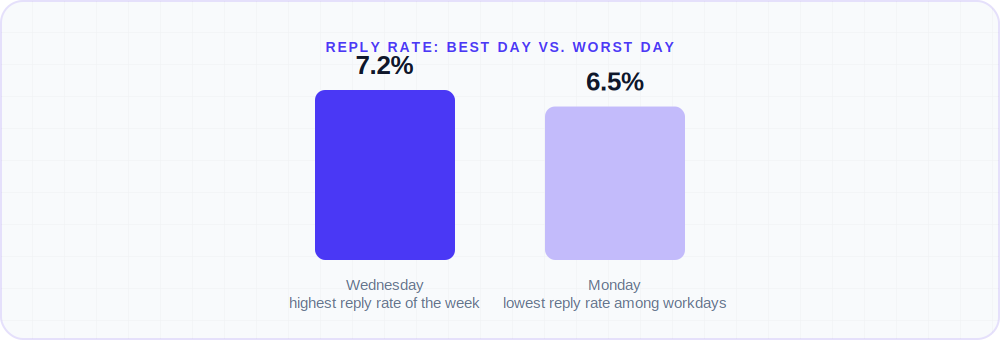
Other well-sourced studies give the crown to Wednesday or Thursday instead. Belkins' analysis of cold B2B outreach found the best day of the week for outreach emails was Wednesday, with the highest reply rate (7.2%) and open rate (37%) of the week, narrowly ahead of Tuesday on opens. A newer Belkins dataset, refreshed with more recent send data, found Wednesday and Thursday tied at the top among standard workdays at 0.48% reply rate each, while Monday, despite having the highest send volume, sat mid-table. Salesforce's own guidance for B2B teams lands in the same neighborhood, pointing to Tuesday through Thursday as the strongest engagement window and calling out Monday and Friday as comparatively weak.
Where the days clearly underperform, Monday and Friday, the reasoning is fairly consistent across sources: Monday inboxes are clogged with weekend backlog and people are still triaging rather than engaging, while Friday afternoons see attention drift toward the weekend. That said, this isn't universal. One Growthlist analysis concluded Monday and Tuesday were actually the best-performing days for cold email, a direct contradiction of the Belkins and Salesforce findings, and a useful reminder that industry, list type, and even single-company idiosyncrasies can flip the ranking. In that same Belkins dataset, a reply rate of 7.2% on the best day versus 6.5% on the worst working day (Monday) is the kind of gap real sales teams are fighting over.
Mornings or evenings: when should you send?
Time of day has moved even more than day of week. Belkins' newer study found mornings win clearly: emails sent between 8 a.m. and noon generated the highest reply rate at 0.54%, with early morning (5 to 8 a.m.) close behind at 0.52%. That's a meaningful reversal, the same research notes that in previous years, late evening sends (8 to 11 p.m.) were the top-performing slot, and in the newer dataset they rank last alongside overnight sends at just 0.40%. The likely explanation offered in that research is a shift in inbox behavior, professionals now triage email differently than they did even a couple of years ago.
Other B2B-focused sources land in a similar late-morning-to-early-afternoon zone. Salesforce's guidance for B2B senders points to 9 to 11 a.m. for higher open and click-through rates, while a chrysales review of cold outreach research found mornings between 8 and 10 a.m. and late afternoons between 3 and 5 p.m. outperforming midday sends, with Monday before 10 a.m. and Friday after 2 p.m. underperforming across the board. None of these numbers match exactly, but the shape of the day is consistent: avoid the very start and very end of the workweek, and avoid the very start and very end of the workday too.
Does send time even matter that much?
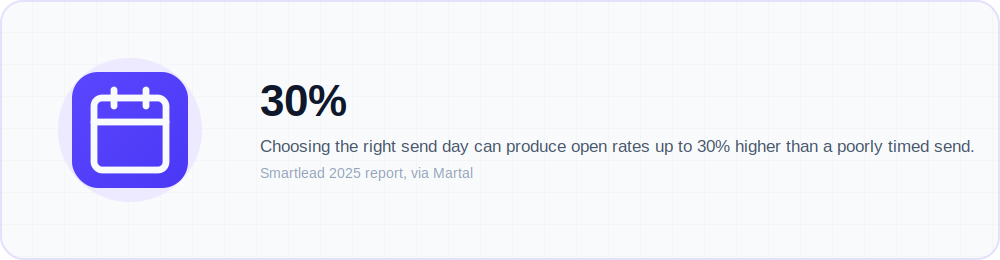
Here's the honest caveat most "best time to send" articles skip. Timing clearly helps, Smartlead's 2025 research, cited by Martal, found that choosing the best day to send can produce open rates as much as 30% higher than a poorly timed send. That's a real, actionable lift for something that costs nothing but a scheduling decision.
But timing is not the dominant lever. Omnisend's own dataset found the open-rate spread between the highest and lowest day of the week was only about 1.6 percentage points, a far cry from the dramatic swings some blog headlines imply. And separate research on cold email performance (cited by Artisan, drawing on a Belkins analysis of 16.5 million cold emails) found the average cold email response rate sits around 5.8%, with sending just one follow-up increasing that average response rate by nearly 50%. In other words, whether you hit send at 8 a.m. or 2 p.m. matters less than whether you follow up at all. Teams chasing the "perfect hour" while letting replies sit unanswered for days are optimizing the wrong variable.
Curious how this looks with your own pipeline?
15-minute walkthrough, no pressure, cancel anytime.
Where Pixelwand CRM fits in
If send-time optimization only moves the needle a few points while follow-up consistency moves it by nearly 50%, the highest-leverage fix isn't a smarter send-time algorithm, it's a system that makes sure the follow-up actually happens on schedule, every time, for every lead. Pixelwand CRM's Gmail and Outlook sync auto-logs every email thread directly onto the lead or deal record, so a rep can see exactly when a prospect last opened a conversation without digging through a separate inbox. Because Pixelwand unifies leads and deals from calls, WhatsApp, web forms, and email into one pipeline automatically, a cold email that goes quiet doesn't have to stay quiet, reps can switch channels and follow up over WhatsApp Business API or a click-to-call from the same record instead of waiting on a single channel's timing quirks. Slack notifications flag new replies and stalled deals in real time, and Google Calendar sync with meeting-prep summaries makes sure a reply that does land turns into a booked meeting instead of a missed window. Custom statuses and assignment rules keep every "sent, no reply yet" lead visible and owned, so the next follow-up happens on schedule regardless of whether Tuesday morning or Thursday afternoon turned out to be the lucky send time.
Sources: Belkins B2B email timing study, Belkins cold email response rates study, Artisan on B2B cold email response rates, Omnisend best time to send email research, Martal on best time to send cold emails, Salesforce best time to send marketing emails, Qualtir best time to send cold email, Growthlist cold email statistics, Chrysales on best time to send B2B cold outreach
Sales email open rate statistics show real opens near 24%, while vendor benchmarks claim up to 42%. See why the gap exists and what to track instead.
Video prospecting statistics show video emails get 26% more replies and cut close time nearly in half. See the real data behind video outreach.
TextUs surveyed 763 revenue pros: SMS earns 34.7% response versus 8.5% for email, yet top texting funnel stages get used least.
Frequently asked questions
What is the best day to send a sales email?
Most large-scale studies point to Tuesday, Wednesday, or Thursday. Belkins' analysis of B2B cold outreach found Wednesday produced the highest reply rate at 7.2%, while a newer Belkins dataset put Wednesday and Thursday tied at the top among standard workdays. Omnisend's broader dataset gives Tuesday the edge for opens and clicks. Not every study agrees though, at least one analysis found Monday and Tuesday performing best, which is why testing your own list still matters more than copying a single benchmark.
Does the time you send an email actually matter?
Yes, but less than most headlines imply. Timing can swing results, Smartlead's research (cited by Martal) found choosing the right send day can produce open rates up to 30% higher than a poorly timed send. At the same time, Omnisend found the open rate gap between the best and worst day of the week was only about 1.6 percentage points across its dataset, meaning list quality, subject line, and follow-up cadence usually matter more than the exact hour.
Is Monday a bad day to send cold emails?
In several studies, yes. Belkins found Monday had the lowest open rates (under 35%) and reply rates (6.5%) of the working week, and a newer Belkins dataset still places Monday mid-table despite carrying the highest send volume. But this isn't universal, Growthlist's research concluded Monday and Tuesday were actually the strongest days, which is a good example of why send-time data varies by list type and industry.
What time of day gets the highest email reply rate for B2B outreach?
Recent data points to mornings. Belkins' newer study found emails sent between 8 a.m. and noon generated the highest reply rate at 0.54%, with early morning (5 to 8 a.m.) close behind at 0.52%. That's a reversal from older studies, which had late evening sends (8 to 11 p.m.) on top; in the newer dataset, evening sends dropped to last place at 0.40%.