Sales Email Open Rate Statistics: Why It's Only 24%
Sales email open rate statistics show real opens near 24%, while vendor benchmarks claim up to 42%. See why the gap exists and what to track instead.
TL;DR: Sales email open rate statistics are a mess right now, and that's the point. Gartner-cited data puts real opens at just 23.9%, while vendor tools claim anywhere from 27.7% to 44%. The gap exists because Apple's privacy tools inflate recorded opens, so most teams are now watching reply and click rates instead. Personalized subject lines still move the needle, adding a 31% lift in one 5.5-million-email study, but open rate alone can no longer be trusted as a health check on your outreach.
What is the average sales email open rate today?
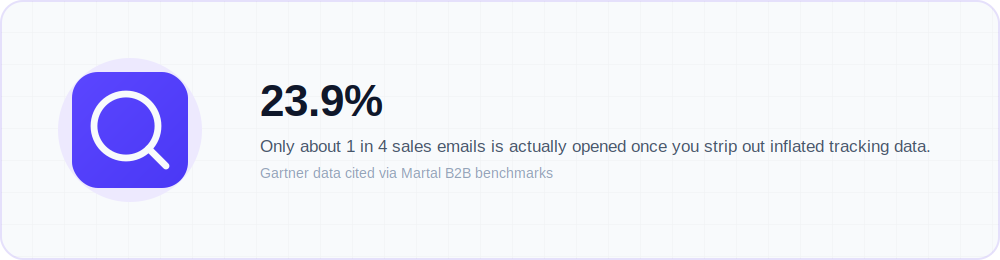
There isn't one clean number. Gartner-cited data puts the real average sales email open rate at just 23.9%, meaning roughly three out of four sales emails never get opened at all. Vendor-reported benchmarks run much higher, often between 27.7% and 44%, because they measure differently and get skewed by privacy tools.
Woodpecker's analysis of over 20 million cold emails found an average open rate range of 27.7% to 44%, with anything above 40 to 60% considered good and 65%+ excellent. That's a wide spread for a single metric, and it's not a data quality problem so much as a definition problem. Some tools count opens against emails sent, others against emails delivered, and almost none of them can fully separate a human open from a bot preloading an image.
Why do sales email open rate benchmarks vary so much?
Benchmarks vary mainly because of Apple Mail Privacy Protection (MPP), which automatically preloads images and tracking pixels for a huge share of iPhone and Mac Mail users, whether or not anyone actually reads the email. That single feature has inflated open rate data across the industry since 2022, making the metric far less reliable than it used to be.
Estimates on the scale of the distortion vary, but Apple MPP is reported to affect roughly 50% to 60% of recorded email opens industry-wide. Add in industry variance on top of that. One benchmark study of B2B cold email found the average sits around 39%, but energy sector campaigns can hit 46.31% open rates while SaaS lags at just 25.71%, a gap driven by how receptive each buyer audience is to unsolicited email in the first place. Stack privacy inflation on top of natural industry variance and it becomes clear why no two open rate reports will ever agree.
Does personalizing the subject line actually increase open rates?
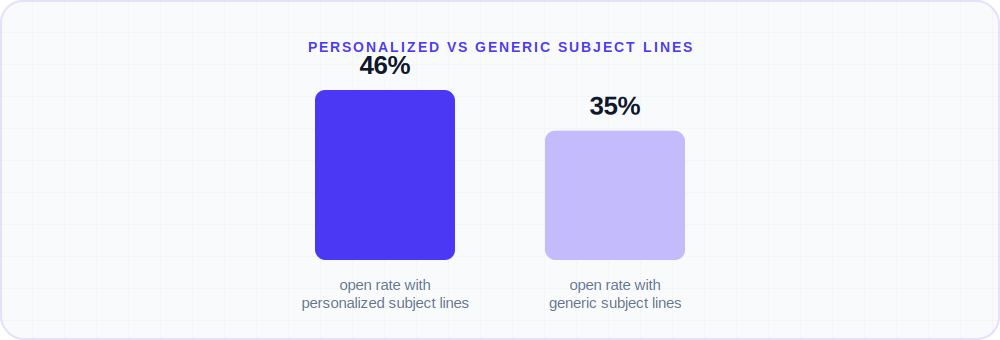
Yes, and the lift is measurable even with all the open rate noise. An analysis of 5.5 million B2B cold emails found personalized subject lines earned a 46% open rate compared to 35% for generic ones, a 31% relative lift. A separate Adobe-cited study puts the personalization boost at a more conservative 20% to 26%, but the direction is consistent across every dataset.
The same 5.5-million-email study found question-based subject lines also hit that same 46% ceiling, suggesting curiosity works about as well as personal detail. On the flip side, subject lines packed with marketing hype, urgency words, or generic greetings dragged open rates below 36%. The subject line is doing more work than most reps realize. One analysis citing ZeroBounce found 43% of recipients decide whether to open or delete an email based on the subject line alone, and 69% will flag an email as spam purely from that one line, before ever reading the body copy.
That's a lot of outcome riding on ten seconds of writing. If your team is sending from a generic list without any context on the lead's recent activity, no subject line trick will fully make up for it. This is where having every past call, WhatsApp thread, and web form fill visible on the same lead record actually helps reps write something that isn't generic, because they can reference what the prospect already did instead of guessing.
How reliable is open rate as a sales metric anymore?
Open rate is still useful directionally, but it's no longer a trustworthy standalone signal, because MPP-driven inflation means a "40% open rate" campaign and a genuinely engaged one can look identical on paper. That's why more sales and marketing teams have shifted their primary focus toward click-to-open rate, reply rate, and conversion, since those require an actual human action.
The Gartner-cited figure of just 23.9% of sales emails actually being opened is a useful gut check precisely because it's lower than the vendor averages, not higher. It's a reminder that the inflated numbers most teams see in their own tools are probably optimistic. If your open rate looks unusually strong, it's worth checking whether it lines up with downstream activity like replies and booked meetings, because that's where the real signal lives now.
What's a good reply rate for B2B cold sales emails?
A good reply rate for B2B cold email sits around 5% to 10%, with the overall average closer to 3.43% across large benchmark datasets and anything above 10% considered excellent. The spread between top and bottom performers is enormous, with some analyses putting the gap at up to 16x between elite and struggling senders.
That gap rarely comes down to clever wording. It's driven by list quality, targeting, and whether the message references something real about the recipient's business. Teams running tight, well-researched lists with genuine personalization are the ones landing in that top bracket, while broad, unverified blasts sit closer to the bottom. This is also why reply and follow-up tracking matters more than open rate day to day. A unified pipeline that logs every email thread, call, and WhatsApp reply against the same deal record makes it much easier to see which messages are actually landing, instead of guessing from an inflated open count.
Curious how this looks with your own pipeline?
15-minute walkthrough, no pressure, cancel anytime.
Where Pixelwand CRM fits in
Open rate noise is exactly why deal-level context matters more than campaign-level averages. Pixelwand CRM's Gmail and Outlook sync auto-logs every email thread directly on the lead or deal record, so reps can see whether a prospect actually replied, not just whether a pixel fired. Combined with native WhatsApp messaging and click-to-call on the same record, reps get a full picture of engagement across channels instead of relying on one unreliable email metric.
Because leads and deals from web forms, calls, WhatsApp, and email all land in one pipeline automatically, sales ops can build assignment rules and custom views around actual reply and follow-up activity rather than open rate alone. Teams evaluating their current stack against alternatives can see how this compares on the CRM comparison page, and anyone curious about setup can check the integrations documentation for exactly how email sync and Slack notifications work together.
Quick answers
Real opens sit near 24%. Vendor tools report 27 to 44% because Apple privacy preloading inflates recorded opens.
Personalization still lifts opens. Personalized subject lines earned 46% versus 35% generic in a 5.5-million-email study.
Track replies, not opens. Average cold reply rates sit near 3.4%, with good campaigns at 5 to 10%, a truer health signal.
Sources: Belkins B2B Cold Email Subject Line Study, InboxAlly Email Marketing Statistics Report, Woodpecker Cold Email Statistics, Martal B2B Cold Email Statistics, Autobound B2B Email Subject Line Guide, Popupsmart Cold Email Statistics, Focus Digital B2B Cold Email Open Rates
Video prospecting statistics show video emails get 26% more replies and cut close time nearly in half. See the real data behind video outreach.
Studies disagree on the best time to send sales emails, but mid-week mornings beat Mondays and late evenings, lifting open rates by up to 30%.
Analysis of 53M+ cold emails: inbox placement averages 95.2%, and domains with SPF, DKIM, and DMARC land in the inbox 2.7x more often.
Frequently asked questions
What is a good open rate for sales emails?
Anything above 20 to 25% is considered solid for cold B2B sales email, though vendor tools often report 27% to 44% because Apple's privacy features inflate the numbers. Gartner-cited data puts real opens closer to 24%, so treat any figure above 40% with some skepticism.
Why do sales email open rate benchmarks vary so much?
Benchmarks vary because Apple Mail Privacy Protection auto-loads tracking pixels for roughly half of Apple Mail users, inflating recorded opens even when nobody actually reads the email. Different vendors also count opens against different denominators, so their averages rarely match.
Does personalizing the subject line actually increase open rates?
Yes. An analysis of 5.5 million B2B cold emails found personalized subject lines earned a 46% open rate versus 35% for generic ones, a 31% lift. Adobe-cited data separately puts the personalization boost at 20 to 26%.
What is a good reply rate for B2B cold sales emails?
Average reply rates sit around 3.43% across large benchmark studies, with good campaigns hitting 5 to 10% and excellent ones topping 10%. The gap between top and bottom performers can run as high as 16x, driven mostly by list quality and personalization.