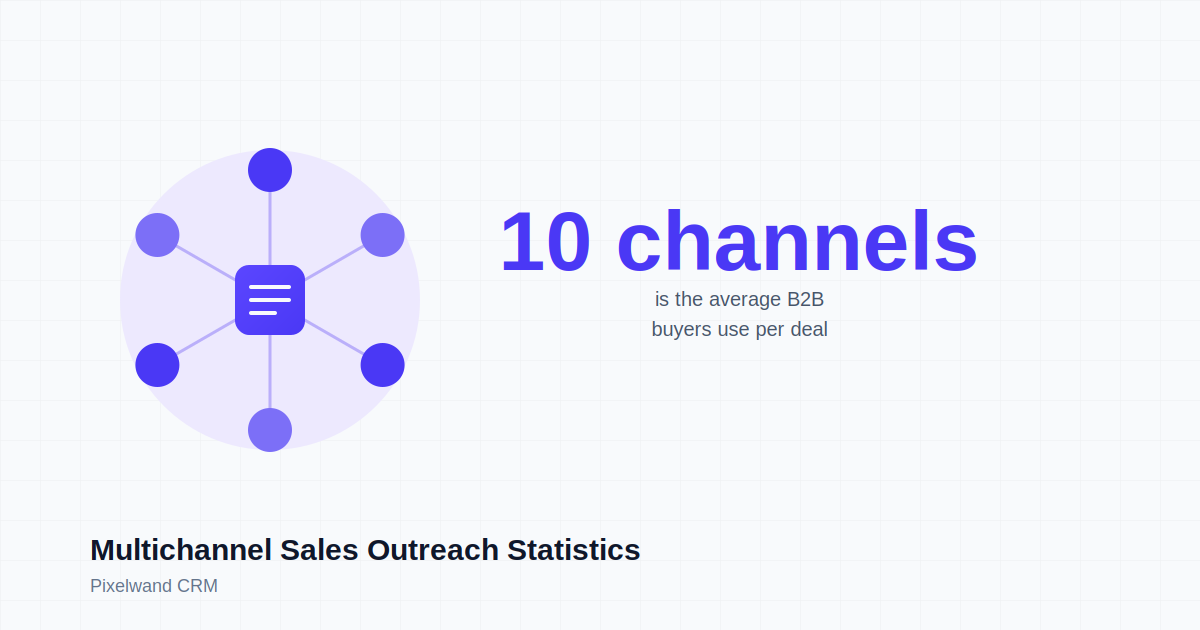
Multichannel Sales Outreach Statistics
Multichannel sales outreach statistics show social beats email 42% to 26%, and buyers now use 10 channels per deal, per HubSpot and McKinsey.
TL;DR: Multichannel sales outreach statistics point to one uncomfortable fact for reps who still lean on a single channel: HubSpot's 2025 State of Sales Report found social media now delivers the highest cold outreach response rate at 42%, ahead of email (26%) and phone (23%). Meanwhile, McKinsey's Global B2B Pulse Survey shows buyers already interact with sellers across an average of 10 channels per purchase. The data doesn't say pick one channel. It says stop treating channels as separate systems.
What do multichannel sales outreach statistics actually show?
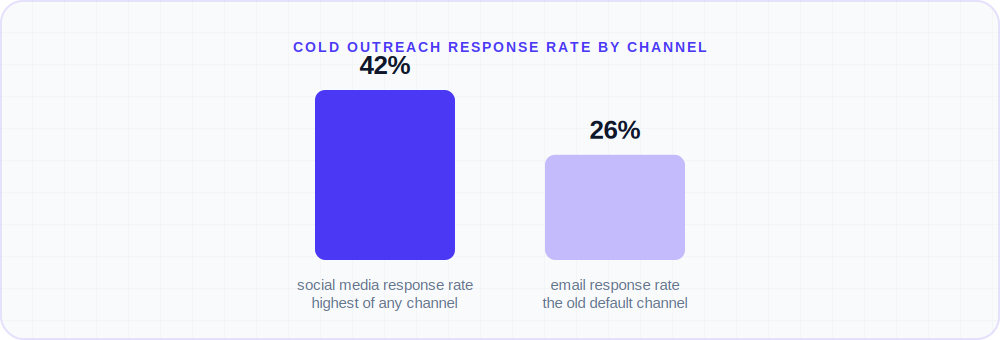
Multichannel sales outreach statistics show that no single channel wins on its own anymore. HubSpot's 2025 State of Sales Report found social media now delivers the highest cold outreach response rate at 42%, ahead of email at 26% and phone at 23%. Buyers, on the other side of that outreach, are already moving across roughly 10 different channels during a single purchase.
That gap matters because most sales orgs still build their process around one primary channel, usually email or the phone, and treat everything else as a side activity. The data suggests that's backwards. Social media is also the top source of high-quality leads for 35% of sales teams surveyed by HubSpot, and 45% of sales pros rate it "very effective" at driving sales, higher than in-person meetings (44%) or video calls (35%). Email and phone still work. They're just no longer the whole story, and reps who only use one are fishing in a shrinking part of the pond.
How many channels do B2B buyers actually use now?
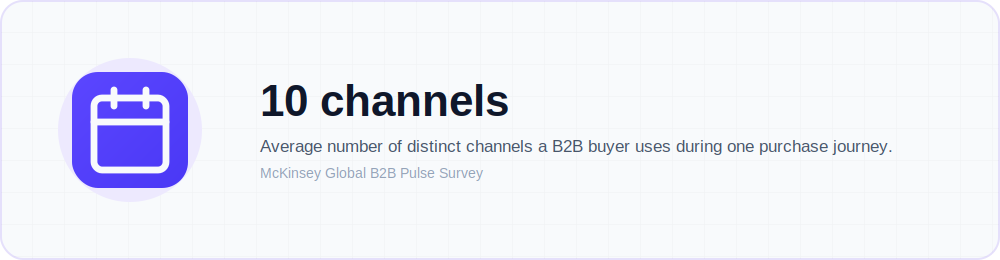
B2B buyers now use an average of 10 channels across a single purchasing journey, according to McKinsey's Global B2B Pulse Survey, which draws on responses from thousands of decision-makers. That number keeps buyers moving between a company's website, in-person sales, video conference, email, mobile apps, and self-serve portals, often before a rep even knows they're in-market.
McKinsey's research also describes a "rule of thirds" that holds across industries and deal sizes: at any stage of the buying journey, roughly one third of buyers want in-person interaction, one third want remote contact like phone or video, and one third prefer digital self-serve. A sales process built around a single channel structurally serves only one of those three groups well at any given moment. The other two thirds either wait, disengage, or go find a competitor who meets them where they already are.
Does social outreach really outperform email and phone?
Yes, by HubSpot's most recent measure. Social media outreach now produces the highest cold response rate among sales professionals surveyed (42%), compared to 26% for email and 23% for phone. It's also rated the most effective channel overall, ahead of in-person meetings and video calls.
That doesn't mean email or the phone should be dropped. It means the channel that gets ignored in most sales stacks (social) is quietly outperforming the two channels most reps are trained to lean on hardest. A rep who never touches social selling is voluntarily skipping the best-performing channel in HubSpot's own benchmark, while buyers are actively researching sellers there before ever replying to a cold email.
Why do reps who use LinkedIn well outperform everyone else?
Reps who invest in social selling consistently outperform peers who don't, and LinkedIn's own research backs that up directly. LinkedIn Sales Solutions has stated that salespeople who excel at social selling create more opportunities and are 51% more likely to hit quota than those who don't. That gap tracks the platform's own Social Selling Index, which scores profile strength, prospecting activity, and relationship building.
Part of the reason individual reps matter so much here is reach. Oktopost's analysis of B2B social data found that employees collectively have 10 times more first-degree connections than their company page has followers on LinkedIn. A single rep with a decent network can put a message in front of more relevant people than the entire corporate account. That's a structural advantage most sales orgs still leave sitting on the table because social selling gets treated as a marketing job instead of a sales one.
Curious how this looks with your own pipeline?
15-minute walkthrough, no pressure, cancel anytime.
What happens when you combine channels instead of picking one?
Combining channels means a buyer who ignores your email might still answer your call, respond to a WhatsApp message, or engage with a LinkedIn comment, because you're meeting them on whichever of their 10 channels they actually use that week. Single-channel outreach structurally misses buyers who prefer a different mode of contact at that exact moment.
This is where most sales teams quietly lose deals, not from bad messaging, but from channel mismatch. A prospect who skimmed and archived three emails might pick up a phone call the same afternoon. Someone who never answers cold calls might reply to a WhatsApp message within minutes. The fix isn't sending more messages on the same channel. It's making sure every channel a buyer might use is actually visible to the rep working that deal, on the same record, without switching tools. Tools like Pixelwand's integrations exist specifically to close that gap between the channels buyers use and the channels reps can see.
Where Pixelwand CRM fits in
Pixelwand CRM was built around the reality that leads and deals now show up across calls, WhatsApp, web forms, and email, not one clean pipeline. It automatically unifies those channels into a single record, so a rep can see a WhatsApp reply, an email thread, and a call log on the same deal without hunting through separate apps.
That matters directly for the channel-mix problem these statistics describe. Native two-way WhatsApp Business API messaging sits on the lead record itself, not in a separate app, which covers one of the fastest-growing response channels outside of email and phone. Click-to-call via Twilio handles the phone side. Gmail and Outlook sync auto-logs every email thread, and Facebook and Instagram lead ads sync into the CRM on the frequency you set (the sync is in beta) so social-sourced leads don't get lost between platforms. Reps get one view of a buyer who's using several channels, which is exactly what the data says they need. You can see the full channel breakdown on the features page, or compare how it stacks up against other CRMs on the compare page.
Plan availability: native WhatsApp messaging starts on the Growth plan. See pricing for details.
Sources: HubSpot 2025 State of Sales Report, McKinsey Global B2B Pulse Survey, LinkedIn Sales Solutions, Oktopost B2B Social Media Statistics
Upsell and cross-sell statistics show existing customers convert 60-70% of the time, versus just 5-20% for new prospects, per Marketing Metrics research.
Lead nurturing statistics: nurtured leads make 47% larger purchases and convert 20% more often, yet 65% of marketers skip nurture programs.
Referrals win 50 to 70% of opportunities, cold outbound 10 to 20%. See how big the gap is and why most teams can't see which source converts.
Frequently asked questions
What percentage of sales response rates come from social media vs email?
HubSpot's 2025 State of Sales Report found 42% of sales pros say social media delivers the highest cold outreach response rate, compared with 26% for email and 23% for phone calls. Social has overtaken both as the top-performing channel.
How many channels should a B2B sales cadence use?
There's no single magic number, but buyers themselves use an average of 10 channels across a purchase journey, per McKinsey's Global B2B Pulse Survey. Sales teams relying on just one or two channels are missing most of that journey.
Is cold email dead because of multichannel outreach?
No. Email still carries detail and scale that other channels can't match, but it's no longer enough alone. HubSpot's data shows email now trails social media on response rate, which is why teams pair it with calls, WhatsApp, and social touches.
What is a good LinkedIn Social Selling Index score?
LinkedIn's own research shows sellers who excel at social selling are 51% more likely to hit quota than peers who don't, according to LinkedIn Sales Solutions. Most sellers can check their score for free at linkedin.com/sales/ssi.