Upsell and Cross-Sell Statistics: The 60-70% Rule
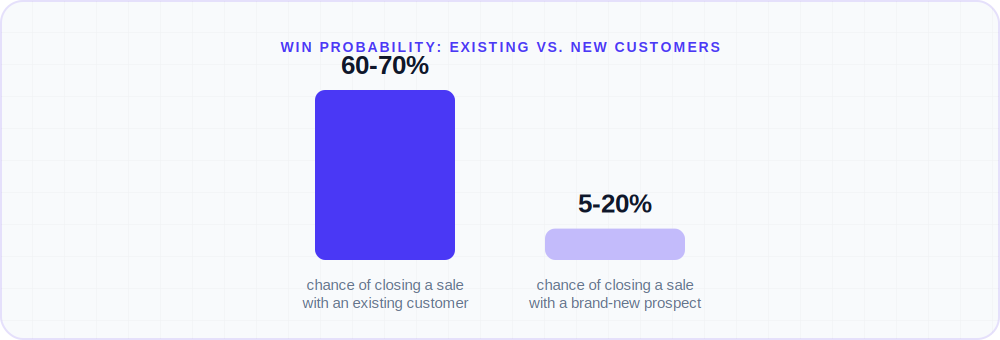
Upsell and cross-sell statistics show existing customers convert 60-70% of the time, versus just 5-20% for new prospects, per Marketing Metrics research.
TL;DR: Upsell and cross-sell statistics all point the same direction. Selling to an existing customer succeeds 60-70% of the time, compared to just 5-20% for a brand-new prospect. Existing accounts already make up about 65% of typical B2B revenue, yet 37% of salespeople still avoid upselling and cross-selling because it feels pushy. The gap between how well expansion works and how rarely teams do it on purpose is the real story here.
What Do Upsell and Cross-Sell Statistics Actually Show?
The core finding is simple: existing customers are far easier to sell to than new prospects. Research compiled from Marketing Metrics puts the probability of selling to an existing customer at 60-70%, against just 5-20% for a new prospect. That is not a small edge, it is close to a 5x difference in close probability.
The adoption numbers back this up. HubSpot's survey of roughly 1,400 salespeople across North America, Europe, and Asia found that 87% of sales professionals cross-sell and 91% upsell, and together those efforts drive about 21% of total company revenue. Loyal, existing customers also spend 67% more per transaction than new customers do, according to research cited by Janek Performance Group. None of this is a fringe tactic. It is a large, proven revenue channel that most teams already touch, just not always deliberately.
How Much B2B Revenue Comes From Existing Accounts?
Existing customers typically generate about 65% of a company's revenue, according to research cited by Zippia and referenced across multiple retention studies. That means the majority of most B2B revenue is already sitting inside accounts a sales team has already won, not in the next cold lead.
McKinsey's analysis goes further on the financial upside: done well, cross-selling can lift revenue by roughly 20% and profit by around 30%. Wisernotify's compilation of upsell data found that 72% of salespeople who actively use these tactics saw their revenue grow as a direct result, and that upselling and cross-selling combined can add 42% more revenue when executed with real customer context instead of generic pitches. The pattern across every source is consistent. Expansion revenue is not a nice-to-have side project, it is one of the highest-probability levers a revenue team has.
Curious how this looks with your own pipeline?
15-minute walkthrough, no pressure, cancel anytime.
Why Do Many Sales Reps Still Avoid Upselling?
Despite the numbers, a meaningful share of sales and marketing professionals hold back. Roughly 37% of marketers and salespeople avoid cross-selling and upselling altogether, largely out of concern that it will come across as pushy or self-serving, based on research cited by Fluent Support.
That hesitation is not entirely unfounded. Gitnux data shows only about 20% of customers believe the cross-sell or upsell recommendations they receive actually meet their needs. In other words, the problem usually is not the tactic, it is relevance and timing. A pitch that ignores what a customer is actually doing with your product reads as a sales push. A recommendation grounded in real usage, support history, or a renewal date reads as a genuinely useful nudge. The gap between those two experiences is almost entirely about whether the rep has the full account picture in front of them when the conversation happens, rather than a fragmented view spread across email, calls, and chat logs.
What Is Net Revenue Retention and Why Does It Matter?
Net revenue retention (NRR) is the metric that captures whether upsell and cross-sell revenue is actually outpacing churn inside your existing customer base. A 2025 benchmark study of 936 B2B SaaS companies by Benchmarkit put median NRR at 101%, with median gross revenue retention at 88%, meaning the average company is barely growing from existing accounts once churn is netted out.
The gap between average and elite performance is enormous. McKinsey's analysis of more than 100 B2B SaaS companies found that NRR is one of the metrics most correlated with valuation, with top-quartile NRR companies trading at roughly a 24x revenue multiple compared to just 5x for bottom-quartile peers. That is not a rounding error. It is the difference between a business that grows mostly by replacing lost customers and one that compounds revenue from the accounts it already has. For any team weighing whether to invest in expansion motion versus pure new-logo acquisition, that valuation gap is hard to ignore.

Where Pixelwand CRM fits in
Spotting the right moment to upsell or cross-sell depends on seeing the whole relationship, not just the last email. Pixelwand CRM unifies leads and deals from calls, WhatsApp, web forms, and email into one pipeline automatically, so an account's full history sits on a single record instead of scattered across inboxes and phones. That matters because the signals that precede a good expansion conversation (a support question, a renewal date approaching, a spike in call activity) rarely show up in just one channel.
With Gmail and Outlook sync, every email thread and calendar event tied to an account logs itself automatically, so reps do not have to reconstruct context before an expansion conversation. Native two-way WhatsApp messaging and click-to-call via Twilio or Exotel keep those touchpoints attached to the same deal record rather than living in a separate app. Custom fields and custom statuses let teams flag accounts as expansion-ready, and assignment rules make sure those flagged accounts route straight to the rep who already owns the relationship. Slack notifications can alert an account owner the moment a deal tied to an existing customer moves, so expansion opportunities do not sit unnoticed the way they often do when systems don't talk to each other. Teams evaluating options can compare approaches on the CRM comparison page or see the full unified pipeline in the features overview.
How Should Teams Start Tracking Expansion Revenue?
Start by separating new-logo revenue from expansion revenue in reporting, since blending them hides whether growth is coming from existing accounts or new acquisition. From there, track basic NRR alongside win rate and deal size so the true health of the existing customer base is visible on its own, not folded into overall pipeline numbers.
Most teams already have the raw data to do this sitting in their CRM, it just is not segmented. Custom views and saved filters can separate expansion deals from new-business deals without extra tooling, and syncing calendar and email activity automatically (rather than relying on manual logging) means the data stays accurate enough to trust. Teams that want a deeper look at how communication data flows into a CRM automatically can check the integrations documentation for what connects out of the box.
Sources: Janek Performance Group, Genroe, SHNO, Wisernotify, SerpSculpt B2B Customer Retention Statistics
Frequently asked questions
What percentage of B2B revenue comes from existing customers?
Roughly 65% of a typical company's revenue comes from existing customers, not new logos. That is why account expansion (upsells and cross-sells) carries so much weight in B2B revenue planning, even though new customer acquisition gets most of the marketing budget.
Is upselling or cross-selling more profitable?
Both lift revenue in similar ranges. McKinsey research found effective cross-selling can raise revenue by about 20% and profit by about 30%, while HubSpot data shows combined upsell and cross-sell activity drives roughly 21% of total sales revenue for the average team.
How do I know when to upsell an existing customer?
Watch for usage growth, repeated questions about a feature you do not yet sell them, and renewal windows. The strongest signals usually show up across calls, email, and chat, which is why timing works best when that history lives in one record instead of scattered inboxes.
What is net revenue retention and why does it matter for upsells?
Net revenue retention (NRR) measures expansion revenue minus churn among existing customers. A 2025 benchmark of 936 B2B SaaS companies put median NRR at 101%, and McKinsey found top-quartile NRR companies trade at far higher valuation multiples than bottom-quartile peers.