Lead Nurturing: Nurtured Buys Run 47% Larger
Lead nurturing statistics: nurtured leads make 47% larger purchases and convert 20% more often, yet 65% of marketers skip nurture programs.
TL;DR: Lead nurturing statistics tell a consistent story: nurtured leads convert into sales opportunities about 20% more often, close 23% faster, and end up making purchases that are 47% larger than deals from non-nurtured leads. Companies that do it well generate 50% more sales-ready leads at a 33% lower cost per lead. And yet, by most surveys, somewhere around two thirds of B2B marketers still haven't built a real lead nurturing program. The gap between what nurturing delivers and how few teams actually run it is the story here.
Why do 80% of new leads never become sales?
Most leads that enter a pipeline are not ready to buy, and most of them never get there. Multiple industry roundups put the number at 80% of new leads that never translate into a sale, largely because nobody keeps the relationship warm after the first touch. That tracks with older Forrester research showing only about 5% of leads are sales-ready the moment they're generated, meaning the other 95% require some kind of ongoing nurturing before they're worth a rep's time.
That is a brutal ratio if your only follow-up motion is "call once, maybe email once, move on." It also explains why so much marketing spend evaporates before it ever reaches a quota number. A lead that isn't ready today isn't a dead lead, it's an unfinished one, and the data suggests finishing the job pays off in specific, measurable ways.
What nurturing actually buys you?
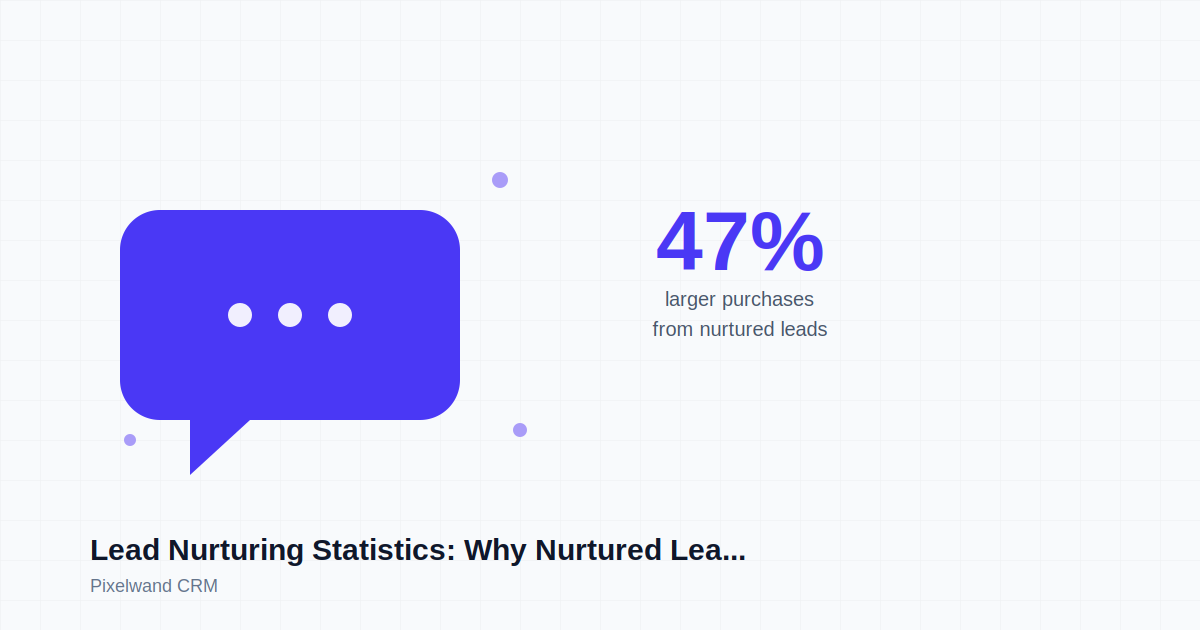
The most cited figure in this space comes from Annuitas Group research, popularized widely by HubSpot: nurtured leads make purchases that are on average 47% larger than purchases from non-nurtured leads. That's not a conversion rate stat, it's a deal size stat, which is a different and arguably more important number for revenue planning.
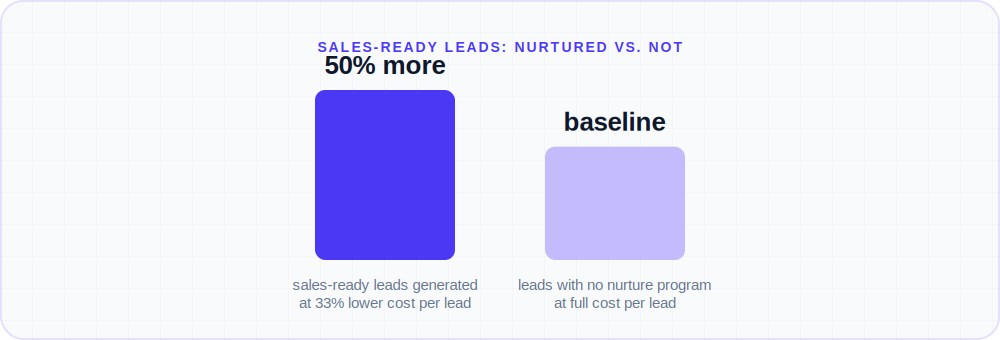
The same research stream shows nurtured leads produce a 20% increase in sales opportunities compared to leads left alone, and a 23% shorter sales cycle, meaning nurtured deals don't just close more often, they close faster too. On the acquisition side, Forrester research cited across multiple sources found that companies that excel at lead nurturing generate 50% more sales-ready leads at a 33% lower cost per lead than companies that don't nurture at all. Put those together and nurturing isn't a marketing nice-to-have, it's a lever on cost, speed, and deal size simultaneously.
How many touches nurturing actually takes?
If nurturing works this well, the obvious next question is how much of it you actually need to do. The answer, across several benchmark sources, sits in a fairly tight band. Madison Logic's research puts the average at 6 to 8 touches to move a marketing qualified lead to a sales qualified one. Other estimates cited in broader lead generation roundups put the number closer to 10 marketing-driven touches before a lead is considered sales-ready, and older BrightTALK research pegged it at roughly 8 nurturing steps before a lead converts to a paying customer.
Channel matters here too. Lead nurturing emails get 4 to 10 times the response rate of standalone email blasts, according to SilverPop/DemandGen Report data cited by HubSpot, which is a strong argument for sequenced, personalized follow-up over one-off blasts. Personalized emails specifically improve click-through rates by 14% and conversion rates by 10%, per Aberdeen Group data referenced in the same research.
Where do nurture programs break down most?
None of this works if the follow-up itself doesn't happen on time, and that's where most teams lose the thread. Survey data compiled by Demandsage found 41% of companies report they struggle to follow up with leads quickly, and 44% say their sales reps are simply too busy to follow up at all. That's not a strategy problem, it's an execution problem, and it's exactly the kind of gap that shows up as "lost" pipeline months later with no clear cause.
It also explains the adoption gap. Despite everything above, research compiled by Invesp and echoed elsewhere puts the share of B2B marketers who have not yet implemented any lead nurturing strategy at roughly 65%. Fewer than four in ten teams are systematically doing the thing that the data says works.

Curious how this looks with your own pipeline?
15-minute walkthrough, no pressure, cancel anytime.
Where Pixelwand CRM fits in
Lead nurturing statistics keep pointing at the same root cause for failure: leads and their history live in too many disconnected places, so nobody follows up consistently across the 6 to 10 touches it actually takes. Pixelwand CRM unifies leads and deals from calls, WhatsApp, web forms, and email into one pipeline automatically, so a lead that first arrived through a Facebook or Instagram lead ad and later replied on WhatsApp shows up as one nurture history on one record, not three disconnected threads.
Because Gmail and Outlook sync auto-logs every email thread and calendar event directly on the lead record, reps can see exactly which nurture touch happened last without digging through inboxes, which matters when the average nurture sequence runs 6 or more touches over weeks. Native two-way WhatsApp Business API messaging attached to the record makes it easy to add a high-response channel into that sequence instead of relying on email alone. Custom fields and custom statuses let teams build an actual nurture stage structure (early, mid, sales-ready) instead of a flat "new lead" bucket, and assignment rules plus Slack notifications help close the exact gap the survey data points to: the 44% of reps who say they're simply too busy to follow up in time. When the next nurture touch is a task in the CRM instead of a mental note, it's a lot more likely to happen on schedule.
Quick answers
How many touches does it take to nurture a lead into a sale?
Most benchmarks land somewhere between 6 and 10 touches. Madison Logic puts the average at 6 to 8 touches to move a marketing qualified lead to a sales qualified lead, while broader research cited by Forrester puts the number closer to 10 marketing-driven touches before a lead is sales-ready. The real number depends on deal size and industry, but single-touch or two-touch outreach is almost never enough.
What is the difference between lead nurturing and lead scoring?
Lead scoring ranks how sales-ready a lead is right now, usually based on fit and engagement signals. Lead nurturing is the ongoing process of moving a lead toward that ready state through emails, calls, content, and other touches. They work together: scoring tells you who to prioritize, nurturing is what actually changes the score over time.
Does lead nurturing really increase deal size, or just conversion rate?
Both, based on the data. Nurtured leads convert into sales opportunities more often, roughly 20% more per research from Annuitas cited across multiple sources, and the deals that do close from nurtured leads tend to be 47% larger than deals from non-nurtured leads, per the same Annuitas research popularized by HubSpot.
What is the best channel for lead nurturing?
Email still carries the most nurture volume for B2B teams, and lead nurturing emails get 4 to 10 times the response rate of one-off email blasts according to SilverPop/DemandGen data cited by HubSpot. But channel diversity matters too. Teams that nurture across email, WhatsApp, calls, and social touches tend to see more consistent engagement than teams relying on a single channel.
Sources: HubSpot, Invesp, Nutshell, Madison Logic, Demandsage, Sci-Tech Today
Lead source conversion stats: referrals win 50-70% of opportunities versus 10-20% for cold outbound. Yet most CRMs can't show it.
How many touchpoints to convert a B2B lead: 8 average touches to 266 for a full SaaS deal, and why top performers need fewer, not more.
Upsell and cross-sell statistics show existing customers convert 60-70% of the time, versus just 5-20% for new prospects, per Marketing Metrics research.
Frequently asked questions
How many touches does it take to nurture a lead into a sale?
Most benchmarks land somewhere between 6 and 10 touches. Madison Logic puts the average at 6 to 8 touches to move a marketing qualified lead to a sales qualified lead, while research cited by Forrester puts the number closer to 10 marketing driven touches before a lead is sales ready. The real number depends on deal size and industry, but single touch or two touch outreach is almost never enough.
What is the difference between lead nurturing and lead scoring?
Lead scoring ranks how sales ready a lead is right now, usually based on fit and engagement signals. Lead nurturing is the ongoing process of moving a lead toward that ready state through emails, calls, content, and other touches. They work together: scoring tells you who to prioritize, nurturing is what actually changes the score over time.
Does lead nurturing really increase deal size, or just conversion rate?
Both, based on the data. Nurtured leads convert into sales opportunities more often, roughly 20% more per research cited by Annuitas and Demandsage, and the deals that do close from nurtured leads tend to be 47% larger than deals from non-nurtured leads, per the same Annuitas research popularized by HubSpot.
What is the best channel for lead nurturing?
Email still carries the most nurture volume for B2B teams, and lead nurturing emails get 4 to 10 times the response rate of one off email blasts according to SilverPop/DemandGen data cited by HubSpot. But channel diversity matters too. Teams that nurture across email, WhatsApp, calls, and social touches see more consistent engagement than teams relying on a single channel.