Missed Call Statistics: Why 82% of Callers Just Call Your Competitor Next
New 2025 research shows only 61% of business calls actually reach a person, and among callers who don't get through, 82% say they'll call a competitor next. Here's what the missed call statistics mean for sales pipelines.
TL;DR: New research on missed business calls found that only 61% of calls to businesses actually connect with a person, meaning 39% of callers get voicemail, a dead end, or nothing at all. What happens next is worse than a delayed follow-up: 78% of consumers say they've abandoned a business entirely after an unanswered call, and 82% say they'll call a competitor, often immediately. Only 42% bother leaving a voicemail first. For a sales team, a missed call isn't a scheduling inconvenience. It's a lead that just walked into someone else's pipeline.
A ringing phone is not the same as a connected call
Sales teams spend a lot of energy on speed-to-lead once a lead exists in the CRM: how fast a rep replies to a form fill, how fast a WhatsApp message gets answered, how fast an email gets a response. Far less attention goes to the call that never gets picked up in the first place, even though the phone is still the highest-intent channel a prospect can use. Someone calling your sales line has already decided to talk to a human right now, and if nobody answers, that intent doesn't sit patiently in a queue waiting for a callback. It usually just moves to whoever answers next.
That gap between "the phone rang" and "the call actually connected" is where a surprising amount of pipeline quietly disappears, and it rarely shows up in a CRM report unless someone is specifically tracking it.
How many sales calls actually get answered
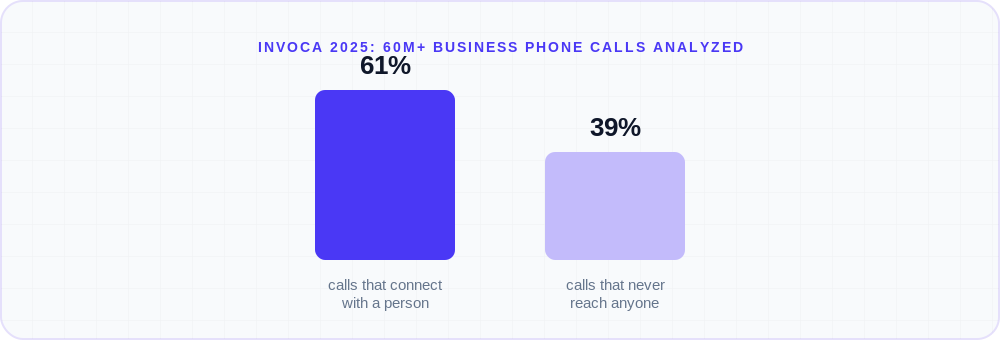
The scale of the problem is bigger than most sales leaders assume. Invoca's 2025 Call Conversion Industry Benchmarks Report, built from an AI-powered analysis of more than 60 million phone calls across nine industries, found that 61% of callers to a business actually speak with a person, meaning close to four in ten calls do not connect with anyone at all. That answer rate isn't uniform either: Invoca found it swings from 54% to 69% depending on the industry, which is exactly why the report frames answer rate as something every business should benchmark for itself instead of guessing.
Connecting is only step one. The same report found that just 35% of calls generated by digital marketing turn out to be qualified leads in the first place, and of those, 37% convert during the call itself, with the strongest performers in home services converting 46% of the time and the weakest, business services, converting only 22%. Every one of those numbers assumes the call got answered. A call that rings out doesn't get a chance to become any of them.
What happens in the seconds after nobody picks up
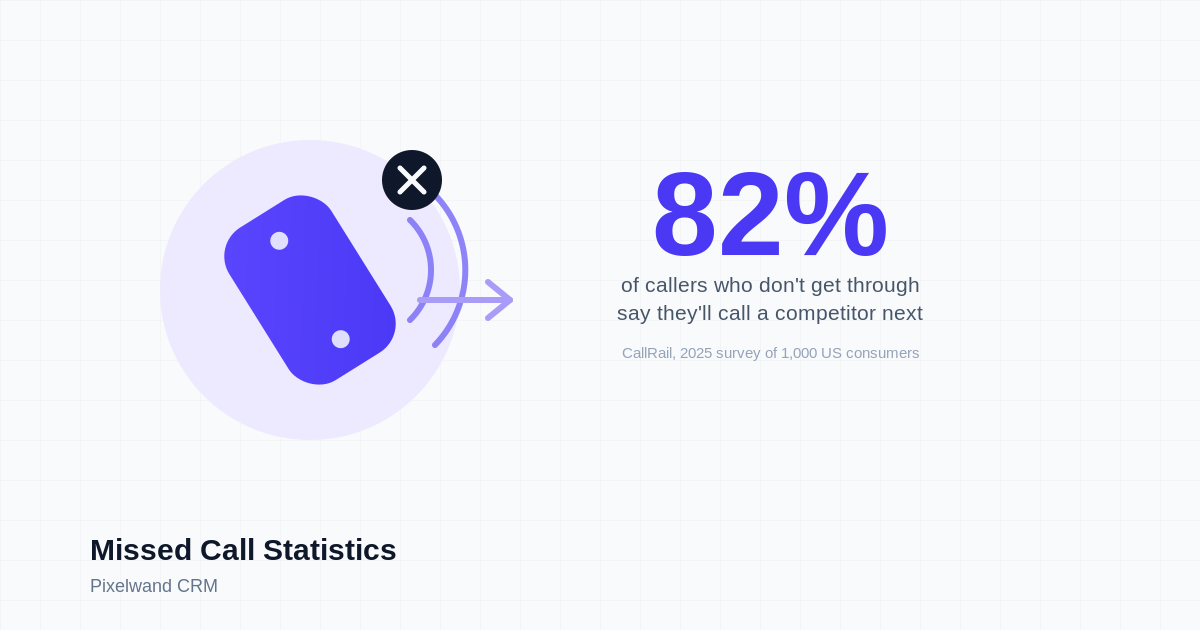
The consequence of an unanswered call is faster and more permanent than most sales teams expect. CallRail's 2025 survey of 1,000 US consumers found that 78% say they've abandoned a business entirely because a call went unanswered, and 82% say they'll call a competitor instead. Roughly 21% don't even wait: they call another business immediately, rather than trying the same number again later.
That timing matters. A missed call doesn't sit in a queue the way an unanswered email or a slow chat reply might. There's no inbox reminding the caller to follow up. The moment nobody picks up, the decision about who gets that lead has effectively already been made, and it's rarely the business whose phone just rang out.

The voicemail safety net doesn't really exist
It's tempting to assume voicemail catches most of what a missed call loses, but the data says otherwise. CallRail's same 2025 survey found only 42% of consumers leave a voicemail when a call goes unanswered, which means roughly 58% simply hang up without saying anything. Another 24% switch to online chat instead of trying the phone again. For a sales team relying on "they'll leave a message if it's important," the math doesn't hold up: most callers don't leave a trail at all, they just move on.
That's a meaningful blind spot, because a voicemail at least gives a rep a callback number and some context. Silence gives nothing, and there's no record in the CRM that the call, or the opportunity, ever happened.
Curious how many calls your team is missing?
15-minute walkthrough of call tracking inside the pipeline, no pressure.
Why answer rate deserves the same attention as speed-to-lead
Most sales teams already treat response time to an inbound lead as a tracked, coached metric. Answer rate on live calls rarely gets the same treatment, even though it sits earlier in the funnel and the cost of missing it is just as real. Invoca's finding that business services converts calls at only 22%, against a home services benchmark of 46%, is a useful reminder that industries with lower-intensity call culture tend to also have the weakest phone follow-through, and the two are connected. A team that doesn't watch its answer rate has no way of knowing whether its funnel problem is lead quality, sales skill, or simply a phone that keeps ringing out during lunch or after the last rep logs off.
The fix isn't necessarily more headcount. It's visibility: knowing which hours calls go unanswered, which reps are missing them, and whether a caller who didn't get through called back or disappeared. None of that is answerable from gut feel. It requires the same kind of reporting sales teams already apply to email opens and lead response time, just pointed at the phone.
Where Pixelwand CRM fits in
Answer rate is hard to fix when calls live in a separate phone system from the rest of the pipeline. Pixelwand CRM runs native calling through Twilio or Exotel, with click-to-call available directly from the Lead, Deal, and Contact pages, so a rep never has to leave the record to dial or to pick up. Inbound calls trigger a live call pop-up showing caller name, number, and status before anyone answers, and every call, answered or missed, is logged automatically to the Calls tab on that lead or deal, with call recording available when it's turned on.
The Call Log then reports on exactly the kind of visibility this problem requires: filtering by inbound or outbound, by agent, by date range, and by outcome, so a manager can see call-to-answer rates by rep and by time of day instead of assuming coverage is fine. Because calls sit in the same unified pipeline as WhatsApp messages, web form submissions, and email, a missed call doesn't disappear into a separate system either. It's the same record everyone on the team is already looking at.
If missed calls are quietly costing you leads and nobody can say how many, that's exactly what call tracking inside a single pipeline is built to surface.
*Sources: Invoca, Call Conversion Industry Benchmarks Report 2025, Invoca press release via PR Newswire, CallRail, Missed Calls Cost Businesses More Than Ever (2025 consumer survey)
Frequently asked questions
What percentage of business calls actually get answered?
Invoca's 2025 Call Conversion Industry Benchmarks Report, an analysis of more than 60 million phone calls across nine industries, found that 61% of callers to businesses speak with a person, meaning 39% do not get through to anyone. Answer rates vary widely by industry, from 54% up to 69%, which is why Invoca recommends every business track and benchmark its own answer rate rather than assume it.
What do callers do when a business doesn't pick up?
According to CallRail's 2025 survey of 1,000 US consumers, 78% say they have abandoned a business entirely after a call went unanswered, and 82% say they'll call a competitor instead, with 21% doing so immediately rather than trying again later. A missed call rarely turns into a delayed call. It usually turns into someone else's lead.
Do most callers leave a voicemail if nobody answers?
No. The same CallRail 2025 survey found only 42% of consumers leave a voicemail when a call goes unanswered, meaning roughly 58% simply hang up, and 24% switch to online chat instead. Voicemail is not a reliable backstop for a missed call.
How can a sales team improve its call answer rate?
The main lever is routing and visibility rather than hiring more reps: click-to-call and click-to-answer from the lead or deal record instead of a separate phone system, a live call pop-up that shows who's calling before pickup, and a call log that reports answer rate as a tracked metric instead of an assumption. Teams that can see answer rate by hour and by rep tend to fix coverage gaps quickly once the gap is actually visible.