Best Time to Call Leads: Data-Backed Windows
The best time to call leads sits in two windows most studies agree on, late morning and late afternoon. Here's where the data still disagrees.
TL;DR: Nearly every large dataset on this question, from a 2007 MIT and InsideSales.com study to Gong's analysis of 100,000+ B2B calls to ZoomInfo's review of 1.4 million outbound dials, points to two peak windows for the best time to call leads: late morning (roughly 10 to 11 AM) and late afternoon (roughly 4 to 5 PM), in the prospect's local time zone. The original research found the best hour produced a 114% better contact rate than the worst one. But the studies do not fully agree with each other on the details, and knowing where they disagree matters as much as knowing where they align.
What did the original MIT timing study find?
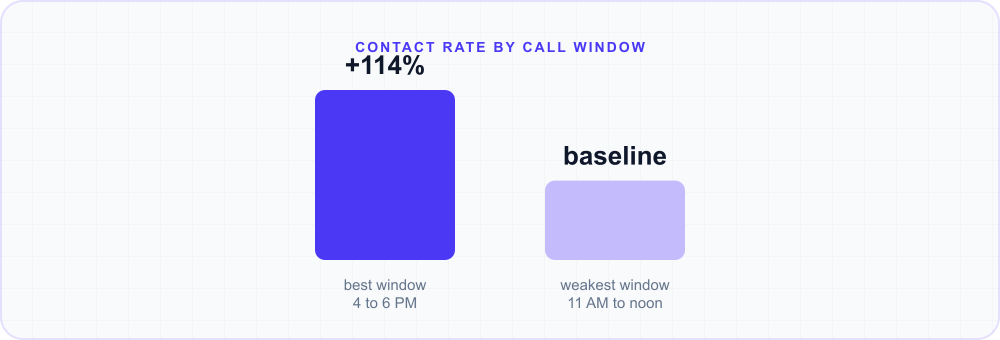
Almost every "best time to call" article traces back to the same source. Professor James Oldroyd of MIT worked with InsideSales.com on a study that examined three years of data from six companies, more than 15,000 leads, and over 100,000 call attempts, to find out when reps should call web-generated leads for the best contact and qualification outcomes. The findings were specific: the period from 4 to 6 PM produced a 114% improvement in successful contact compared to the 11 AM to noon window, and 8 to 9 AM plus 4 to 5 PM were the best hours for actually qualifying a prospect once reached. The same research found that Wednesdays and Thursdays outperformed other weekdays, with Thursday showing a 49.7% better contact rate than the weakest day, Tuesday.
That study is nearly two decades old, and newer research has both confirmed and complicated it.
Where does the newer call data agree?
Gong's 2017 analysis of 100,000 connected B2B sales calls found the highest connection rates clustering in late morning (10 to 11 AM) and late afternoon (4 to 5 PM), a pattern independently reported by Cleverly after reviewing its own dataset of over 1 million cold calls. CallHippo's separate research identified a similar shape, with 8 to 9 AM and 4 to 5 PM standing out as the most productive hours and Wednesday and Thursday again ranking as the best days to dial. ZoomInfo's more recent review of 1.4 million+ outbound calls found Tuesday and Wednesday together account for 44% of all demos booked, with Tuesday leading on connect rate and Wednesday leading on raw call volume. Gong's own benchmark documentation for its Engage product now recommends Tuesday and Wednesday mornings, 9 AM to noon, as the highest connect-rate window for outbound sequences.
Across nearly every dataset, one thing holds steady regardless of the exact hour named: Monday mornings and Friday afternoons are consistently the weakest times to call. Decision-makers are either buried in a backlog from the weekend or mentally checked out before it starts, and midday lunch hours also show a reliable dip in every study that measured them.

Where does the call-timing data disagree?
This is the part most "best time to call" roundups skip over. HubSpot's more recent survey of cold callers found late morning, specifically 10 AM to noon, to be the clear favorite, with 51% of regular cold callers naming it their most productive window, while only 6 to 11% found late afternoon (3 to 5 PM) productive and just 2 to 6% found after-hours calling worthwhile at all. That puts HubSpot's respondents at odds with Gong, Convoso, and the original MIT/InsideSales research, all of which rank the 4 to 5 PM (or 4 to 6 PM) window as equal to or better than late morning.
The day-of-week data has similar friction. The original MIT/InsideSales study found Thursday beat Tuesday by nearly 50%, while ZoomInfo's newer, much larger dataset found Tuesday leading on connect rate specifically. ZoomInfo's own writeup is candid about why: the foundational timing studies are aging, remote and hybrid work mean decision-makers are no longer reliably at a desk during traditional business hours, and spam-call filtering plus AI-powered dialers have changed answer behavior industry-wide since 2007. None of that invalidates the older research, it just means the exact peak hour is a moving target that's worth re-testing against your own call logs rather than copying wholesale from any single study.
What this means for how you actually dial?
The practical takeaway isn't "call at exactly 4:07 PM." It's that calling during the post-open, pre-lunch stretch or the pre-close, end-of-day stretch beats calling first thing in the morning, right after lunch, or on a Friday afternoon, and that avoiding Monday mornings is one of the few points every study agrees on. It's also worth remembering that time-of-day optimization is a different lever than response speed. The same MIT/InsideSales research that produced the timing numbers also found that contacting a lead within five minutes of it arriving makes a rep roughly 100 times more likely to reach them and 21 times more likely to qualify them compared to waiting 30 minutes. A fresh inbound lead should get called immediately no matter the hour; the timing windows above are for outbound cold calls, callback attempts, and cadences on leads that are already a few hours or days old.
Curious how this looks with your own pipeline?
15-minute walkthrough, no pressure, cancel anytime.
Where Pixelwand CRM fits in
Timing research is only useful if your team can act on it inside the flow of a normal workday. Pixelwand's native calling, built on Twilio (bring-your-own-carrier), gives reps click-to-call directly from the lead or deal record, so when a fresh lead lands from a call, WhatsApp message, web form, or Facebook/Instagram lead ad, someone can dial immediately without switching apps, which matters more than any time-of-day window for a brand-new inbound lead. For leads that need a scheduled callback in one of those higher-converting afternoon or mid-morning slots, Google Calendar sync with meeting-prep summaries makes it easy to book that follow-up call for the right window and walk in with context already pulled up. Custom fields, statuses, and saved views let teams segment leads by time zone or ideal callback window, and assignment rules make sure the right rep is holding those leads when the window opens, rather than letting them sit in a shared queue until someone happens to notice.
Sources: Lead Response Management Study (MIT/InsideSales.com), ClientTether: Best Times to Call Customers, HubSpot: The Best Time to Make a Sales Call, Convoso: Best Time to Cold Call, ZoomInfo: Best Days to Cold Call, Gong Help Center: Engage Analytics Benchmarks, Cleverly: Best Time to Cold Call, Revenue.io: Best Time to Cold Call Prospects
Cold call connect rate statistics range from 1.55 to 19 dials per conversation by source. Here's what drives the gap and how to close it.
Voicemail response stats: up to 80% of B2B calls land in voicemail, yet fewer than 5% get a callback. Here's what works instead.
Only 61% of business calls reach a person, and 82% of blocked callers say they'll call a competitor next. Here's what it means for pipeline.
Frequently asked questions
What is the best time to call leads?
Most large studies converge on two windows: late morning, roughly 10 to 11 AM, and late afternoon, roughly 4 to 5 PM, in the prospect's local time zone. Gong's analysis of over 100,000 B2B sales calls and CallHippo's separate research both point to these two slots, and the original MIT and InsideSales.com Lead Response Management study found the 4 to 6 PM window produced 114% better contact rates than the worst midday block. HubSpot's more recent survey of cold callers instead ranks 10 AM to noon as the single best window, so treat both slots as strong candidates and test which one wins with your own leads.
What is the best day of the week to call prospects?
Tuesday and Wednesday show up most often as the strongest days. ZoomInfo's analysis of more than 1.4 million outbound calls found Tuesday and Wednesday together account for 44% of all demos booked, and Gong's engagement benchmarks flag Tuesday and Wednesday mornings as the highest connect-rate window. The original MIT and InsideSales.com study instead found Thursday had a 49.7% better contact rate than the worst day, Tuesday, which shows some real disagreement between datasets, but almost every study rules out Monday morning and Friday afternoon as the weakest times to dial.
Does timing matter more than how fast you respond to a lead?
No, response speed matters more. The same MIT and InsideSales.com research that produced the timing findings also found that contacting a web lead within five minutes makes a rep roughly 100 times more likely to reach them and 21 times more likely to qualify them compared to waiting 30 minutes. Timing windows help you optimize outbound cold-calling and callback attempts on leads that are already a few hours or days old, but a fresh inbound lead should always be called immediately regardless of the hour.
Why do different studies disagree on the best time to call?
The foundational research is old. MIT and InsideSales.com published their landmark timing study in 2007-2008, Gong followed with a 2017 analysis, and CallHippo published its own data in 2019. Remote work, aggressive spam-call filtering, and AI dialers have all changed how and when decision-makers pick up the phone since then, so newer datasets like ZoomInfo's occasionally point to different peak windows than the older studies, even though they still agree on avoiding early Monday mornings and Friday afternoons.