Sales Voicemail: Under 5% Ever Get a Callback
Voicemail response stats: up to 80% of B2B calls land in voicemail, yet fewer than 5% get a callback. Here's what works instead.
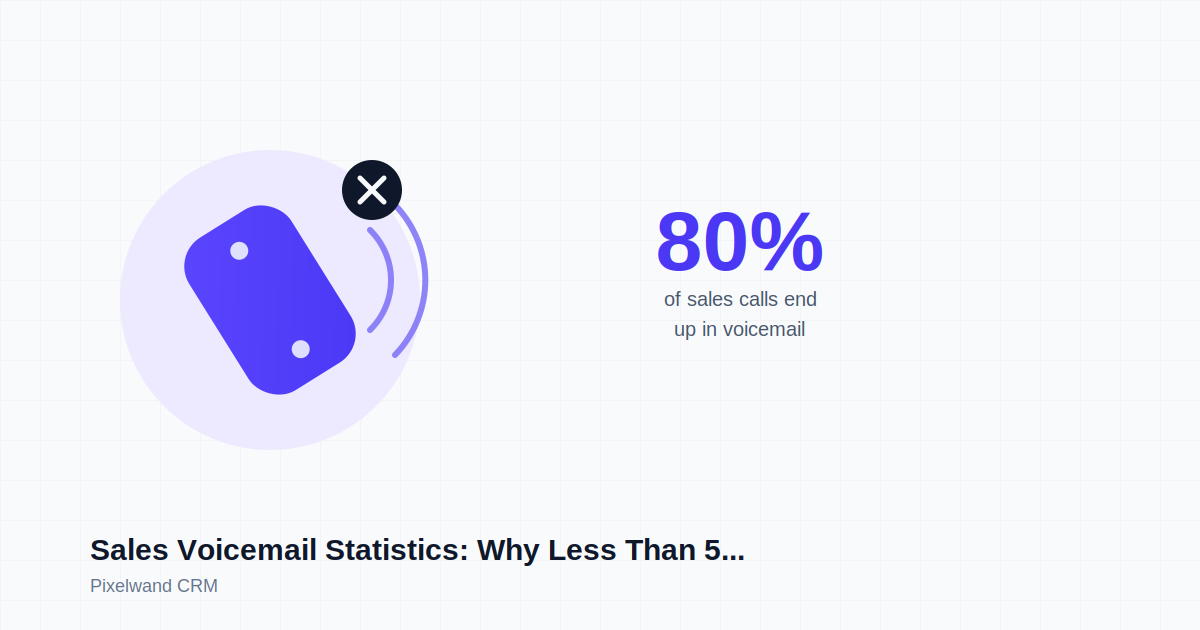
TL;DR: Sales voicemail response rate statistics tell an uncomfortable story: somewhere between 72% and 80% of B2B sales calls end in voicemail, but fewer than 5% of those voicemails ever get a callback. Reps still spend up to 15% of their workday leaving messages that mostly go unheard, and the one place voicemail reliably pays off isn't the callback at all, it's the email that follows it. Teams that treat voicemail as a priming touch instead of a standalone tactic get meaningfully better results than teams that measure it in isolation.
How many sales calls actually go to voicemail?
The exact number depends on whose dialing data you're looking at, but every credible source agrees on the direction: most outbound calls don't reach a live person. Data attributed to RingLead puts the figure at 80% of all sales calls going to voicemail, a benchmark repeated across multiple sales-tooling glossaries and blogs. GreetNow's 2026 sales call benchmark report puts the number a bit lower, estimating that approximately 72% of sales calls go to voicemail. Pew Research Center, looking at consumer behavior more broadly, found that 81% of calls from unknown numbers go to voicemail, and 67% of recipients check the voicemail from an unknown number at all.
Some providers report meaningfully better numbers when direct-dial numbers and local-presence dialing are used, with one dialer vendor citing a 52% voicemail rate for its client base versus the 81% industry figure, attributing the gap to caller-ID and area-code matching. That's a useful reminder that "voicemail rate" isn't a fixed law of nature, it moves with how the call is placed. But even in the best case, a coin-flip or worse of every dial still ends in a recording, not a conversation.
Why is the voicemail response rate under 5%?
Reaching voicemail is only step one. Getting anyone to act on it is the harder number. SalesLeads Inc. reports that the average response rate for B2B voicemails is less than 5%, a figure echoed almost exactly by SellCell's 2026 voicemail statistics roundup, which puts the average voicemail response rate at 4.8%, meaning over 95% of voicemails go completely unaddressed. Growthlist's cold calling data set puts B2B voicemail response rates in the same range, hovering below 5%.
Zoom in further and the picture gets starker. Orum's dialer data found that leaving a voicemail only increases the chance of a callback from about 2.277% to 2.538%, an 11.5% relative lift that still leaves the absolute odds close to zero. Demandnexus's cold calling benchmarks land in a similar place: voicemails left consistently produce a 3 to 4% callback rate, and without a voicemail at all the callback rate is effectively 0%. So voicemail isn't worthless, it's just not the mechanism most reps think it is.
Does leaving a voicemail even help?
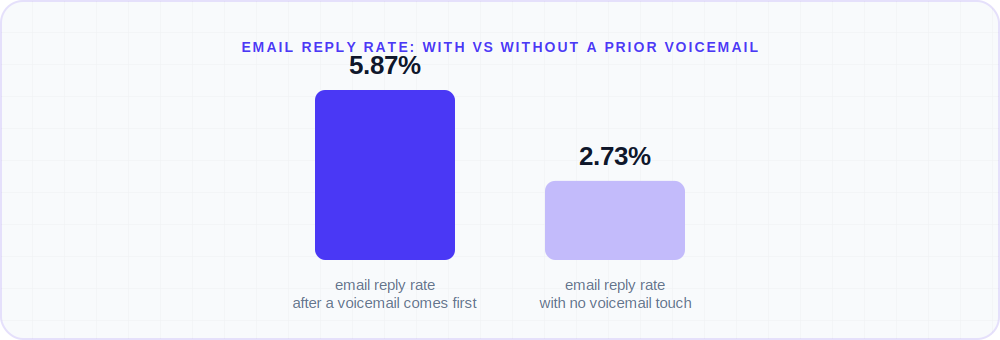
This is where the data actually splits into two camps, and both are right about different things. Camp one measures voicemail by direct callback and concludes it barely moves the needle, consistent with the sub-5% response rates above. Camp two measures cross-channel response and finds voicemail is doing real work, just not the work anyone's tracking. Gong's analysis, cited by Martal's cold calling metrics research, found that voicemails more than double the email reply rate from those same contacts, lifting it from 2.73% to 5.87% when an email follows shortly after. The same analysis found a real cost on the other side of the ledger: leaving a voicemail reduces future connect rates by roughly 28%, because the prospect now knows a salesperson is calling and is more likely to screen the next attempt.
Put those two findings together and the strategic implication is clear. A voicemail is not a callback play, it's a priming touch for the email or text that follows within the hour. Demandnexus's data backs this timing detail directly, finding that an email sent within one hour of a cold call nearly doubles response rate compared to waiting 24 hours. Teams that leave a voicemail and then wait for the phone to ring are measuring the wrong outcome. Teams that leave a voicemail and immediately follow with an email are seeing the actual lift.
What does 15% of rep time on voicemail cost?
Voicemail's low direct return would be easier to live with if it were cheap to produce, but it isn't. SellCell and multiple industry sources put the figure at sales reps spending up to 15% of their time leaving voicemails for the people they call, which for a rep working a full pipeline of daily dials adds up fast. CallHippo's client data quantifies the per-call cost more precisely: leaving a manual, personalized voicemail takes 30 to 60 seconds per call, and at 50 calls a day that's up to 50 minutes of rep time spent on voicemails alone, time that isn't going toward the next dial or the follow-up email that actually drives response. SellCell frames the opportunity cost even more bluntly, estimating that in the time spent leaving voicemails a rep could make 25% more calls.
Curious how this looks with your own pipeline?
15-minute walkthrough, no pressure, cancel anytime.

None of this means reps should stop leaving voicemails. It means the message itself should be short (multiple sources converge on 8 to 14 seconds as the sweet spot), and the real payoff should be measured downstream, in the email or text that follows, not in the phone ringing back.
Where Pixelwand CRM fits in
The voicemail problem is really a visibility and follow-through problem: a call happens, a message gets left, and then the outcome lives in a rep's memory instead of the record. Pixelwand CRM's native calling, built on Twilio for bring-your-own-carrier setups, puts click-to-call directly on the lead or deal record, so every dial (answered or not) is tied to the same timeline instead of scattered across a separate phone app.
Because the whole point of a voicemail is the fast follow-up that comes after it, Pixelwand's Gmail and Outlook sync auto-logs the email thread that follows a call onto that same record, so a rep can see at a glance whether the voicemail-then-email sequence actually happened within the window that matters. For teams that want to skip the voicemail dead end entirely on a given attempt, native two-way WhatsApp Business API messaging is attached to the same lead or deal record, giving reps a channel that doesn't rely on someone checking a recording days later. Slack notifications on deal and task activity mean a manager can see follow-up gaps forming in near real time, rather than discovering weeks later that a batch of voicemails never got a second touch.
Quick answers
Direct callbacks stay under 5%. Most B2B voicemails go unaddressed, so measure voicemail as priming, not a standalone ask.
Pair voicemail with fast email. A follow-up email after a voicemail more than doubles reply rates, from 2.73% to 5.87%.
Keep messages short and cheap. Aim for 8 to 14 seconds, since reps can spend up to 15% of the day leaving messages.
Sources: Close, SalesLeads Inc., SellCell, SaleHive, Martal, GreetNow, DemandNexus, Growthlist, CallHippo
Cold call connect rate statistics range from 1.55 to 19 dials per conversation by source. Here's what drives the gap and how to close it.
The best time to call leads sits in two windows most studies agree on, late morning and late afternoon. Here's where the data still disagrees.
Only 61% of business calls reach a person, and 82% of blocked callers say they'll call a competitor next. Here's what it means for pipeline.
Frequently asked questions
How many sales calls actually go to voicemail?
Estimates vary by dataset and dialing method, but most benchmarks land between 70% and 80%. RingLead-sourced data puts the figure at 80% of sales calls, GreetNow's 2026 benchmark set puts it at roughly 72%, and Pew Research has found that 81% of calls from unknown numbers go straight to voicemail. Direct-dial and local-presence dialing can pull the number down closer to 50%, but for cold outbound, voicemail is still the single most common outcome of a dial, not the exception.
Does leaving a voicemail increase callback rate?
A little, but not much on its own. Orum's dialer data found leaving a voicemail lifts the chance of a callback from about 2.277% to 2.538%, an 11.5% relative improvement that still leaves the absolute odds low. Where voicemail earns its keep is as a set-up for the next channel: Gong's data shows email reply rates jump from 2.73% to 5.87% when the email follows a voicemail, more than doubling response versus email alone.
Does leaving a voicemail hurt future connect rates?
It can. Analysis of cold call data cited by Martal found that leaving a voicemail reduces future connect rates by roughly 28%, because the prospect now knows a salesperson called and is more likely to screen the next attempt. That is the core tension in sales voicemail response rate statistics: voicemail rarely gets its own callback, but it can quietly make the next call harder to land.
What is the ideal length for a sales voicemail?
Shorter than most reps think. Multiple benchmark sources put the optimal length between 8 and 14 seconds, with GreetNow recommending messages under 20 seconds that state a specific reason for calling and repeat the phone number. Longer, scripted-sounding messages tend to get abandoned before the caller even reaches the ask.