Lead Routing: 1 in 4 Leads Reaches Wrong Rep
Lead routing statistics: automated assignment lifts conversion 25-40%, yet one in four leads still lands with the wrong rep. Here's the data.
TL;DR: Lead routing statistics point to a strange gap: automated assignment reliably lifts conversion by roughly 25-40% and pushes follow-up rates as high as 97%, yet a landmark survey of 527 B2B sales and marketing professionals found that one in four leads still ends up with the wrong rep. The technology to fix this has existed for years. The gap is mostly a data and process problem, not a tooling problem, and it is quietly costing pipeline every single day.
What does a broken lead handoff really cost?
Lead routing rarely gets the attention that lead generation does. Marketing teams pour budget into ads, content, and events to generate a lead, and then that lead often lands in a shared inbox, a round-robin spreadsheet, or a queue nobody owns. The 2017 State of Lead Management survey, conducted by LeanData among 527 B2B sales and marketing professionals, put hard numbers on just how broken this handoff usually is. More than 57 percent of respondents expressed doubts that their lead workflow was creating an ideal experience for customers, and they estimated that one out of every four leads was routed to the incorrect account owner, resulting in lost leads and reduced sales efficiency.
The same survey exposed a perception gap between the two teams responsible for that handoff. Sixty-one percent of sales leaders said their teams always follow up on marketing-generated leads, but only 30 percent of marketing leaders believed that was actually happening, and nearly 48 percent of respondents said they were concerned sales and marketing were not aligned. When a quarter of leads are misrouted and the two teams cannot even agree on whether follow-up is happening, it is not a mystery why pipeline leaks.

How much automated routing actually lifts conversion?
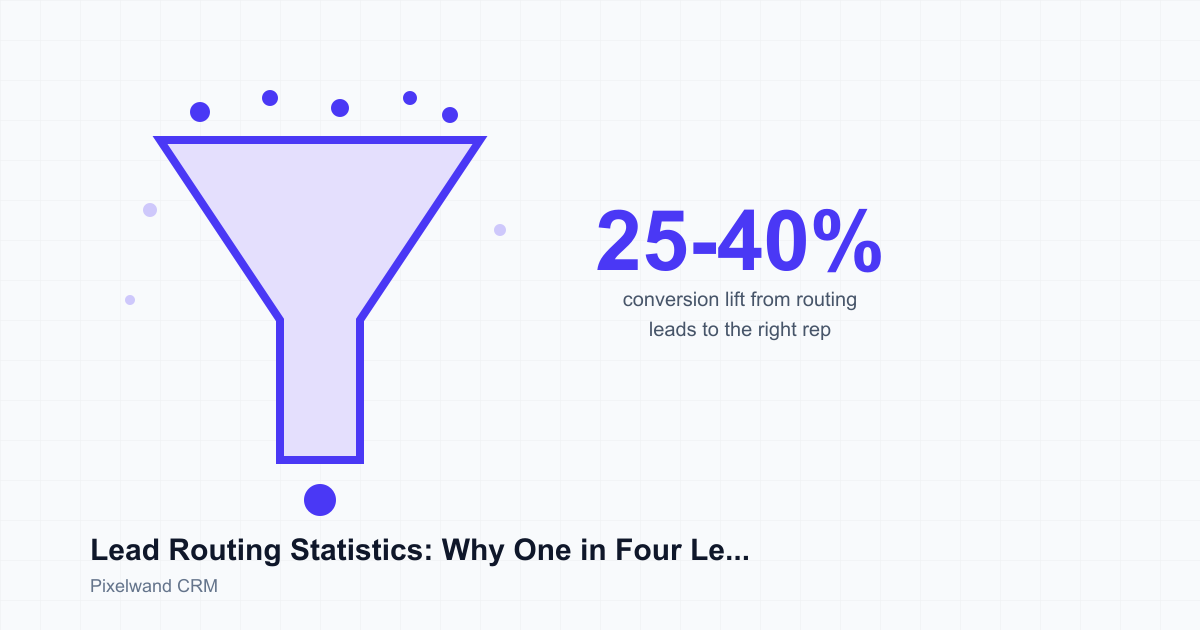
The upside of fixing this is well documented. When leads are routed to reps with relevant expertise and appropriate availability instead of whoever happens to be next in a spreadsheet, conversion rates typically increase by 25 to 40 percent, according to a small business lead routing guide that analyzed the shift from manual to rules-based assignment. A separate analysis found that structured lead assignment rules, paired with SLA tracking, result in a 97% follow-up rate, essentially closing the gap that the LeanData survey exposed between sales and marketing perceptions of who is actually working a lead.
Speed compounds the effect. Automating lead routing has been shown to cut response times by roughly 50%, and separate metrics tracking shows automated assignment can reduce lead-assignment delays by 73% compared to manual distribution. That speed matters because response time itself is one of the most heavily researched variables in B2B sales. The original Lead Response Management Study, run out of MIT with InsideSales.com, found that contacting a web lead within five minutes made a rep roughly 21 times more likely to qualify it compared to waiting 30 minutes. Velocify's separate analysis of millions of leads found that responding within the first minute lifted conversion by 391% compared to slower follow-up. Routing is the mechanism that makes any of that speed possible. A rep cannot respond in five minutes to a lead that is still sitting unassigned in a shared inbox.

Why manual routing breaks down as channels multiply?
Manual assignment can limp along when a team is handling a handful of leads a day from one channel. It falls apart fast once volume climbs and channels multiply. One RevOps-focused breakdown put the practical ceiling at around 10 leads per day per rep before manual routing starts breaking; past that point, automated assignment becomes essential just to avoid adding operational overhead as the team scales. Poor system integration compounds the problem. Research on real-time routing metrics found that weak integration between marketing and sales systems can create a lag of up to 45 minutes between a form submission and the moment a rep is actually notified, which is an eternity relative to the five-minute window that determines whether a lead converts.
The complexity gets worse the moment leads start arriving from more than one channel at once. A web form lead, a Facebook ad lead, an inbound WhatsApp message, and a missed call each carry different metadata, and a routing rule built for one format often silently fails on another. Routing rules are only as good as the underlying field data they read: a territory rule evaluating an empty state field routes nothing correctly, and a stale employee-count field misclassifies an account that has grown since it was last enriched. This is the same failure mode the LeanData survey captured back in 2017, and it has not gone away just because more channels have been added on top of it.
Curious how this looks with your own pipeline?
15-minute walkthrough, no pressure, cancel anytime.
Where Pixelwand CRM fits in
Most lead routing failures trace back to leads scattered across disconnected systems and inconsistent fields, which is exactly the problem Pixelwand CRM is built to remove. Pixelwand automatically unifies leads and deals from calls, WhatsApp, web forms, and email into a single pipeline, so there is no shared inbox or spreadsheet stage where a lead can quietly go unassigned. Facebook and Instagram lead ads sync directly into the CRM, closing the exact channel gap that trips up routing rules built for form submissions alone. From there, assignment rules route each new lead to the right rep automatically based on the criteria your team defines, and custom fields and custom statuses keep the data those rules depend on clean and current rather than stale or blank. Native click-to-call through Twilio and two-way WhatsApp messaging attached directly to the lead record mean that once a rep is assigned, they can act on the five-minute window immediately instead of switching tools first. Pinned, public, and saved views give managers the visibility to catch a lead sitting unassigned before it becomes one of the misrouted quarter that keeps showing up in every lead management survey.
Quick answers
Automated routing lifts conversion 25 to 40%. Structured assignment with SLA tracking pushes follow-up rates as high as 97%.
One in four leads still lands with the wrong rep. Blank territory fields and mislabeled sources break even well-built rules.
Manual triage breaks near 10 leads a day per rep. Past that point delays stack up and conversion starts slipping.
Sources: LeanData, 2017 State of Lead Management Survey (PRNewswire), LeanData press release, learn.leandata.com, Automated Data, Lead Routing and Assignment Guide, Fullcast, Automated Lead Assignment, Reform, Real-Time Lead Routing Metrics, Fullcast, Best Practices for Lead Routing, LeadAngel, Speed to Lead Statistics
Closed-lost leads statistics: up to 80% of prospects marked dead still buy within 18-24 months, often from a competitor who stayed in touch.
The average MQL to SQL conversion rate sits at just 13%, but the real range runs from 10% to 51% depending on industry, channel, and how fast reps respond.
Lead scoring accuracy stats: only 35% of reps trust scores and 34% of MQLs become SALs. Here's why the model keeps breaking.
Frequently asked questions
What is lead routing in a CRM?
Lead routing is the process of automatically assigning an incoming lead, whether it arrives by web form, phone call, WhatsApp message, or ad click, to the right sales rep based on rules like territory, product interest, capacity, or lead score. Done well, it replaces manual triage in a shared inbox or spreadsheet with instant, rules-based assignment inside the CRM.
How much does automated lead routing improve conversion rates?
Research on lead assignment consistently finds gains in the 25-40% range when leads are matched to reps with the right expertise and availability, and one survey found automation pushed follow-up rates as high as 97%. The exact lift depends on lead volume, rule quality, and how fast the handoff happens after assignment.
Why do leads still get routed to the wrong rep?
Most misrouting comes down to bad or missing data. If a territory field is blank, a company name does not match account records, or a lead source is mislabeled, routing rules cannot work correctly even when the logic itself is sound. A 2017 LeanData survey of 527 B2B professionals found one in four leads was routed to the wrong account owner for exactly this reason.
Is manual lead routing still viable for small sales teams?
It can work at very low volume, but most guides put the breaking point somewhere around 10 leads a day per rep. Once a team is pulling leads from multiple channels, calls, WhatsApp, web forms, email, and social ads, manual triage turns into a full-time job and delays stack up fast, which is exactly when conversion rates start slipping.