Lead Scoring Accuracy: Why Reps Distrust Scores
Lead scoring accuracy stats: only 35% of reps trust scores and 34% of MQLs become SALs. Here's why the model keeps breaking.
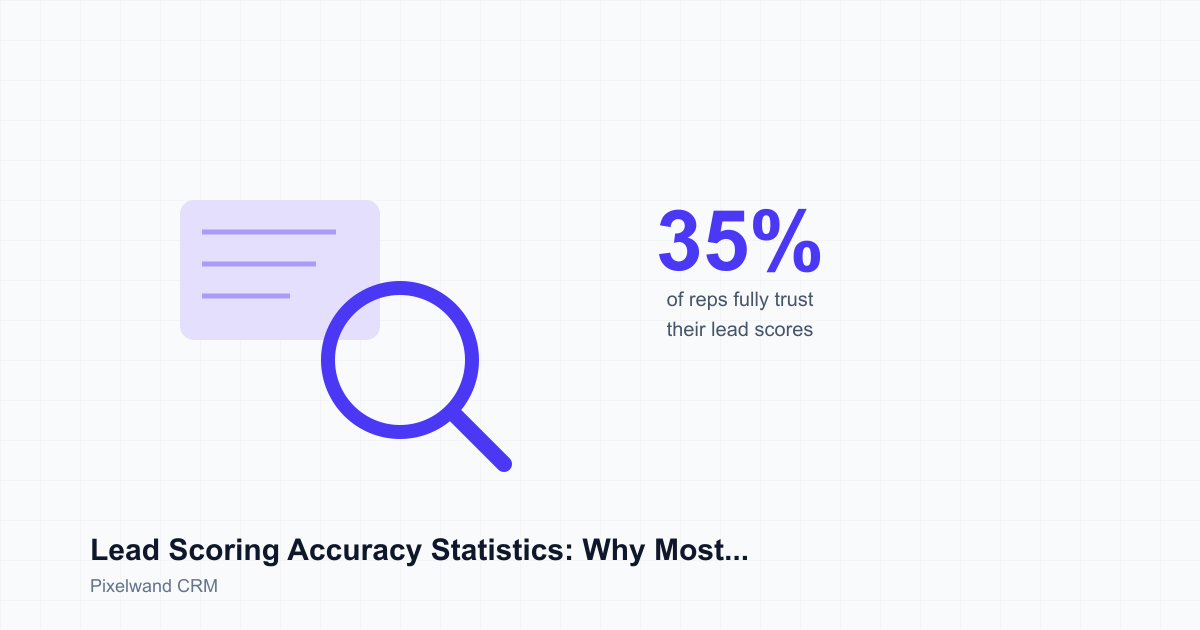
TL;DR: Lead scoring accuracy statistics paint a rough picture. Most B2B companies score leads, but most sales teams don't trust the result. Research cited by Bitrix24 found that 68% of B2B companies use some form of lead scoring, yet only 40% of salespeople say they actually get value from it, and separate research from Martal found only 35% of reps have full confidence in their company's scoring accuracy. Gartner data shows only 34% of marketing qualified leads (MQLs) ever convert to sales accepted leads, and just 47% of those go on to become genuinely qualified. The problem usually isn't the point system itself. It's stale data, no feedback loop, and scores built on activity instead of intent.
Why is lead scoring adopted but rarely trusted?
Lead scoring sounds like a solved problem. Assign points for fit and behavior, set a threshold, route the hot ones to sales. In practice, the gap between adoption and trust is enormous. According to research cited by Bitrix24, 68% of B2B companies use some form of lead scoring, but only 40% of salespeople get value from it. That 28-point gap is the whole story of why lead scoring has a credibility problem: companies build the model, but reps quietly stop using it.
Martal's research on B2B lead scoring found that only 35% of salespeople have full confidence in their company's lead scoring accuracy, meaning nearly two-thirds of reps doubt the scores they're handed. And it isn't because reps are stubborn. Sales teams cite poor lead quality as a persistent complaint. Separate data compiled by Spotio found that 42% of reps name poor lead quality as a top frustration, and only about 5% of salespeople rate their inbound leads as very high quality. Once a rep has worked a handful of "hot" leads that were actually a student researching a school project or someone who downloaded a whitepaper out of curiosity, they stop trusting the queue and start working their own instincts instead.

Where does the funnel leak from MQL to SQL?
The clearest evidence that scoring accuracy is a real problem, not just a rep morale issue, shows up in the conversion data itself. Gartner's own research found that while 34% of MQLs convert to sales accepted leads, only 47% of those SALs evolve into qualified leads worth working, meaning the vast majority of leads marketing labels "qualified" never reach a stage where sales considers them real.
That drop-off compounds. A widely cited SiriusDecisions statistic, referenced across sales and marketing operations write-ups, holds that 98% of MQLs never result in closed business. MarketingSherpa research reported a similar pattern, finding that 79% of MQLs never convert into a sale, often because of a lack of follow-up nurturing rather than a fundamentally bad lead. And Gleanster Research's often-cited benchmark puts it plainly: on average, only about 25% of marketing-generated leads are high enough quality to go directly to sales. Put those numbers together and the picture is consistent: most organizations' scoring thresholds are letting through leads that look qualified on paper but were never going to buy.

Why lead scoring accuracy breaks down?
Three recurring failure modes show up across the research. First, most models measure activity, not intent. A prospect who downloads five whitepapers can outscore a VP who visited the pricing page once, even though the second person is far closer to a buying decision. Second, most scoring models are additive only. Points accumulate but rarely decay, so a lead who unsubscribed, changed jobs, or went cold six months ago can still be sitting at the top of the queue with a stale high score. Third, and most fundamentally, most scoring models never close the loop. Marketing sets the criteria, sales works the leads, and the outcomes (which "qualified" leads actually closed, and which high scorers turned out to be dead ends) rarely make it back into the model to recalibrate it.
This is also why the sales and marketing definition gap matters so much. If marketing counts anyone who requests a checklist as sales-ready, and sales defines a qualified lead as someone with confirmed budget and an active need, the score is sitting on top of two incompatible definitions of "qualified." No amount of point-tuning fixes that until both teams agree on what the threshold actually means.
How to fix scoring accuracy without starting from scratch?
The fixes that show up repeatedly in the research are less about better math and more about better inputs and better feedback. Combine fit signals (company size, industry, job title) with behavioral signals (page visits, reply behavior, meeting requests) rather than leaning on either alone. Add negative scoring so cooling leads, bounced emails, and irrelevant job title changes pull a score down instead of leaving it frozen at its peak. And build a real feedback loop: review closed-won and closed-lost data on a regular cadence, and adjust weighting when high scorers keep getting disqualified in the first call or when low scorers keep quietly converting anyway.
None of that works if the data feeding the model is scattered across five disconnected tools. A score calculated from marketing automation engagement data that never talks to what actually happened on the call, in the WhatsApp thread, or in the follow-up email is guessing, not scoring.
Where Pixelwand CRM fits in
Lead scoring accuracy is ultimately a data completeness problem before it's a math problem. Pixelwand CRM unifies leads and deals from calls, WhatsApp, web forms, and email into one pipeline automatically, which means the behavioral signals that should feed (and correct) a lead score, an inbound call, a WhatsApp reply, an opened email thread, actually live on the same record instead of being trapped in separate systems.
Native calling through Twilio with click-to-call, plus two-way WhatsApp Business API messaging attached directly to the lead record, means engagement signals are captured where the score can actually see them. Gmail and Outlook sync auto-logs email threads on the record, so "opened three emails but never replied" (where open tracking is on) and "requested a meeting" are both visible in one place instead of split across a marketing platform and an inbox. Facebook and Instagram lead ad syncing (currently in beta) brings the lead form's fields and source into the CRM on the frequency you set, which matters because inconsistent source data is one of the most common reasons scoring models drift. Custom fields, custom statuses, and assignment rules let teams encode their actual qualification criteria (not a generic point template) directly into how leads are routed, while Slack notifications keep the team looped in on pipeline activity in real time instead of waiting for a weekly report to reveal that the "hot" queue is full of dead leads.
If your team is still debating whether the lead scoring model or the sales team is the problem, the fastest way to find out is to look at where the actual engagement data lives.
Plan availability: native WhatsApp messaging, the Slack integration and assignment rules start on the Growth plan. See pricing for details.
Curious how this looks with your own pipeline?
15-minute walkthrough, no pressure, cancel anytime.
Sources: Gartner, Bitrix24, Martal, Salesgenie, Spotio, LinkedIn
Closed-lost leads statistics: up to 80% of prospects marked dead still buy within 18-24 months, often from a competitor who stayed in touch.
The average MQL to SQL conversion rate sits at just 13%, but the real range runs from 10% to 51% depending on industry, channel, and how fast reps respond.
Lead routing statistics: automated assignment lifts conversion 25-40%, yet one in four leads still lands with the wrong rep. Here's the data.
Frequently asked questions
What is a good lead scoring accuracy rate?
There is no universal benchmark, but the pattern in the data is consistent: most models are directionally useful, not precise. Gartner research finds only 34% of marketing qualified leads (MQLs) convert to sales accepted leads, and just 47% of those go on to become qualified leads worth working. A model that gets even half of its high scores right is often outperforming the industry norm, which is why closed-won and closed-lost feedback loops matter more than the point system itself.
Why don't sales reps trust lead scores?
The main reason is a track record of false positives. Research cited by Bitrix24 found that 68% of B2B companies use some form of lead scoring, but only 40% of salespeople say they get real value from it, and separate research from Martal found only 35% of reps have full confidence in their company's scoring accuracy. Once reps get burned by a handful of high scoring leads that go nowhere, they quietly build their own prioritization habits and stop trusting the queue.
What's a good MQL to SQL conversion rate?
Benchmarks vary by industry and how strictly a company defines "qualified," but most sources put a healthy MQL to SQL conversion rate somewhere in the 10% to 25% range. MarketingSherpa research reported that 79% of MQLs never convert into a sale at all, which is why tightening the definition of a qualified lead usually improves close rates even when it shrinks total lead volume.
Is predictive lead scoring more accurate than rules-based scoring?
Predictive, machine-learning based scoring can outperform static rules-based point systems because it updates on new closed-won and closed-lost data instead of relying on a score that only ever goes up. But predictive models are only as good as the underlying data feeding them. A model trained on incomplete contact records, stale firmographic fields, or engagement data disconnected from the CRM will inherit the same accuracy problems as a manual point system, just with more confidence attached to the wrong number.