MQL to SQL Conversion: Only 13% Survive to Sales
The average MQL to SQL conversion rate sits at just 13%, but the real range runs from 10% to 51% depending on industry, channel, and how fast reps respond.
TL;DR: The average MQL to SQL conversion rate across industries is just 13%, according to First Page Sage's multi-year client benchmark study, meaning roughly 87 out of every 100 marketing qualified leads never get accepted by sales. But that average hides a huge spread: by industry it runs from 10% in legal services and real estate to 26% in HVAC and business insurance, and by channel it swings even wider, from 26% on paid search to 51% on SEO-sourced leads. Underneath almost all of that variance sits one operational factor sales teams control directly: how fast, and how consistently, a rep actually follows up.
What MQL to SQL actually measures (and why the number is so slippery)?
A marketing qualified lead (MQL) is a contact marketing believes is worth sales attention, usually based on engagement or fit signals. A sales qualified lead (SQL) is a lead a rep has personally vetted and accepted into the pipeline. The MQL to SQL conversion rate is simply the share of MQLs that clear that second bar.
The trouble is that "MQL" means something different at almost every company. Some teams count anyone who crosses a lead-scoring threshold. Others require confirmed budget and a demonstrated intent to buy before a contact even earns the MQL label. That definitional gap is exactly why benchmark reports disagree so much, and why two companies in the same vertical can both honestly report numbers 30 points apart. First Page Sage, whose research team analyzed client data gathered between 2019 and 2025 across more than 25 industries, defines an MQL as a contact who has indicated purchase intent and been determined able to afford the product, and an SQL as a lead sales has independently vetted and booked a meeting with. Using that stricter definition, the cross-industry average settles at 13%.
Why does the 13% MQL benchmark mislead?
That 13% cross-industry figure is the number most KPI reference guides cite as the baseline, and it shows up consistently across independent sources tracking the same First Page Sage research. But averaging HVAC contractors with law firms and calling it one metric hides more than it reveals. First Page Sage's own industry table runs from about 10% in legal services and real estate, where buying committees are large and cycles are long, up to roughly 26% in HVAC and business insurance, where intent signals are much easier to read at the point of lead capture.
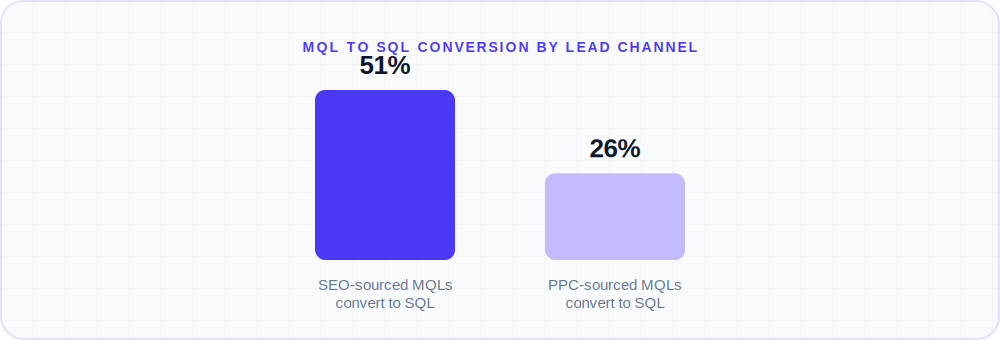
Channel matters even more than industry. Within First Page Sage's B2B SaaS funnel benchmarks, MQLs sourced from SEO convert to SQL at 51%, email at 46%, webinars at 39%, LinkedIn at 30%, and paid search (PPC) at just 26%. That is nearly a 2x spread between the best and worst channel, inside a single industry, using a single company's definitions. The lesson isn't that PPC leads are bad, it's that they typically carry lower declared intent than someone who searched for a solution and landed on your site organically, so they need a different qualification and follow-up motion.
Downstream, the funnel keeps compounding. First Page Sage's related benchmarks put SQL to opportunity conversion between 38% and 49% depending on channel, and SQL to closed-won near 12%. Multiply the stages together and it's easy to see why marketing and sales so often disagree about whether "the funnel is healthy": a team can be hitting a perfectly respectable 13% MQL to SQL rate and still be losing most of its revenue potential two stages later.
Is speed to lead the hidden MQL lever?
If MQL to SQL rates vary this much by definition and channel, what actually moves the number for a given team? The single best-documented lever is response time. The 2007 MIT and InsideSales.com Lead Response Management Study, which analyzed three years of data across six companies, more than 15,000 leads, and over 100,000 call attempts, found that the odds of qualifying a lead drop 21 times when a rep waits 30 minutes to call instead of 5, and the odds of making contact at all drop 100 times over that same window.
A separate 2011 Harvard Business Review study by Oldroyd, McElheran, and Elkington audited 2,241 US firms by submitting test web leads and timing their responses. It found the average first response, among companies that responded at all, took 42 hours, and 23% of firms never responded to the test lead at all. The same research found firms that tried to contact a lead within an hour were nearly 7 times more likely to qualify it than firms that waited just one more hour, and more than 60 times more likely than firms that waited a full day or longer.
Curious how this looks with your own pipeline?
15-minute walkthrough, no pressure, cancel anytime.
Put those two studies together and the pattern is unmistakable: MQL to SQL conversion isn't primarily a lead-quality problem, it's a lead-handling problem. A lead can be genuinely well qualified by marketing and still die in sales simply because it sat in an inbox, a spreadsheet, or the wrong rep's queue for a few hours too long.

Why marketing and sales disagree about the number?
Response time isn't the only friction point. HubSpot's own research on sales and marketing alignment found only 9.1% of salespeople said the leads they received from marketing were very high quality, which is a big part of why reps quietly discount or ignore MQLs instead of working them fast. On the other side of that same relationship, 78% of sales leaders say their CRM effectively improves alignment between sales and marketing teams, according to HubSpot Research, which suggests the fix isn't necessarily better lead scoring rules on a whiteboard, it's a shared system where both teams can see the same lead, the same status, and the same history in real time.
That combination, low trust in lead quality plus no shared system of record, is what turns a mediocre-but-honest 13% conversion rate into a genuinely broken one. When marketing hands off a lead through a form export or a separate dashboard, sales has no visibility into how the lead arrived, what it engaged with, or how urgent it is, so it sits. When the lead lands directly on a rep's desk, inside the same pipeline they already work in, with a notification the moment it arrives, the odds of a fast, well-informed first touch go up dramatically.
Where Pixelwand CRM fits in
Most of the MQL to SQL leakage described above traces back to two operational gaps: leads arriving through too many disconnected channels, and reps finding out about them too slowly. Pixelwand CRM is built to close both gaps directly. It automatically unifies leads and deals from calls, WhatsApp, web forms, and email into a single pipeline, so an MQL that comes in through a Facebook or Instagram lead ad syncs straight into the same record a rep already works from, instead of sitting in a separate ads dashboard waiting to be exported.
Speed to lead depends on reps actually knowing the moment a new MQL lands, so Pixelwand pushes real-time deal and pipeline notifications into Slack the instant a lead arrives or a task is due, and assignment rules route it to the right rep automatically rather than waiting for a manual triage step. Once a rep is notified, click-to-call through native Twilio integration lets them start that first call in seconds rather than hunting for a dialer, and two-way WhatsApp messaging attached directly to the lead record makes a fast first response possible even for leads that would rather not pick up the phone. Custom statuses and custom fields let marketing and sales agree on one shared MQL and SQL definition inside the CRM itself, so both teams are finally looking at the same number instead of arguing about whose spreadsheet is right.
Quick answers
The average is 13%, but segment first. Industry runs 10 to 26%, and channel swings wider, from 26% on paid search to 51% on SEO.
Definitions drive most variance. Teams counting different populations as MQLs can report honestly different rates in the same vertical.
Speed is the controllable lever. Calling within 5 minutes makes qualifying 21 times more likely than waiting 30 minutes.
Sources: First Page Sage, Understory Agency, Lead Response Management Study (MIT / InsideSales.com), Harvard Business Review, "The Short Life of Online Sales Leads", HubSpot Blog, HubSpot Marketing Statistics
Closed-lost leads statistics: up to 80% of prospects marked dead still buy within 18-24 months, often from a competitor who stayed in touch.
Lead routing statistics: automated assignment lifts conversion 25-40%, yet one in four leads still lands with the wrong rep. Here's the data.
Lead scoring accuracy stats: only 35% of reps trust scores and 34% of MQLs become SALs. Here's why the model keeps breaking.
Frequently asked questions
What is a good MQL to SQL conversion rate?
Across industries, the average MQL to SQL conversion rate is about 13%, according to First Page Sage's multi-year client benchmark study. Anything meaningfully above that is considered strong, though the honest answer depends on your industry and lead source. First Page Sage's cross-industry table runs from 10% in legal services and real estate up to 26% in HVAC and business insurance, so a fair benchmark for you is your own industry's average, not the blended 13% figure.
Why do MQL to SQL conversion rates vary so much between companies?
Mostly because companies define MQL and SQL differently. Some count any lead that crosses a scoring threshold as an MQL, while others require confirmed budget and intent. Two companies in the same industry can honestly report 13% and 40%+ conversion rates simply because they are measuring different populations, not because one sales team is better than the other.
How much does lead response time affect MQL to SQL conversion?
Enormously. The MIT and InsideSales.com Lead Response Management Study found reps are 21 times more likely to qualify a lead when they call within 5 minutes versus 30 minutes, and 100 times more likely to reach the lead at all. A separate Harvard Business Review audit found firms contacting a lead within an hour were nearly 7 times more likely to qualify it than firms that waited just one hour longer.
What causes a low MQL to SQL conversion rate?
The three most common causes are a vague or overly broad MQL definition that lets low-intent leads through, slow or inconsistent follow-up after the lead lands in a rep's queue, and leads scattered across disconnected channels (forms, ads, WhatsApp, calls) that never make it into one pipeline where a rep can act on them quickly.