Closed-Lost Leads: 80% Still Buy Within 2 Years
Closed-lost leads statistics: up to 80% of prospects marked dead still buy within 18-24 months, often from a competitor who stayed in touch.
TL;DR: Closed-lost leads statistics tell an uncomfortable story: a lead marked "dead" in your CRM is often not dead at all. Research from SiriusDecisions found that up to 80% of prospects disqualified or discarded by sales eventually buy something within 18 to 24 months, frequently from a competitor who simply stayed in touch longer. A separate lead-recycling analysis puts the more conservative estimate at 15-30% converting somewhere within two years. Meanwhile, a 2026 CRM data study found 13.8% of leads returning to re-engage had already been marked closed-lost. The problem is not that these leads are unqualified. It is that most sales teams have no process for finding them again.
Why "closed lost" doesn't mean "gone"?
Every CRM has a status called something like Closed Lost, Disqualified, or Dead, and every sales team treats it the same way: once a lead lands there, it stops existing. That instinct is understandable. Reps are measured on pipeline they can influence this quarter, and a stale lead from four months ago competes badly against a fresh inbound form fill. But the data on what actually happens to those "dead" leads tells a different story.
SiriusDecisions, the B2B research firm now part of Forrester, found that roughly 70% of the qualified leads that make it to sales get disqualified or discarded at some point in the process. The catch is what happens next: up to 80% of those dead-end prospects go on to buy from someone, either the original vendor or a competitor, within 18 to 24 months. A more conservative estimate from lead-recycling research puts the number at 15-30% of disqualified leads buying something within two years. The two figures disagree on magnitude, but they agree on direction: a large share of the leads your team writes off are not lost because they were bad fits. They are lost because the timing was wrong and nobody followed up again.
Were your closed-lost leads ever really dead?
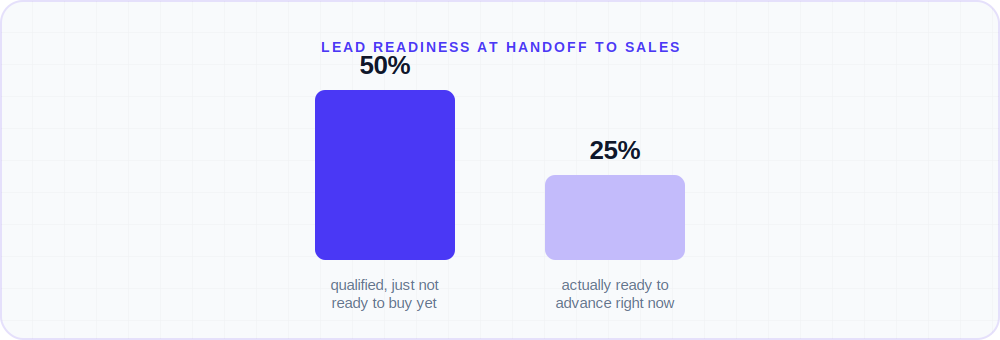
Part of the reason so many "dead" leads come back to life is that they were misclassified from the start. Gleanster Research, in a widely cited study still referenced across CRM and marketing platforms today, found that 50% of leads passed to sales are qualified but simply not ready to buy yet, while only 25% are legitimate, sales-ready opportunities in the moment they are handed off. The other quarter is genuinely unqualified. In other words, half of every batch of leads that gets marked "not ready" or eventually "lost" was never junk to begin with. It just needed more time than a single sales cycle allows.
That mismatch compounds with how persistent reps actually are. Industry surveys consistently find that roughly 44% of salespeople give up after one follow-up attempt, even though closing a sale typically requires several more touches than that. MarketingSherpa has separately reported that 79% of marketing-generated leads never convert into a sale, and a lack of structured nurturing is the most commonly cited reason. Put these together and the picture is clear: a huge portion of your closed-lost column is really just an under-nurtured column wearing a different label.
What a real CRM audit found?
The clearest evidence comes from a 2026 data study by Foureyes, which analyzed thousands of dealership CRM records to see what happened to leads after they were marked closed-lost. The findings: leads previously marked closed-lost accounted for 13.8% of all traffic that returned to shop the dealer's website again, and 14.1% of all leads that clicked back into a dealer's follow-up emails. These are people a sales team had already given up on, actively re-engaging anyway. The same research found dealers are now marking leads lost in a median of just 18 days, three days faster than the year before, meaning the write-off window keeps shrinking even as the return rate holds steady.
That combination, faster write-offs plus a consistent share of leads coming back, is exactly the gap a lead-recycling process is built to close. Most CRMs are not designed to surface this on their own. A lead that goes quiet just sits in a closed status, invisible to anyone unless someone remembers to go looking for it.
Where do these leads actually go?
When a closed-lost lead does eventually buy, it rarely buys from whoever gave up first. Trade show data illustrates the same underlying pattern from a different angle: Cvent has reported that 80% of trade show leads never receive any follow-up at all from the exhibiting company, despite 81% of trade show attendees having actual buying authority. Leads that fall through a follow-up gap do not disappear from the market, they just disappear from your pipeline. Whichever vendor is still in the inbox, still calling, or still showing up in search results when the buyer is finally ready wins the deal that a competitor's sales team already paid to generate and then abandoned.

How do you build a lead-recycling process that works?
Reviving closed-lost leads is not the same as re-adding random old contacts to an email blast. The teams that do it well start by requiring a documented lost reason at the moment a lead is closed, distinguishing timing and budget losses (recoverable) from fit and "do not contact" losses (not recoverable). From there, leads get segmented by age, original engagement depth, and whether anything material has changed since, a new feature, a new price point, a new case study in their exact industry. A generic "just checking in" email rarely works. A message that references the earlier conversation and explains what changed performs meaningfully better, because it treats the prospect as someone with history rather than a cold name pulled from a list.
Curious how this looks with your own pipeline?
15-minute walkthrough, no pressure, cancel anytime.
Where Pixelwand CRM fits in
Lead recycling only works if the "dead" leads are actually visible and organized, not buried in a status nobody filters by. Pixelwand CRM's custom statuses and custom fields let teams capture a specific lost reason, timing, budget, no response, competitor, right at the point a deal is closed, instead of dumping everything into one generic "lost" bucket. Saved and pinned views make it simple to build a standing segment of recoverable leads (say, everyone lost to "timing" in the last 12 months) that a rep or manager can revisit on a schedule instead of relying on memory.
Because Pixelwand unifies leads and deals from calls, WhatsApp, web forms, and email into a single pipeline automatically, a closed-lost contact who suddenly replies to an old email thread, sends a WhatsApp message, or fills out a new web form shows back up on the same record instead of creating a confusing duplicate. Gmail and Outlook sync auto-logs that re-engagement directly on the lead, and Slack notifications can alert the assigned rep the moment something changes on a record they had already written off. Assignment rules make sure a recovered lead gets routed back to a rep with capacity to work it properly, rather than sitting untouched in a queue again.
Quick answers
Treat closed lost as a snooze button, not a delete button. Up to 80% of discarded prospects buy within 18 to 24 months, usually from whichever vendor stayed in touch.
Recycling beats re-adding. Tag the lost reason and re-engage with what changed, a new feature, price, or case study, not a generic check-in.
Require a reason before closing. Timing and budget losses are recoverable, bad fit and do-not-contact are not, so separate them at close time.
Sources: ForceManagement (SiriusDecisions data), Acton Software Lead Nurturing Toolkit (SiriusDecisions data), Foureyes: The Leads You Marked as Lost Are Still Shopping, Social Media Today: 30 Thought-Provoking Lead Nurturing Stats (Gleanster Research), rework.com: Lead Recycling Strategies, Wave Connect B2B Sales Statistics 2026 (Cvent trade show data)
The average MQL to SQL conversion rate sits at just 13%, but the real range runs from 10% to 51% depending on industry, channel, and how fast reps respond.
Lead routing statistics: automated assignment lifts conversion 25-40%, yet one in four leads still lands with the wrong rep. Here's the data.
Lead scoring accuracy stats: only 35% of reps trust scores and 34% of MQLs become SALs. Here's why the model keeps breaking.
Frequently asked questions
How many closed-lost leads eventually buy from someone?
Research from SiriusDecisions found that up to 80% of leads marked dead or disqualified by sales eventually buy something within 18 to 24 months, though not always from the company that gave up on them first. A separate analysis of lead recycling programs puts the more conservative figure at 15-30% of disqualified leads converting somewhere within two years. Either way, a meaningful share of your closed-lost pile is not actually gone, it is just unmanaged.
What is lead recycling and how is it different from just re-adding a lead?
Lead recycling is the structured process of pulling qualified-but-not-ready leads back out of closed-lost status, tagging why they went cold, and re-engaging them on a deliberate cadence instead of starting from a blank slate. It differs from a random re-add because it uses the lost reason, past activity history, and any new product or pricing changes to decide who is worth another touch and what the new pitch should say.
How long should a lead sit before you mark it closed-lost?
There is no single industry number, but automotive CRM data shows dealers are now marking leads lost in a median of about 18 days, three days faster than the year before, even though a meaningful share of those leads later come back and shop again. The safer approach is to base the timeline on your typical sales cycle length and require a documented lost reason before closing, rather than closing automatically after a fixed period of silence.
Why do sales reps close leads as lost too early?
Reps are usually measured on this quarter's pipeline, so a lead that has gone quiet competes poorly against a fresh inbound inquiry that might close faster. Industry data also shows 44% of reps stop following up after a single attempt, and Gleanster Research found that half of all leads handed to sales are qualified but simply not ready yet, which means a large share of closed-lost records were never actually bad fits, just early ones.