B2B Touchpoints: 8 Touches to Convert a Lead
How many touchpoints to convert a B2B lead: 8 average touches to 266 for a full SaaS deal, and why top performers need fewer, not more.
TL;DR: There is no single magic number. Depending on the source, deal size, and how you define a "touch," B2B teams report anywhere from 5 touches for a hot inbound lead to 266 touchpoints for an average SaaS deal and over 400 for six-figure enterprise contracts. The consistent finding across every dataset is that top-performing reps need fewer touches than average reps, not more, and that most pipelines die because sequences stop at 1 or 2 attempts instead of the 6 to 8 that actually move a deal forward.
Why "the rule of 7" doesn't work anymore?
For years, sales and marketing teams repeated a version of the "rule of seven," the idea that a prospect needs seven exposures to a message before buying. That number came out of decades-old advertising research, and it has not held up in modern B2B selling. Research from Abstrakt Marketing Group found it takes 6 to 8 meaningful and strategic touchpoints to convert a lead into a customer, and that number rises further for complex or high-ticket deals. Other benchmark studies push the range even wider: one 2026 analysis reports that a typical B2B purchase now involves 13 internal stakeholders, and each one effectively needs their own set of touches before a deal closes.
The honest answer to "how many touchpoints does it take to convert a B2B lead" is: it depends on what you count as a touchpoint, and what the deal is worth.
What the data actually shows, segmented by deal size?
Averaged across all deal types, most modern benchmarks cluster around 8 touches. A 2025-2026 sales operations benchmark covering 939 companies found B2B lead conversion requires an average of 8 touchpoints, but that number splits sharply by segment: SMB deals convert in roughly 5 to 7 touches, mid-market deals need 8 to 10, and enterprise deals require 12 to 15. A separate 2025 study from Focus Digital, compiling data across industries, found an even wider spread: low-value transactions under $100 closed in about 6.9 touches on average, while transactions above $100,000 required nearly 47 touches to reach a decision.
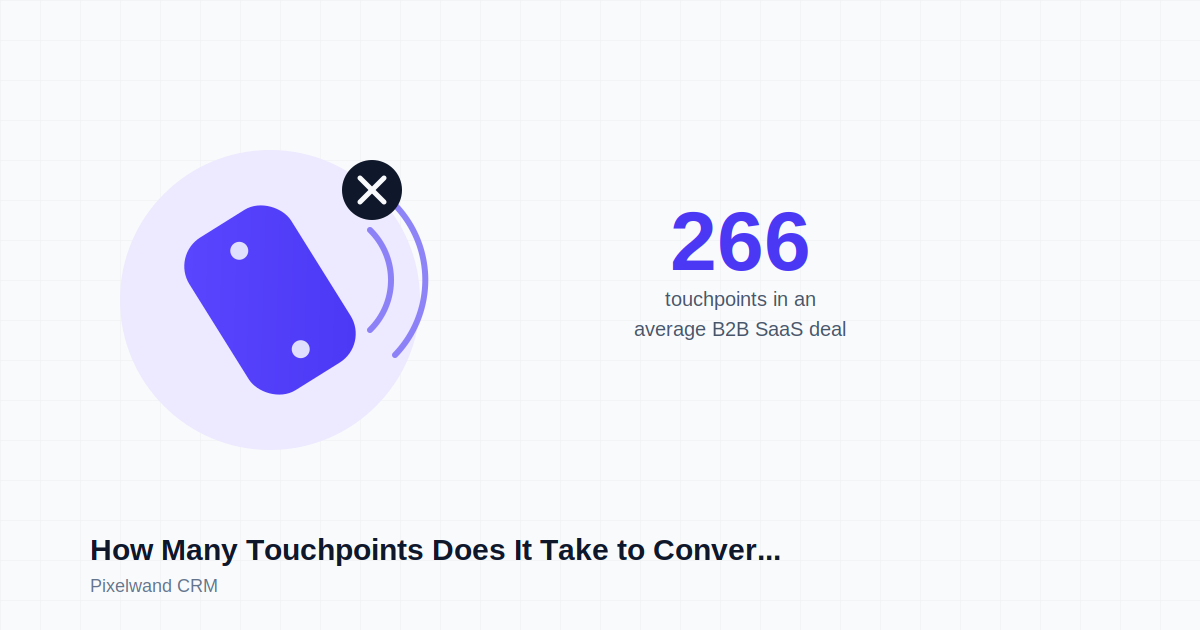
At the far end of the scale, full-funnel tracking tells a different story entirely. Data cited from HockeyStack Labs shows B2B SaaS companies now average 266 touchpoints from first impression to closed deal, a figure that rises to roughly 417 touchpoints for deals above $100,000 in annual contract value. That number counts every ad impression, email open, and content interaction across the whole buyer journey, not just direct sales outreach, which is why it looks so much larger than the "8 touches" most reps have in their heads. The lesson isn't that reps need to make 266 calls. It's that a huge share of those touches are happening through marketing and self-serve channels before a rep ever gets a reply, and the sales touches that do land need to count.
Why do top performers close in 5 touches, not 8?
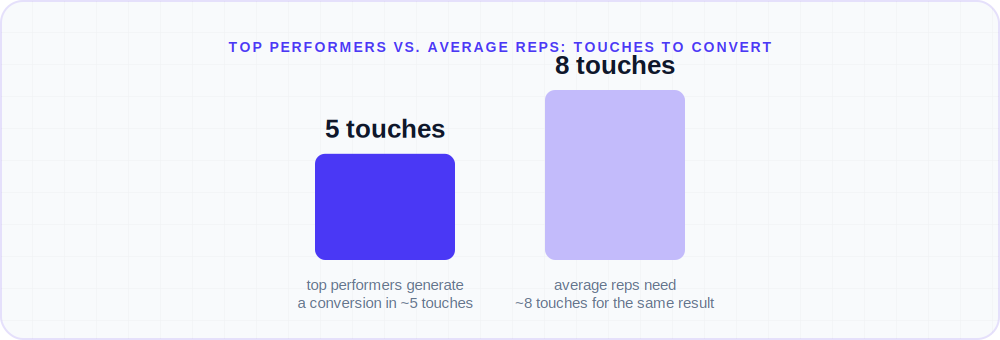
If persistence alone won deals, the top reps on every team would be the ones sending the most emails. The data says the opposite. RAIN Group's research found that while the average rep needs about 8 touches to generate a conversion, top-performing sellers do it in an average of 5. The gap isn't volume, it's relevance: each touch from a top performer is more likely to reference something specific to the buyer's situation, which means fewer wasted attempts before the prospect engages.
This matters for how sales teams should read the touchpoint numbers. A rep chasing a rigid "8 touches, then move on" rule is optimizing for the wrong variable. The teams that convert fastest treat the touchpoint count as a symptom of quality, not a checklist to complete. Separate research on response rates backs this up: on average, it takes close to 4.8 touches just to get any response at all, regardless of how warm the lead is, which means most of the early touches in a sequence are about earning attention, not closing.
Why most sequences never even reach that number?
Here's the gap that actually costs teams pipeline: most sequences don't get anywhere near 6 to 8 touches before a rep gives up. Analysis of B2B conversion data points out that most teams sequence only 1 to 2 touches and treat a non-response as a dead lead, when the underlying data says leads that don't convert immediately are often just not ready yet, not unqualified. A commonly cited figure across multiple sales training sources holds that 80% of sales require five or more follow-ups, and 80% of all closed deals happen somewhere between the fifth and twelfth contact attempt. If a sequence stops at touch two, it is stopping before the statistically likely window for a yes even opens.
Channel mix compounds this. Sequences that combine channels instead of repeating the same one outperform single-channel outreach by roughly 3 to 4x on appointment-setting outcomes, and coordinated email, phone, and LinkedIn sequences have been shown to boost engagement by as much as 287% versus single-channel campaigns. A prospect who ignores three emails in a row may still pick up a call or reply to a WhatsApp message, which is why the channel a touchpoint arrives on matters almost as much as the count itself.

Curious how this looks with your own pipeline?
15-minute walkthrough, no pressure, cancel anytime.
Where Pixelwand CRM fits in
Hitting 6 to 8 relevant touches (or the 12 to 15 an enterprise deal actually needs) is nearly impossible if every touch lives in a different app. Pixelwand CRM unifies leads and deals from calls, WhatsApp, web forms, and email into one pipeline automatically, so a rep can see exactly which touchpoints have already happened on a lead before adding another one. Native two-way WhatsApp Business API messaging and click-to-call via Twilio sit directly on the lead record, which makes it easy to vary the channel instead of sending a fourth identical email. Gmail and Outlook sync auto-logs every email thread and calendar event against the record, so nobody has to guess whether touch six already happened. And because assignment rules and custom statuses can track exactly where a lead sits in a sequence, teams can build a follow-up cadence around the data (5 to 7 touches for a smaller deal, more for an enterprise one) instead of guessing when to stop.
Quick answers
Plan on 6 to 8 meaningful touches. Hot inbound can convert in about 5, while six-figure enterprise deals can need 46 to over 400 total interactions.
Top performers use fewer touches, not more. RAIN Group found top reps convert in about 5 versus 8 for average reps, through relevance rather than volume.
Multichannel beats repetition. Mixed email, phone, and social sequences outperform single-channel outreach by roughly 3 to 4x.
Sources: Apollo (Abstrakt Marketing Group research), Optifai Sales Ops Benchmark, Instantly.ai (HockeyStack data), Sword and the Script (Focus Digital study), RAIN Group, Martal Group, SyncGTM, DeltaPoint Partners, Qwilr
Lead nurturing statistics: nurtured leads make 47% larger purchases and convert 20% more often, yet 65% of marketers skip nurture programs.
Lead source conversion stats: referrals win 50-70% of opportunities versus 10-20% for cold outbound. Yet most CRMs can't show it.
Upsell and cross-sell statistics show existing customers convert 60-70% of the time, versus just 5-20% for new prospects, per Marketing Metrics research.
Frequently asked questions
How many touchpoints does it take to convert a B2B lead?
Most benchmarks land around 6 to 8 meaningful touchpoints for a typical B2B lead, but the real number ranges from 5 for a hot inbound lead up to 400+ for a six-figure enterprise deal once every stakeholder and channel is counted. Deal size, buying committee size, and lead temperature all move the number more than any single rule of thumb.
How many touches does it take to close a sale on average?
Research from RAIN Group puts the average at 8 touches for most reps, while top performers close the same conversion in about 5. Other datasets, like Focus Digital's 2025 study, found an overall average closer to 29 interactions once smaller confirmatory touches are counted, showing the answer depends heavily on what you define as a touchpoint.
Do top sales performers need more or fewer touchpoints than average reps?
Fewer. RAIN Group's research found top performers generate a first meeting in about 5 touches versus 8 for average performers, suggesting the gap is about the quality and relevance of each touch rather than sheer volume.
Does the number of touchpoints change with deal size?
Yes, significantly. Benchmarks segment touch counts by deal value, with small transactions closing in under 10 touches and six figure enterprise deals requiring anywhere from 46 to over 400 touchpoints once every stakeholder, channel, and procurement step is included.