Email Deliverability: Authenticated Mail Wins 2.7x
Analysis of 53M+ cold emails: inbox placement averages 95.2%, and domains with SPF, DKIM, and DMARC land in the inbox 2.7x more often.
TL;DR: An analysis of more than 53 million cold emails found average inbox placement of just 95.2%, meaning roughly 1 in 20 sales emails never reach a prospect's inbox at all. The single biggest lever on that number is authentication: domains with SPF, DKIM, and DMARC fully set up land in the inbox 2.7 times more often than domains without it, a gap worth about 38 percentage points. Google and Microsoft have both moved from recommending authentication to enforcing it, which means the sales teams still skipping it are losing pipeline they can't even see.
What "reaching the inbox" actually means?
Most sales teams track open rates and reply rates and assume that if those numbers look reasonable, deliverability is fine. That assumption breaks down more often than it should. A message can be accepted by a mail server, never bounce, and still never reach the inbox, landing in spam or a promotions tab instead where no rep will ever know it existed. Deliverability and delivery are not the same thing, and the gap between them is exactly where sales pipeline quietly disappears.
How many sales emails miss the inbox?
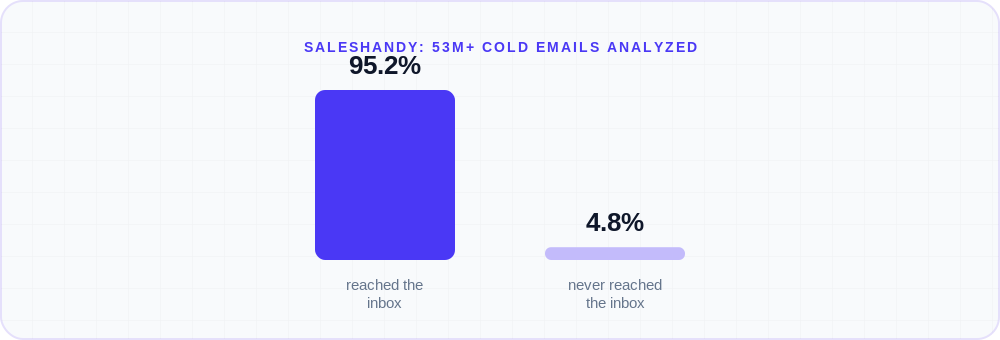
Saleshandy's analysis of its own sending data, covering more than 53 million cold emails sent in 2026, put a number on that gap. The blended inbox placement rate across the dataset was 95.2%, meaning 2.6% of delivered emails were filtered to spam and another 0.8% went missing entirely, never confirmed as delivered or bounced. Put differently, even at a rate most teams would consider healthy, roughly 1 in 40 delivered emails still gets filtered to junk, and closer to 1 in 20 never reaches the inbox once bounces are counted too. For a sales team running outbound at any real volume, that is hundreds of prospects a month who never see a message a rep believes went out clean.
The same dataset put the blended bounce rate at 2.2%, close to the cross-industry average of 2.33%. Most providers start throttling a sending domain once its bounce rate crosses 3%, and recovery from that kind of throttling typically takes 30 to 60 days, which turns a sloppy list into a multi-month deliverability problem rather than a one-week one.

Why is authentication the biggest deliverability lever?
If one variable explains most of the gap between senders who land in the inbox and senders who don't, it's authentication. SPF, DKIM, and DMARC are the technical records that let a mailbox provider confirm a message actually came from the domain it claims to, rather than being spoofed or relayed through infrastructure the domain owner doesn't control.
The numbers on adoption explain why this still matters as much as it does. Saleshandy's data found SPF published on only 56% of sending domains, DKIM passing on 90.9% of global email traffic, and a DMARC record published on 52.1% of the top 1.8 million domains, but DMARC actually set to enforce, rather than just monitor, on only about 23% of the domains that have one. That last number is the one that matters most: roughly 3 in 4 domains with DMARC in place still aren't using it to block spoofed mail, which mailbox providers can see and factor into how they treat a domain's traffic.
The payoff for closing that gap is large. Fully authenticated domains, meaning SPF, DKIM, and DMARC all correctly configured, land in the inbox 2.7 times more often than domains with none of the three, and the difference between full and zero authentication works out to roughly 38 percentage points of inbox placement. That is a bigger swing than almost any copywriting or subject-line change a sales team could make, and it's a one-time technical fix rather than an ongoing effort.
Curious how this looks with your own pipeline?
15-minute walkthrough, no pressure, cancel anytime.
Why are Gmail and Microsoft done being lenient?
Deliverability used to be mostly a best-practices conversation. It has shifted into an enforcement one. Google's official bulk sender guidelines, in effect since February 1, 2024, require any sender pushing more than 5,000 messages a day to Gmail addresses to keep their spam complaint rate below 0.3%, measured through Google Postmaster Tools, alongside required SPF, DKIM, and DMARC authentication and one-click unsubscribe support. Cross the 0.3% threshold and a sender loses access to Gmail's mitigation support until the rate stays below that line for seven straight days, which in practice means degraded inbox placement across every campaign from that domain, not just the one that triggered it.
Microsoft has followed a similar path, tightening its own authentication requirements for high-volume senders in 2025. Saleshandy's data also found Microsoft the least forgiving mailbox provider in its dataset by every measure it tracked: the highest bounce rate among major providers at 2.46%, and the lowest open and reply rates of any segment. For a sales team whose prospect list skews toward corporate Outlook addresses, that gap alone is worth planning around, since the same list can perform meaningfully worse there than it does landing in Gmail.
Where Pixelwand CRM fits in
Most of this deliverability problem is invisible from inside a typical sales workflow. A rep sends an email, sees it leave their outbox, and has no easy way to know whether it landed in an inbox, a spam folder, or nowhere at all, especially when outreach happens from a personal inbox or a disconnected email tool that never talks to the CRM.
Pixelwand CRM syncs each rep's real email account, Gmail, Outlook, or a custom domain, directly to their Lead and Deal records, so every send, reply, and bounce is logged automatically against the record it belongs to instead of living in a separate tool nobody checks. Combined with native Twilio calling and WhatsApp Business API integration, it keeps every channel a prospect actually replies on inside one pipeline, so a bounced or ignored email doesn't quietly stall a deal that's still very much alive on WhatsApp or a call. If your team can't currently answer "did that email even land" for last week's outreach, that's usually the first sign worth investigating.
Plan availability: native WhatsApp messaging starts on the Growth plan. See pricing for details.
Sources: Saleshandy, Google Workspace Admin Help, Validity.
Sales email open rate statistics show real opens near 24%, while vendor benchmarks claim up to 42%. See why the gap exists and what to track instead.
Clean an email list with syntax, disposable-domain, and MX checks, then download a report before sending your next sales campaign.
Video prospecting statistics show video emails get 26% more replies and cut close time nearly in half. See the real data behind video outreach.
Frequently asked questions
What is a good email deliverability rate for B2B sales outreach?
An analysis of over 53 million cold emails by Saleshandy found an average inbox placement rate of 95.2%, meaning roughly 1 in 20 emails never reach the inbox at all. Anything below 90% inbox placement is considered a sign of a list-quality or infrastructure problem worth fixing, and teams that verify every address before sending report inbox placement closer to 95% or higher.
Why do authenticated emails perform so much better than unauthenticated ones?
Mailbox providers use SPF, DKIM, and DMARC to confirm a message actually came from the domain it claims to. Saleshandy's dataset found fully authenticated domains land in the inbox 2.7 times more often than unauthenticated ones, a gap worth roughly 38 percentage points of inbox placement. Since late 2025, Gmail has enforced authentication checks at the SMTP level, and Microsoft began doing the same in May 2025, so missing authentication increasingly means no delivery rather than just a lower placement rate.
What happens if a sales team's spam complaint rate gets too high?
Google's official bulk sender guidelines require senders of more than 5,000 messages a day to Gmail addresses to keep their spam rate below 0.3%, a policy in effect since February 2024. Cross that line and Gmail suspends mitigation support until the sender holds a rate under 0.3% for seven consecutive days, which can mean days or weeks of degraded inbox placement across an entire sending domain, not just the flagged campaign.
How does a CRM help with email deliverability for sales teams?
The biggest deliverability risk in most sales orgs isn't a single bad campaign, it's reps sending from disconnected tools with no visibility into bounces, spam complaints, or authentication status. A CRM that natively syncs each rep's real email account and logs every send, bounce, and reply against the lead or deal record gives a team an early warning system instead of finding out a domain got throttled after pipeline already went quiet.