Mobile CRM: Reps Hit Quota Nearly 3x More Often
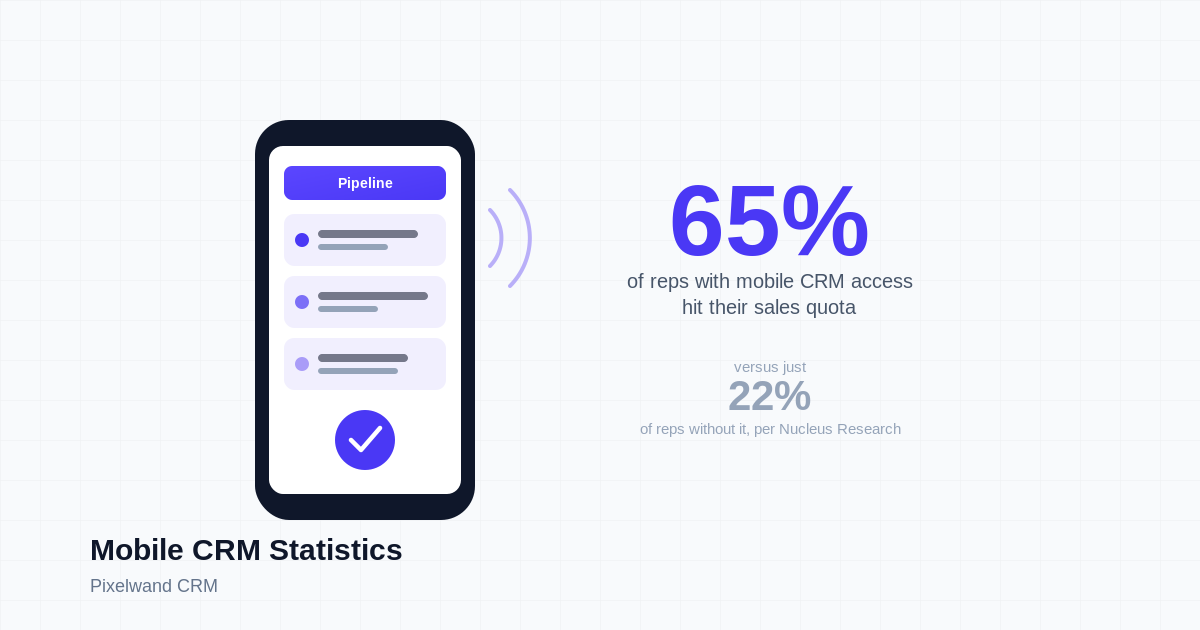
65% of reps with mobile CRM hit quota versus 22% without, plus a 14.6% productivity gain. Here's what the mobile stats show.
TL;DR: Sales reps with mobile access to their CRM hit quota at more than twice the rate of reps without it, 65% versus 22%, according to Nucleus Research. Aberdeen Research found a similar pattern at the company level: firms with a sales-mobility strategy see 76% of teams hit quota versus 53% for firms without one, and their Best-in-Class mobile-enabled sales organizations grew revenue 16.7% a year against just 1.0% for everyone else. Mobile access alone drives a 14.6% average productivity gain, and 81% of CRM users now work from more than one device. The gap isn't about willpower, it's that most CRMs still treat the phone as an afterthought instead of a full working surface.
Ask most sales leaders whether their CRM works on a phone and they'll say yes, technically. Ask their reps how often they actually use it away from a desk, and the honest answer is usually "barely." That gap between technically mobile and actually usable on mobile turns out to be one of the more consistently documented predictors of who hits quota and who doesn't.
Why mobile access quietly decides who hits quota?
Most B2B selling doesn't happen at a desk. Reps are between meetings, at a client site, in a car, or catching a WhatsApp reply from a prospect between calls. Aberdeen Research's study on sales mobility defines this directly as "sales mobility": organizational support for sales professionals whose work regularly happens out of the office. That's not a niche segment of field sales, it's most of B2B selling once you count every rep who leaves the building for meetings, site visits, or events.
The problem is that a CRM built primarily for a desktop screen creates a quiet tax on exactly those moments. A rep who can't log a call, update a deal stage, or check a lead's history from their phone either does it later, from memory, back at a laptop, or doesn't do it at all. Both outcomes degrade the same thing: how current and trustworthy the pipeline is when a manager, or the rep themselves, actually needs to act on it.
How big is the mobile CRM quota gap?
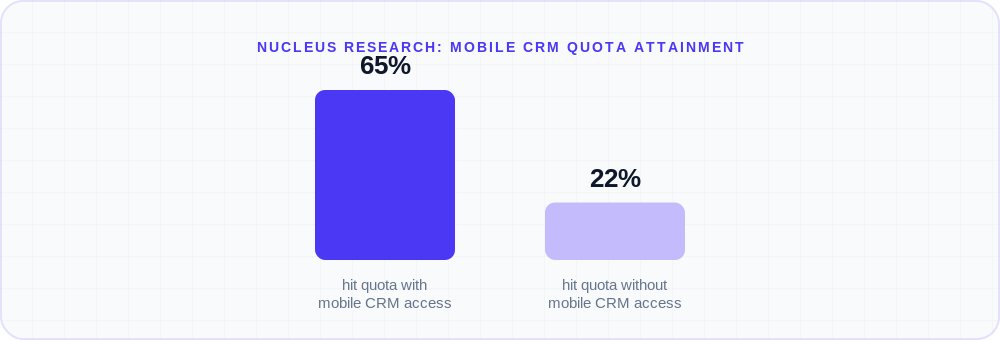
The size of that gap is larger than most sales leaders would guess. Nucleus Research found that 65% of sales reps with mobile access to their CRM achieve their sales quota, compared to just 22% of reps without mobile access, a nearly 3x difference in quota attainment tied to one variable: whether the CRM works properly on a phone.
Aberdeen Research's independent study of sales mobility found the same pattern at the company level. Firms that had adopted a sales-mobility strategy, meaning reps could access and update CRM data from mobile devices while out of the office, saw 76% of their teams hit quota, compared to 53% of firms without a mobility strategy. That's a 23-point gap driven not by hiring better reps, but by whether the tools those reps already have work outside the office.
What "mobile access" actually buys a rep?
It's worth being specific about what's driving the gap, because "mobile access" can mean anything from a cramped, unusable version of a desktop screen to a genuinely functional app. In Nucleus Research's survey of 223 CRM decision-makers, giving salespeople real mobile capabilities produced an average productivity gain of 14.6%, with nearly a third of respondents reporting a gain of more than 20%. Only 2% saw no benefit at all.
That productivity gain shows up because reps are no longer choosing between selling and updating the CRM later. Data compiled by DemandSage, citing Forrester's research on device usage, found that 81% of CRM users now access their system from more than one device, 48% from a mobile phone and 45% from a tablet, meaning multi-device use is the default expectation, not a power-user feature. The market is racing to catch up with that expectation: the global mobile CRM market is projected to grow from $22.27 billion in 2025 to $70.22 billion by 2035, a 12.17% compound annual growth rate, according to Global Growth Insights.

Why the gap doesn't close on its own?
If mobile access is this clearly linked to quota attainment, the obvious question is why so many teams still don't have it in any real sense. Part of the answer is that "mobile CRM" often means a native app built and maintained separately from the desktop product, with its own release cycle, its own feature gaps, and its own bugs. Teams either underinvest in keeping it current, or reps quietly give up on it after one too many broken syncs and go back to typing notes into their phone's notes app instead, notes that never make it back into the actual deal record.
The other part is habit and rollout, not technology. Aberdeen's research found that even among companies that had equipped reps with mobile tools, only 45% actually let reps input or access customer data from any device while on-site with a prospect, and only 39% had deployed mobile apps that directly support sales processes like logging a call or updating a stage. Owning a mobile CRM and actually using it as a full working surface, instead of a read-only dashboard, turn out to be two very different things.
Curious how this looks with your own pipeline?
15-minute walkthrough, no pressure, cancel anytime.
What top-performing mobile deployments do differently?
The teams that get this right aren't doing anything exotic, they're just further along on the same mobile fundamentals. Aberdeen's Best-in-Class sales organizations, the top 20% by performance, achieved 109% of overall sales quota on average, compared to 73% for industry-average companies and just 41% for the bottom performers, and grew annual revenue 16.7% versus only 1.0% for everyone else.
The mobile habits underneath that gap are specific and unglamorous: 89% of Best-in-Class firms synced calendars, contacts, and tasks automatically across devices, 74% could remotely view and modify core CRM records like accounts, leads, opportunities, and forecasts (not just view them), and 65% supported instant messaging or chat directly on mobile. None of that is a moonshot feature. It's closer to a checklist of "does the phone version actually do what the desktop version does," and most CRMs still fail more of that checklist than sales leaders realize until a rep tries to use it from a parking lot between meetings.
Where Pixelwand CRM fits in
Pixelwand CRM is built as a mobile-friendly Progressive Web App from the same codebase as the desktop product, not a stripped-down companion app, so a rep gets full CRM functionality on their phone: the same pipeline, the same lead and deal records, the same activity history, installable directly to an Android or iOS home screen without an app store detour.
That matters most for the exact moments the research above points to. Native calling through Twilio puts click-to-call on a lead record whether a rep is at a desk or standing in a lobby, and two-way WhatsApp Business API messaging is attached to that same record, so a reply sent from a phone between meetings lands on the deal automatically instead of living in a personal chat thread nobody else can see. Calls, WhatsApp messages, and web form submissions all flow into one pipeline in real time, and Slack notifications keep a rep aware of deal movement without needing to open a laptop to check. Gmail and Outlook sync auto-logs email threads in the background, so the record stays current even when a rep hasn't touched the CRM directly all day.
If your team's CRM technically has a mobile version but nobody actually trusts it enough to use in the field, take a look at the full feature set to see how calling, WhatsApp, and lead capture come together in one record.
Sources: Nucleus Research: Social CRM and Mobile Capabilities Boost Productivity by 26.4 Percent, DemandSage: 42 CRM Statistics 2026, Demand Gen Report: Aberdeen Report Highlights Impact of Mobility on Sales Enablement, GlobeNewswire: Best-in-Class Mobile-Enabled Sales Teams Achieved 109% of Quotas (Sage-sponsored Aberdeen research brief), Global Growth Insights: Mobile CRM Market Size, Share & Forecast Report
Sales call prep stats: reps who research 15+ minutes win 50% more deals, yet only 49% of average sellers research consistently.
Clari analyzed 10M opportunities: the top 10% of sellers generate 65% of revenue while the bottom half contributes under 8%.
Rep turnover stats: reps leave at 35% a year, nearly triple the average, and each departure can cost $115,000 to $150,000 in pipeline.
Frequently asked questions
What percentage of sales reps with mobile CRM access actually hit quota?
Nucleus Research found that 65% of sales reps with mobile access to their CRM achieve their sales quota, compared to just 22% of reps without it. Separately, Aberdeen Research found that 76% of firms with a defined sales-mobility strategy hit their team quota, versus 53% of firms without one.
How much does mobile CRM access actually improve sales productivity?
In a Nucleus Research survey of 223 CRM decision-makers, adding mobile capabilities to a CRM produced an average productivity gain of 14.6%, with almost a third of respondents reporting a gain of more than 20%. Only 2% of respondents saw no productivity benefit at all.
Do most reps actually use their CRM from a phone, or is that a minority behavior?
No, it's now the norm. Research cited by Forrester and compiled by DemandSage found that 81% of CRM users access their system from more than one device, with 48% using a mobile phone and 45% using a tablet. The mobile CRM market itself is projected to grow from $22.27 billion in 2025 to $70.22 billion by 2035, a sign that vendors are racing to catch up with how reps already want to work.
What separates top-performing mobile CRM deployments from average ones?
Aberdeen's research on Best-in-Class sales organizations found they hit 109% of quota on average, compared to 73% for industry-average companies and 41% for laggards, and grew annual revenue 16.7% versus just 1.0% for everyone else. The gap traced back to mobile fundamentals: 89% synced calendars, contacts, and tasks across devices, and 74% could remotely view and edit CRM records like accounts, leads, and forecasts, not just glance at them.