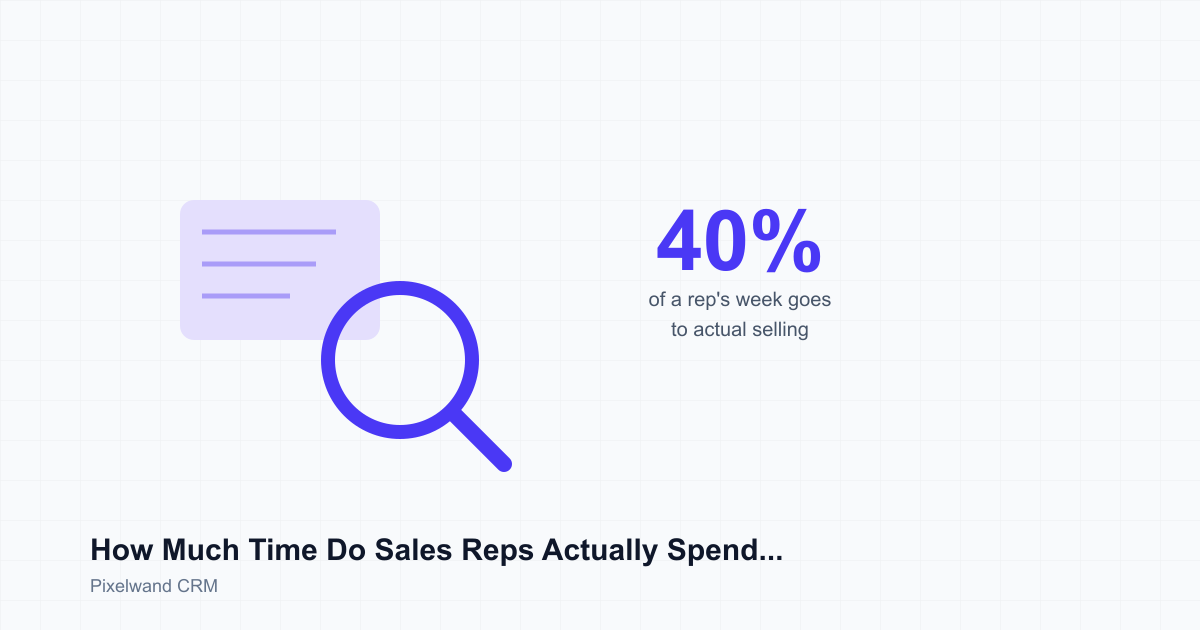
Reps Spend Only 40% of Time Actually Selling
Salesforce data: reps spend just 40% of time selling, down to 35% for newer reps, while CRM admin and tool overload eat the rest.
TL;DR: If you're wondering how much time do sales reps spend selling, the honest answer is not much. Salesforce's 2026 State of Sales report puts it at just 40% of the average week, with the remaining 60% swallowed by admin work, CRM data entry, and internal meetings. Newer reps have it worse: Gen Z sellers spend only 35% of their time selling, largely because they inherit the manual data entry that more tenured reps have learned to avoid. Sellers who feel overwhelmed by their tool stack are 45% less likely to hit quota, according to Gartner. The gap between top and bottom performers comes down almost entirely to how much of that lost time each rep manages to reclaim.
How much time do sales reps spend selling, really?
The number moves depending on which year's survey you read, but the direction never changes. Salesforce's newest State of Sales report finds that sales reps spend 60% of their time on non-selling tasks, which puts actual selling time at roughly 40% of the average week. That is a modest improvement from Salesforce's prior State of Sales edition, which surveyed 5,500 sales professionals across 27 countries and found reps spending closer to 29 to 30% of their time actually selling. Even with the recent gain, three out of every five working hours still go to something other than a customer conversation.
The breakdown of that lost time looks fairly consistent across research firms. Forrester's productivity research, echoed across recent sales benchmarking studies, describes a typical week split roughly into selling activities, admin and data entry, internal meetings, prospect research, and inbox management, with admin and CRM upkeep alone claiming a meaningful double-digit share. None of that is a single villain. It is death by a thousand small tasks: logging a call, updating a deal stage, re-typing a note from a WhatsApp thread into a spreadsheet, hunting for a contact's email in a different inbox.
Why do Gen Z reps sell only 35% of the time?
One of the more striking findings buried in Salesforce's latest report is generational. While the average seller spends 40% of their time selling, Gen Z reps are stuck at just 35%, losing roughly two extra hours every week to manual data entry that more senior reps have automated, delegated, or simply learned to avoid. That gap compounds fast. Over a year, two extra hours a week is close to 100 hours that a newer rep spends re-keying information instead of building pipeline, which helps explain why ramp time for new hires remains such a stubborn problem for sales leaders.
Curious how this looks with your own pipeline?
15-minute walkthrough, no pressure, cancel anytime.
Why tool overload makes the problem worse, not better?
The instinct in most sales orgs is to buy another tool to fix the time problem. The data suggests that instinct backfires. Gartner's September 2024 survey of 1,026 B2B sellers found that 72% feel overwhelmed by the number of skills required for their job and 50% feel overwhelmed by the amount of technology they are expected to use, with overwhelmed sellers 45% less likely to attain quota. Salesforce's own research puts a number on the sprawl: the average seller now uses 8 different tools just to close a single deal, and 42% say they feel overwhelmed by that many tools.
That overload compounds the admin problem instead of solving it, because every disconnected tool creates its own manual re-entry step. A lead comes in through a Facebook ad, a conversation happens over WhatsApp, a call gets logged nowhere, and a follow-up email lives in an inbox the CRM never sees. Each of those gaps is a few minutes of selling time quietly bleeding out, multiplied across every deal in the pipeline.
What top performers do differently with their time?
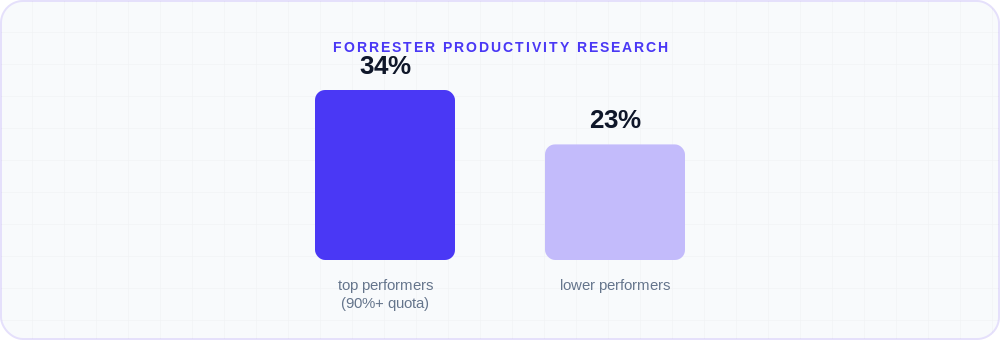
The encouraging part of this data is that the gap between high and low performers is not about working longer hours. Forrester's analysis found that organizations with above 90% quota attainment see reps spending about 34% of their time actively selling, compared to 23% at lower-performing organizations, an 11-point gap that tracks almost directly with revenue outcomes. LinkedIn's State of Sales Report found a similar pattern in preparation habits: 82% of top-performing sellers say they always research a prospect before reaching out, compared to just 49% of other sellers, meaning top performers spend their limited non-selling time more deliberately rather than avoiding it altogether.
CRM discipline shows the same split. Ebsta's analysis of over 122,000 opportunities found that higher-performing companies update their CRM records continuously throughout the week, while lower performers cluster their updates into a single catch-up session, typically at the start of the week. The average rep still spends almost four hours a week manually updating CRM records, time that top performers recover by updating in the moment rather than reconstructing a week's worth of activity from memory on a Friday afternoon.

Where Pixelwand CRM fits in
Most of the lost selling time documented above traces back to one root cause: information living in too many disconnected places. Pixelwand CRM is built around closing that gap rather than adding another tab to switch between. Leads and deals from calls, WhatsApp, web forms, and email flow into one pipeline automatically, so reps are not manually re-entering the same contact three times across three systems.
Native calling through Twilio puts click-to-call directly on the lead record, and two-way WhatsApp Business API messaging is attached to that same record rather than living in a separate app. Gmail and Outlook sync auto-logs email threads and calendar events without a rep touching a keyboard, and Google Calendar sync adds meeting-prep summaries so reps walk into calls already briefed instead of researching from scratch. Slack notifications keep the team aware of deal movement in real time, and Facebook and Instagram lead ads sync straight into the CRM instead of sitting in a separate ads dashboard waiting to be copied over. None of this eliminates admin entirely, but it removes the re-typing, re-checking, and tool-hopping that the research above shows is quietly costing reps hours of selling time every single week.
If your team is losing selling time to the same fragmentation these reports describe, it's worth seeing what a unified pipeline actually looks like in practice, handling calls, WhatsApp, email, and lead capture in one record.
Sources: Salesforce State of Sales Statistics, Salesforce State of Sales Report Announcement 2026, Gartner Sales Survey Reveals Sellers Who Partner With AI, Ebsta: Companies Who Update Their CRM Have Higher Win Rates, LinkedIn State of Sales Report 2022, Everstage Sales Productivity Statistics
Sales call prep stats: reps who research 15+ minutes win 50% more deals, yet only 49% of average sellers research consistently.
Clari analyzed 10M opportunities: the top 10% of sellers generate 65% of revenue while the bottom half contributes under 8%.
Rep turnover stats: reps leave at 35% a year, nearly triple the average, and each departure can cost $115,000 to $150,000 in pipeline.
Frequently asked questions
How much time do sales reps actually spend selling?
According to Salesforce's 2026 State of Sales report, the average seller spends 40% of their time on active selling, meaning 60% goes to non-selling tasks like admin, CRM data entry, and internal meetings. That is actually an improvement over Salesforce's 2024 report, which put selling time closer to 29 to 30%, but it still means the majority of a rep's week has nothing to do with talking to customers.
Why do sales reps spend so much time on CRM data entry?
Ebsta's analysis of over 122,000 opportunities found the average sales rep spends almost four hours per week manually updating their CRM. That workload climbs further when leads and conversations are scattered across email, WhatsApp, calls, and web forms that do not sync automatically, forcing reps to re-key the same information into multiple systems.
What separates top performers from average reps in selling time?
Forrester's productivity research, cited widely across recent sales benchmarking reports, found organizations with above 90% quota attainment see reps spend about 34% of their time actively selling versus 23% at lower-performing organizations. LinkedIn's State of Sales Report similarly found 82% of top performers always research a prospect before reaching out, compared to 49% of other sellers, suggesting top performers are simply more disciplined about protecting selling time.
How can sales teams give reps back more selling time?
The biggest wins come from removing manual re-entry and tool switching rather than adding more dashboards. Gartner found that sellers overwhelmed by the number of technologies they must use are 45% less likely to attain quota, and Salesforce reports the average rep now uses 8 tools just to close one deal. Consolidating calling, messaging, email, and pipeline tracking into a single record is one of the most direct ways to reclaim hours currently lost to admin.