CRM Duplicate Data: Up to 30% of Records Duplicated
CRM duplicate data statistics: 10 to 30% of records are duplicates, costing roughly 550 hours per rep a year. Here's why, and what fixes it.
TL;DR: CRM duplicate data statistics consistently land in the same range: 10% to 30% of records in a typical CRM are duplicates of an existing lead, contact, or deal, and integration-fed data duplicates at a much higher rate, up to 80%, according to an analysis of more than 12 billion Salesforce records. Sales teams lose roughly 550 hours per rep per year to bad CRM data overall, duplicates included, and each individual duplicate record costs an estimated $96 to identify, review, and merge. The fix isn't blocking new leads, it's merging them the moment they land.
How many CRM records are actually duplicates?
Ask five different data-quality vendors "what's the duplicate rate in a typical CRM" and you'll get five numbers in the same neighborhood. Industry data compiled by Databar.ai puts duplication rates between 10% and 30% of total records as normal for companies without an active data quality program, while HubSpot's own research on data duplication cites the same 10% to 30% range as unremarkable for teams that haven't invested in cleanup. A widely referenced Salesforce-focused estimate from Insycle goes further, describing the average duplicate rate in a database as high as 20% to 30%.
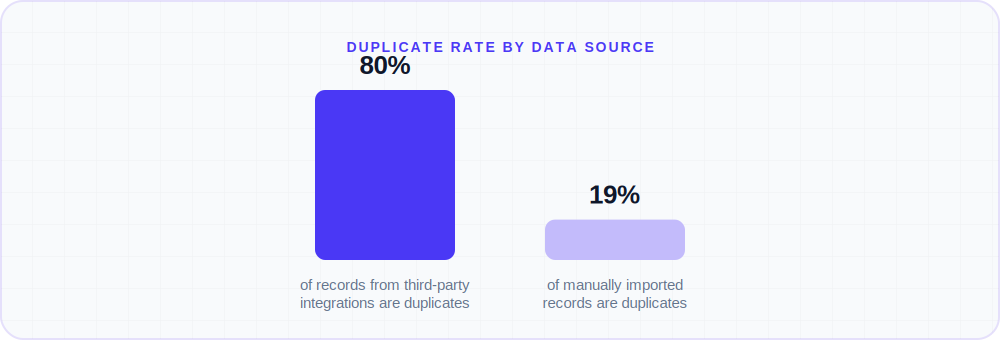
The picture gets worse once you separate manual entry from automated intake. Plauti, a Salesforce data-quality vendor, aggregated 2021 client data across more than 12 billion Salesforce records and found that manual imports return a relatively modest 19% duplicate rate, but records arriving through third-party integrations, think meeting schedulers, webinar tools, and lead-gen forms, come in duplicate about 80% of the time. Looked at across every source combined, more than 45% of records in a typical database turn out to be duplicates. Best-in-class organizations that run continuous, real-time matching instead of an annual scrub keep their duplicate rate under 2%, according to Databar.ai's benchmarking.
None of this is really about sloppy typing. It's a structural side effect of how leads actually reach a modern sales team: the same person fills out a web form, messages on WhatsApp, gets referred by a Facebook lead ad, and eventually calls in, and every one of those touches can spin up a fresh record if the systems behind them aren't talking to each other.
Where do duplicate CRM records come from?
The channel mix is the real story here. Traction Complete's analysis of Salesforce data quality names three main sources of duplicate records: integrations that push data in without governance, bulk imports from list purchases or trade shows, and reps themselves creating a "new" record because they didn't see the existing one. Experian's global data management research backs this up from the other direction, finding that organizations across the UK, US, and France suspect roughly 30% of their contact and prospect data may be inaccurate, and 69% believe that inaccurate data is actively undermining their ability to deliver a good customer experience.
Multiply that across a normal B2B funnel and the failure mode becomes obvious. A lead fills out a form on the website, then messages the WhatsApp Business number with a question, then gets called by a rep following up on a Facebook ad, and if none of those channels write to the same underlying record, the CRM now has two or three versions of one person. Two reps chase the same prospect without knowing it, a pipeline report gets inflated because the same opportunity shows up twice, and the buyer gets the exact kind of "why is your right hand not talking to your left hand" experience that erodes trust fast.
What do duplicate records really cost you?
Duplicate cleanup has a price tag, and it's not trivial. A frequently cited figure from SiriusDecisions, referenced by both Insycle and Inogic in their CRM data-quality research, breaks the cost down by stage: it costs about $1 to verify a record as it's entered, $10 to cleanse and de-duplicate it after the fact, and as much as $100 if nothing is done and the bad data is left to cause downstream errors. Databar.ai's more recent estimate lands in a similar place, pricing the full cost of identifying, reviewing, and merging a single duplicate record at approximately $96 once staff time is factored in.
The bigger number is time, not dollars. Sales teams lose approximately 550 hours per rep per year, or roughly 27% of a rep's total time, to inaccurate CRM data according to analysis cited by Landbase, and duplicate records are consistently named as a major contributor alongside stale contact info and missing fields. That's nearly 14 weeks of a single rep's working year spent untangling which record is real, not selling. Separately, Landbase's research found that 44% of companies lose 10% or more of revenue to data decay of this kind, which includes the duplicate records piling up from every new integration a company turns on.
Curious how this looks with your own pipeline?
15-minute walkthrough, no pressure, cancel anytime.

Why duplicates quietly wreck forecasting too?
The productivity drain is the visible cost. The less visible one is what duplicates do to the numbers leadership actually trusts. If a company record and its duplicate each carry a slightly different version of an open opportunity, weighted pipeline totals can show more coverage than genuinely exists, which is exactly the kind of false confidence that shows up later as a missed forecast. Marketing and sales also tend to disagree about which channel actually sourced a deal once the same buyer exists under two or three different lead records with different "source" fields attached, a pattern data-quality researchers at Insycle have documented repeatedly when studying lead-to-account matching failures.
None of this requires malicious or even careless behavior from anyone on the team. It's simply what happens when five different intake channels (calls, WhatsApp, web forms, email, and paid social) each get to create a new record independently, with no shared rule for recognizing "I've seen this person before."
Where Pixelwand CRM fits in
Duplicate records mostly exist because leads arrive at the same company through different doors that don't talk to each other: a call comes in, a WhatsApp message lands separately, a web form fires its own notification, and a Facebook lead ad drops a fourth version into a spreadsheet somewhere. Pixelwand CRM is built around the opposite premise. It unifies leads and deals from calls, WhatsApp, web forms, and email into one pipeline automatically, so a prospect who calls in on Monday and messages on WhatsApp on Wednesday shows up as activity on one record instead of two.
Because calling runs natively through Twilio with click-to-call straight from the lead record, and WhatsApp Business messaging is attached to that same record rather than living in a separate app, there's no secondary system quietly generating its own copy of the contact. Gmail and Outlook sync auto-logs email threads onto the record they belong to, and Facebook and Instagram lead ads sync directly into the CRM rather than through a manual export-import step, which is exactly the kind of unsupervised import that data-quality research flags as a top source of duplicates. Custom fields, statuses, and assignment rules then let a team enforce its own matching logic (on email, phone, or company) so the same person can be recognized across every channel instead of re-entered.
How many follow ups does it take before duplicates become a problem?
It doesn't take many. A single missed match on the first touch is often enough, because every channel that follows compounds it. If a lead's first web form submission creates record A, and their second touch through WhatsApp or a Facebook ad creates record B before anyone merges the two, every subsequent call, email, and note has a coin-flip chance of landing on the wrong half of that person's history. That's why real-time matching at the point of entry, not a quarterly cleanup project, is what the best-performing organizations in the Databar.ai benchmarking actually rely on.
Quick answers
Expect 1 in 10 to 1 in 3 records duplicated. Unmanaged CRMs sit in the 10 to 30% range, with integration feeds duplicating at far higher rates.
Integrations are the biggest offender. Form, scheduler, and ad-platform feeds drive most dupes, so match on email, phone, and company at entry.
Prevent at intake, not in quarterly cleanups. Merging automatically when a lead lands beats blocking real leads or scrubbing later.
Sources: Databar.ai, RevGenius / Plauti, Insycle, Experian plc, Landbase, HubSpot
After-hours lead response stats: 39% of B2B conversations happen outside 9-to-5, yet slow replies cut qualification odds by up to 60x.
Lead nurturing statistics: nurtured leads make 47% larger purchases and convert 20% more often, yet 65% of marketers skip nurture programs.
Lead source conversion stats: referrals win 50-70% of opportunities versus 10-20% for cold outbound. Yet most CRMs can't show it.
Frequently asked questions
What percentage of CRM records are typically duplicates?
Most benchmarks put duplication rates between 10% and 30% of total records for companies without an active data quality program, according to Databar.ai and HubSpot's own research on the issue. Best-in-class organizations with continuous deduplication in place keep that rate under 2%, while some analyses of raw integration feeds find that as many as 45% of records across all sources are duplicates.
How much do duplicate leads cost a sales team?
One widely cited estimate puts the direct cost of identifying, reviewing, and merging a single duplicate record at roughly $96. Layer on top of that the approximately 550 hours per rep per year that sales teams lose to inaccurate CRM data overall, and duplicates alone represent a meaningful chunk of a rep's non-selling time every year.
Where do most duplicate leads in a CRM come from?
Third-party integrations are the biggest source by far. Analysis of over 12 billion Salesforce records by Plauti found that manual imports produce a duplicate rate of about 19%, while records flowing in through third-party integrations (forms, schedulers, ad platforms, and similar tools) come in duplicate roughly 80% of the time.
How do you prevent duplicate leads in a CRM without blocking legitimate ones?
The practical fix is not blocking incoming data, since that risks losing real leads, but merging duplicates automatically and immediately at the point of entry using matching rules on email, phone, and company fields, rather than relying on a periodic cleanup project. Routing every channel (calls, WhatsApp, web forms, email, and ads) into one pipeline with consistent matching logic is what keeps the rate low without slowing down lead capture.