After-Hours Leads: 39% Arrive Outside 9-to-5
After-hours lead response stats: 39% of B2B conversations happen outside 9-to-5, yet slow replies cut qualification odds by up to 60x.
TL;DR: After-hours lead response statistics tell an uncomfortable story: a huge share of B2B buying activity, roughly 39% of buyer conversations and 41% of booked meetings according to Salesloft and Drift, happens outside standard 9-to-5 hours. Most sales teams still respond on a business-hours schedule anyway. The cost of that mismatch is steep. Harvard Business Review research found companies that contact a lead within an hour are nearly 7x more likely to qualify it than those that wait even an hour longer, and more than 60x more likely than companies that wait 24 hours or more. Even the day of the week matters: Monday, the day everyone is clearing a weekend backlog, is consistently the worst day to follow up.
Is your response window still built for 9-to-5?
For more than a decade, the standard benchmark for lead response has been grim. Harvard Business Review's widely cited study by James Oldroyd, Kristina McElheran, and David Elkington, "The Short Life of Online Sales Leads," audited how companies actually handled inbound web leads and found that the average firm took around 42 hours to make first contact, and a meaningful share never responded at all.
That was 2011. More recent data suggests things haven't improved as much as you'd expect. RevenueHero's 2024 mystery-shopping exercise submitted real demo requests to 1,000 B2B SaaS companies and found that 63.5% never responded at all. Among the companies that did respond, the average wait was 1 day and 5 hours, and only 17.2% replied within two minutes. In an industry that literally sells software for managing customer relationships, most vendors still can't answer their own front door quickly.
The pattern holds because most response processes assume leads arrive when staff are at their desks. They don't.
Why waiting costs so much, even just a few hours?
The part of the research that should worry every sales leader isn't the average, it's the decay curve. The HBR study found that firms trying to contact a lead within an hour were nearly 7 times more likely to qualify that lead (defined as having a meaningful conversation with a decision-maker) than firms that waited even one additional hour. Compared with companies that waited 24 hours or longer, the fast responders were more than 60 times more likely to qualify the lead.
That is not a rounding error. It means the exact same lead, with the exact same budget and the exact same need, converts at wildly different rates purely based on when someone happened to pick up the phone or send a reply. A lead that arrives at 6 PM on a Friday and doesn't get touched until Monday morning has effectively been sitting in the 24-hours-or-longer bucket the entire time, even if nobody on the team thinks of it that way.

Are weekends your biggest blind spot?
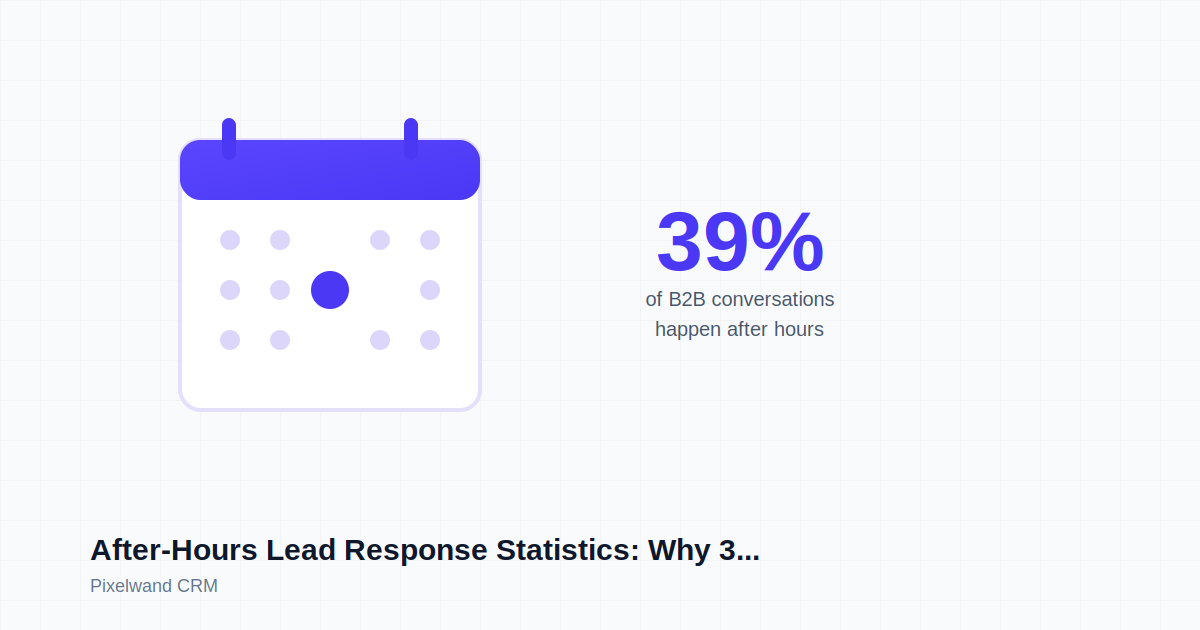
Here's the part most pipeline reviews miss entirely: the leads arriving after hours aren't a small edge case. Salesloft and Drift analyzed more than 30 million buyer conversations across Drift's customer base and found that while most conversations still happened during business hours, an additional 39% happened outside the normal 9-to-5 window. Even more striking, 41% of all meetings booked through those conversations were scheduled outside 9-to-5.
Buyers don't stop evaluating vendors when the workday ends. They research on the couch after dinner, they compare options on a Saturday morning, and they fill out a demo form the moment a Sunday-night planning session surfaces a real problem. If a sales team's routing, notifications, and staffing all assume a Monday-through-Friday, nine-to-five rhythm, then roughly two out of every five real buying moments arrive into a system that isn't actively watching for them.

Does the day of the week matter as much as the hour?
Speed isn't the only variable. The original MIT/InsideSales.com Lead Response Management Study, which examined three years of data across six companies and more than 15,000 leads, also tested whether the day a rep called mattered, independent of how fast they called. It did. Wednesdays and Thursdays were consistently the best days to reach and qualify leads. Thursday was 49.7% better than the worst day, Tuesday, for making contact, and Wednesday was 24.9% better than the worst day, Friday, for qualifying leads once contacted.
The detail that matters most for the after-hours conversation is what happened on Monday. The study found Monday was consistently poor across every single category it measured, for contact rates and for qualification rates alike. The researchers speculated this reflects buyers who quietly reconsidered or moved on over the weekend before anyone from sales ever called them back, plus reps working through a pile of stale leads instead of fresh ones. Either way, the worst day of the week to run a lead through your pipeline is the day right after the two days most teams treat as fully off.
Curious how this looks with your own pipeline?
15-minute walkthrough, no pressure, cancel anytime.
Where Pixelwand CRM fits in
The gap between "when buyers show up" and "when sales teams respond" is largely a systems problem, not an effort problem, and it's exactly the gap Pixelwand CRM is built to close. Pixelwand automatically unifies leads from calls, WhatsApp, web forms, and email into a single pipeline the moment they arrive, so a Saturday-night form fill or a late-evening WhatsApp message lands on the same record a rep sees Monday morning, instead of sitting buried in a separate inbox nobody checks over the weekend.
Native two-way WhatsApp Business API messaging means a lead who reaches out after hours can get an immediate acknowledgment attached directly to their deal record, not a generic autoresponder disconnected from the CRM. Click-to-call through Twilio lets whoever opens the pipeline first, whether that's early Monday or mid-Saturday, clear a backlog fast instead of hunting for phone numbers across tools. Slack notifications surface new leads and deal activity in real time, so an off-hours submission doesn't wait until someone happens to log in to the CRM to be noticed. And assignment rules plus custom statuses let teams flag anything that arrived outside business hours for priority follow-up first thing, rather than letting it get buried under fresher-looking Monday leads.
Quick answers
What percentage of B2B leads come in after business hours? Salesloft and Drift's analysis of more than 30 million buyer conversations found that 39% happened outside normal 9-to-5 business hours, and 41% of meetings booked through those conversations were scheduled outside 9-to-5 as well.
What is the best day of the week to follow up with a lead? The MIT/InsideSales.com Lead Response Management Study found Wednesday and Thursday are the strongest days for both contacting and qualifying leads. Thursday was 49.7% better than the worst day, Tuesday, for making contact, and Wednesday was 24.9% better than the worst day, Friday, for qualifying leads. Monday was consistently the weakest day across every category, likely reflecting a weekend backlog nobody triaged.
How much does response time really affect lead qualification? According to the Harvard Business Review study by Oldroyd, McElheran, and Elkington, companies that contacted leads within an hour were nearly 7 times more likely to qualify them than companies that waited even one hour longer, and more than 60 times more likely to qualify them than companies that waited 24 hours or more.
Does the weekend really hurt conversion, or is it just slower response? Both. The weekend problem is really two compounding problems: leads keep arriving (Salesloft and Drift found a large share of buyer activity happens outside standard hours), and response quality drops when there is no process for handling it, which lines up with why Monday shows up as the weakest day in the MIT/InsideSales.com data. It isn't that Saturday leads are worse leads, it's that they usually wait the longest.
Sources: Harvard Business Review, Salesloft, MIT Lead Response Management Study, RevenueHero
Lead nurturing statistics: nurtured leads make 47% larger purchases and convert 20% more often, yet 65% of marketers skip nurture programs.
Lead source conversion stats: referrals win 50-70% of opportunities versus 10-20% for cold outbound. Yet most CRMs can't show it.
CRM duplicate data statistics: 10 to 30% of records are duplicates, costing roughly 550 hours per rep a year. Here's why, and what fixes it.
Frequently asked questions
What percentage of B2B leads come in after business hours?
Salesloft and Drift's analysis of more than 30 million buyer conversations found that 39% happened outside normal 9-to-5 business hours, and 41% of meetings booked through those conversations were scheduled outside 9-to-5 as well. Buyers research on evenings and weekends far more than most sales processes assume.
What is the best day of the week to follow up with a lead?
The MIT/InsideSales.com Lead Response Management Study found Wednesday and Thursday are the strongest days for both contacting and qualifying leads. Thursday was 49.7% better than the worst day, Tuesday, for making contact, and Wednesday was 24.9% better than the worst day, Friday, for qualifying leads. Monday was consistently the weakest day across every category, likely reflecting a weekend backlog nobody triaged.
How much does response time really affect lead qualification?
According to the Harvard Business Review study by Oldroyd, McElheran, and Elkington, companies that contacted leads within an hour were nearly 7 times more likely to qualify them than companies that waited even one hour longer, and more than 60 times more likely to qualify them than companies that waited 24 hours or more.
Does the weekend really hurt conversion, or is it just slower response?
Both. The weekend problem is really two compounding problems: leads keep arriving (Salesloft and Drift found a large share of buyer activity happens outside standard hours), and response quality drops when there is no process for handling it, which lines up with why Monday shows up as the weakest day in the MIT/InsideSales.com data. It isn't that Saturday leads are worse leads, it's that they usually wait the longest.