CRM Data Quality: 76% of Teams Distrust Pipeline
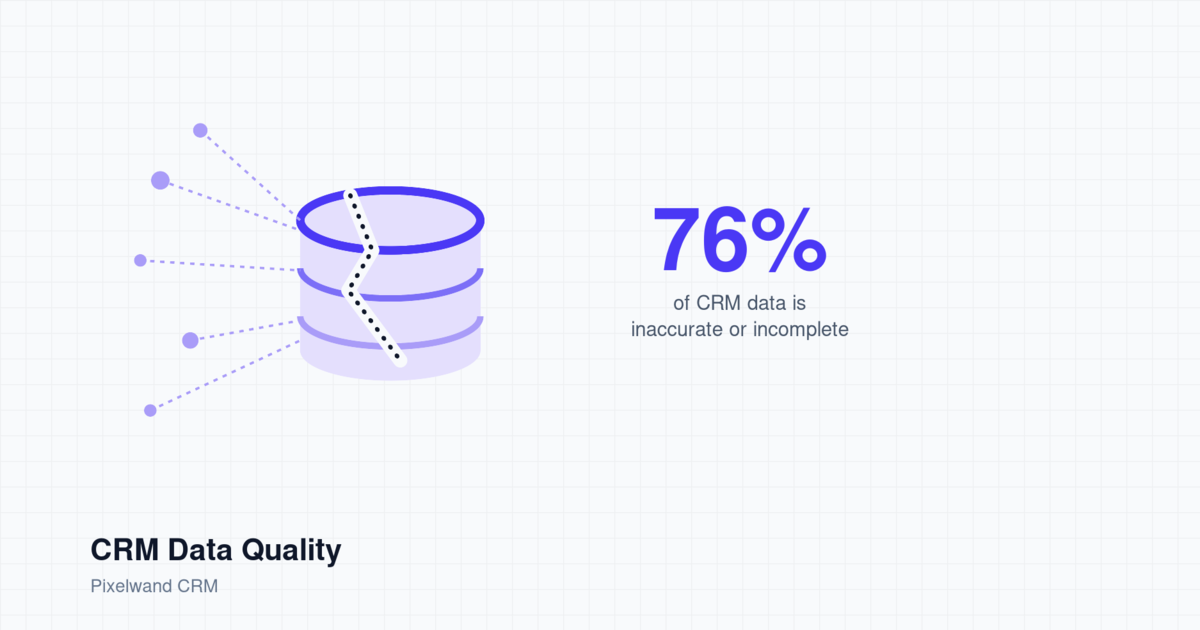
76% of companies say under half their CRM data is accurate, and 37% lost revenue because of it. Here's the real cause of bad CRM data, and what fixes it.
TL;DR: 76% of companies say less than half of their CRM data is accurate and complete, and 37% have lost revenue because of it, according to Validity's 2025 State of CRM Data Management report. The usual explanation, that reps are careless, misses the real cause: sellers juggle an average of 8 separate tools to close a deal, and every one of those tools is a place data can go stale or simply never arrive. Fixing pipeline accuracy means cutting the number of places a rep has to manually type something in, not adding another dashboard on top of the mess.
Every sales leader has opened their CRM pipeline, looked at a deal that hasn't moved in six weeks but is still marked "committed," and quietly stopped trusting the number on the screen. That instinct is backed by data. CRM data quality isn't a minor operational nuisance, it's a problem serious enough that more than a third of companies can point to actual lost revenue because of it.
How much of your CRM data is actually wrong?
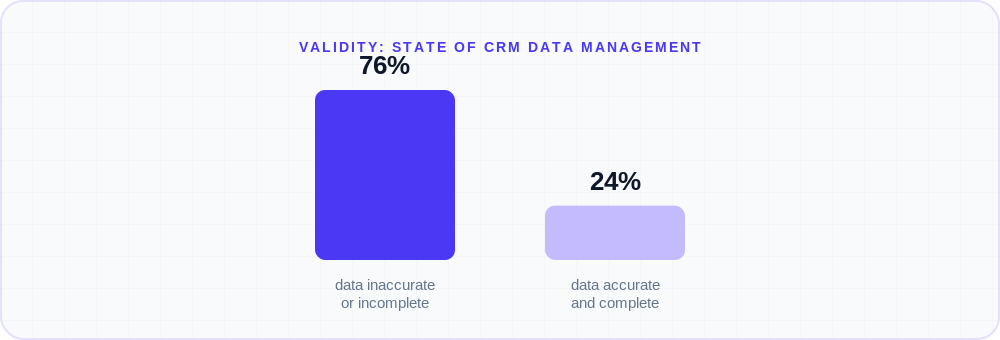
Validity's 2025 State of CRM Data Management report surveyed 602 CRM users and administrators across the US, UK, and Australia, and the headline number is stark: 76% said less than half of their organization's CRM data is accurate and complete. Not "some records need cleanup." Less than half of the whole database.
The downstream effect is just as concrete. 37% of CRM users in the same survey reported losing revenue as a direct consequence of poor data quality, whether that's a deal that stalled because nobody had the right contact info, a forecast that missed because half the pipeline was fiction, or a lead that got double-worked by two reps who couldn't see each other's notes.
There's also a timing problem layered on top. The Validity report found 29% of respondents at VP-level or above feel pressure to use AI as a replacement for high-stakes initiatives like hiring, even as their underlying CRM data isn't ready for it. Feeding an AI agent a pipeline that's half wrong doesn't produce a smarter forecast, it just produces a confidently wrong one, faster.
Why does this keep happening?
It's tempting to blame reps for sloppy data entry, but Salesforce's 2026 State of Sales report points somewhere else: tool sprawl. The report found that sellers use an average of 8 different tools to close a single deal, and 42% of sales reps say they feel overwhelmed by the number of tools they have to manage. That overwhelm isn't just uncomfortable, it's measurably expensive: reps who feel overwhelmed by their tech stack are 45% less likely to attain quota.
Think about what actually happens across a normal week for a rep working 8 tools. A lead comes in through a web form. A call happens on a separate telephony app. A follow-up gets sent from WhatsApp on a personal phone. A note gets typed into a spreadsheet because updating the CRM record felt like one more login. None of that is malicious or even particularly lazy, it's just friction. Every handoff between tools is a moment where the CRM record can either get updated by hand, or not.
Salesforce's same report quantifies how much of a rep's week that friction eats: reps spend 60% of their time on non-selling tasks, a category that includes exactly this kind of manual admin work. Sales leaders in the report also estimate that 19% of their company's data is inaccessible, trapped in whichever tool it landed in rather than living on the deal record where a rep actually needs it.

What actually fixes CRM data quality?
The intuitive fix, adding more process, a stricter data entry policy, a mandatory "update your CRM by Friday" reminder, mostly fails, because it's still asking a person to manually re-type something that already happened somewhere else. It treats a systems problem as a discipline problem.
The more durable fix is reducing how many separate places a rep has to touch to get through a single deal. If a call, a WhatsApp thread, and a follow-up email all land inside the CRM automatically the moment they happen, there's no re-entry step for the data to fall through. This is the practical reasoning behind bringing communication channels directly into the CRM's pipeline instead of stitching together a phone system, a WhatsApp client, and a spreadsheet as separate tools a rep has to remember to update. Fewer handoffs means fewer places for the record to quietly stop matching reality.
It's also worth building a simple, recurring habit on top of that: a short weekly pass where a manager or ops lead scans for deals that haven't had any activity logged in a while and either pushes them forward or marks them closed-lost. Automatic capture solves the "data never arrived" half of the problem; a regular review solves the "nobody ever cleaned this up" half.
Neither fix requires a data quality initiative or a new BI tool. Both are about shrinking the gap between when something happens with a lead and when it shows up, correctly, on the deal record.
Curious how this looks with your own pipeline?
15-minute walkthrough, no pressure, cancel anytime.
Why is manual sync the root of bad CRM data?
CRM data quality problems aren't really about reps being careless. They're a predictable outcome of asking a person to manually keep 8 different tools in sync with one source of truth. The Validity and Salesforce numbers above point at the same conclusion from two different angles: the more places a rep has to touch to close a deal, the less anyone can trust what the pipeline says. Teams that have fixed this didn't do it with a stricter data entry policy. They did it by cutting down the number of places data had to travel through by hand in the first place, whether that's consolidating integrations or simply making sure calls and messages land on the deal automatically.
If you want to see how that looks for WhatsApp and calling specifically, Pixelwand's team can walk through it live.
Sources:
Demo to close rate statistics show just 15-20% of B2B sales demos become closed deals, and enterprise conversion runs as low as 5%.
CRM duplicate data statistics: 10 to 30% of records are duplicates, costing roughly 550 hours per rep a year. Here's why, and what fixes it.
Closed-lost leads statistics: up to 80% of prospects marked dead still buy within 18-24 months, often from a competitor who stayed in touch.
Frequently asked questions
How much CRM data is actually accurate?
According to Validity's 2025 State of CRM Data Management report, 76% of organizations say less than half of their CRM data is accurate and complete, based on a survey of 602 CRM users and administrators.
What does bad CRM data actually cost a sales team?
37% of CRM users report losing revenue as a direct result of poor data quality, per the same Validity report. Salesforce's 2026 State of Sales report adds that reps spend 60% of their time on non-selling tasks, much of it manual admin work caused by fragmented tools.
Why does CRM data become inaccurate in the first place?
Mostly tool sprawl. Salesforce found sellers use an average of 8 separate tools to close a single deal, and 42% feel overwhelmed managing them. Every extra tool is another place a call, message, or note can happen without ever making it back into the CRM record.
How can a sales team improve CRM data quality?
The most durable fix is reducing how much data reps have to type in by hand: capture calls, WhatsApp messages, and form fills automatically into the CRM record instead of relying on reps to remember to log them in a separate app.