Demo to Close Rate Statistics: Why 80% Don't Convert
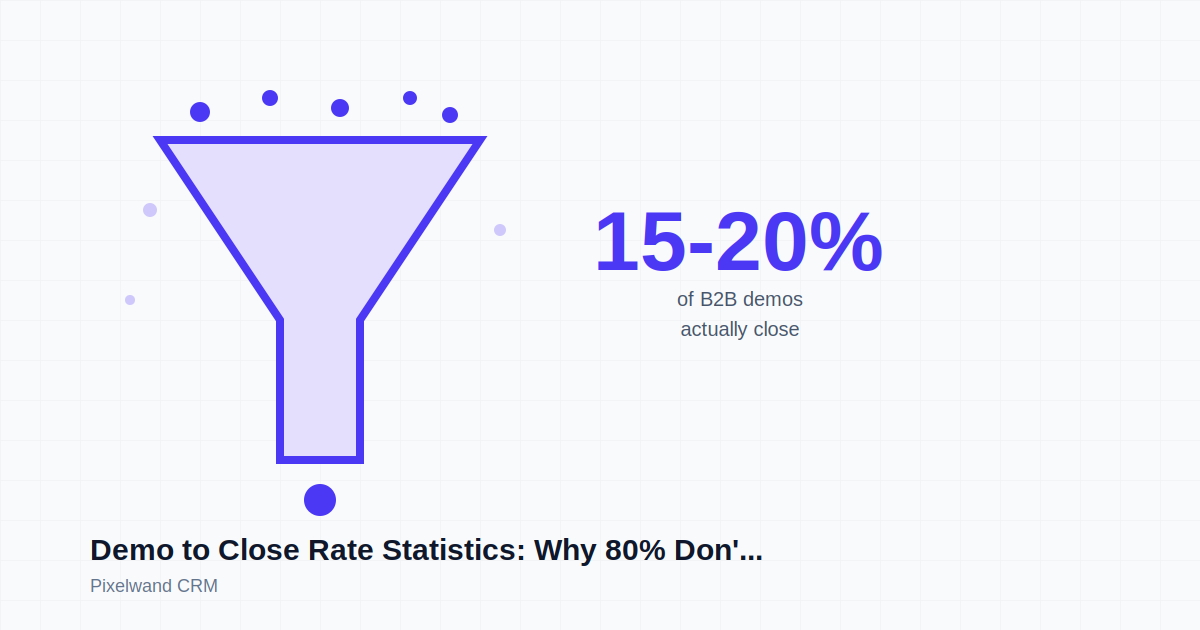
Demo to close rate statistics show just 15-20% of B2B sales demos become closed deals, and enterprise conversion runs as low as 5%.
TL;DR: Demo to close rate statistics from multiple B2B SaaS benchmark studies land in the same rough neighborhood: only 15% to 20% of completed sales demos turn into a closed deal, which means roughly 80% of demos your team runs this quarter won't convert. The ratio gets meaningfully worse as deal size grows, enterprise demos close at just 5-15% versus 15-25% for low-touch SMB deals, and industry-wide the rate has been sliding by an estimated 5 to 10 percentage points year over year as buying committees expand and pipelines get harder to qualify.
What Is a Good Demo to Close Rate in B2B Sales?
A good demo to close rate for most B2B SaaS companies sits between 15% and 20%, which works out to roughly one closed deal for every four to six completed demos. That benchmark comes from Walnut's SaaS sales research, which frames the industry-standard ratio as "1 closed deal for every 4-6 demos", or about 15-20% conversion from demo to close.
Not every source agrees on where "good" ends. Daydream's B2B SaaS benchmark work suggests companies should aim for a demo-to-close rate of 20-30%, a meaningfully higher bar than Walnut's number. The gap mostly comes down to definitions: a 20-30% target usually assumes demos only get booked after a real qualification step (a discovery call, a defined use case, a confirmed budget conversation), while the 15-20% average blends in a lot of unqualified or curiosity-driven demos that were never going to close. That distinction matters more than the raw percentage. A team that books fewer, better-qualified demos will often report a higher rate on paper while closing the same number of deals as a team running twice as many demos.
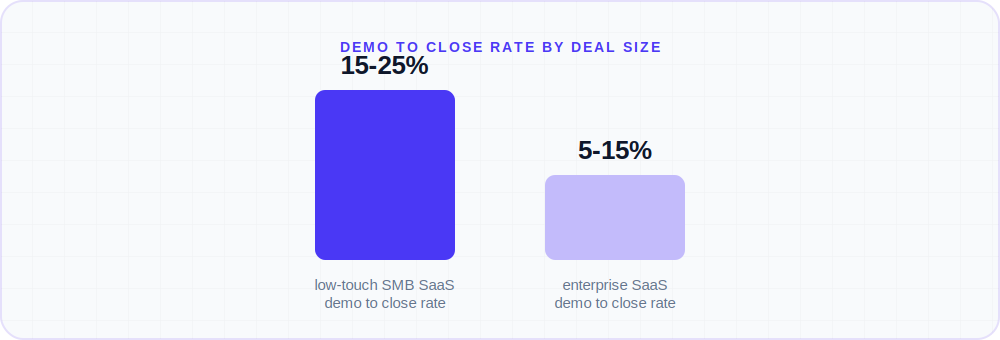
Deal size complicates the picture further. Research compiled by getmonetizely breaks demo conversion down by average contract value: low-touch SaaS in the $0-5k ACV range converts 15-25% of demos, mid-market SaaS ($5k-25k ACV) converts 10-20%, and enterprise SaaS ($25k+ ACV) converts only 5-15%. The pattern is consistent across nearly every benchmark source: the bigger the deal, the lower the single-demo close rate, because bigger deals almost never close off one meeting.
How Many Demos Does It Take to Close One Deal?
For a typical SaaS sales rep, it takes about four to six completed demos to close a single deal, a ratio that holds fairly steady across the sources that publish it. That number is really just the inverse of the 15-20% benchmark rate: if one in five to one in six demos converts, you need that many at-bats to land one signature.
Where the funnel actually leaks matters more than the final number. Data compiled by Zenitdata shows demo-to-opportunity conversion, meaning a demo that produces a real, qualified opportunity rather than going cold, runs 60-80% for average performers and above 90% for elite teams. That's a much narrower gap than the demo-to-close numbers suggest. In other words, most teams are reasonably good at turning a demo into a live opportunity. The real bleeding happens after that, in the opportunity-to-close stage, where enterprise deals close at roughly 31% compared with 39% for SMB deals, according to the same Zenitdata analysis. If your demo to close rate looks weak, the fix is rarely "book more demos." It's almost always what happens in the weeks after the demo, not the demo itself.
A separate lens on the same problem comes from win-rate-by-ACV data cited by Prospeo, drawn from the Optifai Pipeline Study of 939 B2B SaaS companies: SMB deals under $10k ACV win at a 28-35% rate with a median of 31%, while enterprise deals over $100k ACV win at just 12-18% with a median of 15%. Stack that against sales cycle length and the math gets uncomfortable fast: an enterprise rep needs a much larger raw pipeline to hit the same revenue number as an SMB rep, purely because each individual demo and each individual opportunity is less likely to convert.
Why Does Demo to Close Rate Differ by Deal Size?
Demo to close rate drops as deal size rises mainly because bigger purchases involve more people, more internal approval steps, and longer procurement cycles, all of which give a deal more places to stall after a strong demo. A single great demo rarely survives contact with a six-person buying committee untouched.
This is also why the same demo performance can look completely different depending on which stage you measure. A rep can deliver a flawless product walkthrough, get visible enthusiasm from the room, and still watch the deal drift for months while security review, legal, and finance each take a pass. None of that shows up as a "bad demo," but it absolutely shows up as a low demo to close rate if you're tracking from first demo to signed contract. Teams selling into enterprise accounts generally need a longer, multi-touch sequence after the demo, structured follow-up emails, a second technical demo for a different stakeholder, calendar-synced check-ins, rather than expecting the first meeting to do the closing work. Tools that keep every touch after the demo visible on one deal record, instead of scattered across a rep's personal inbox and calendar, make that stretch far easier to manage. Pixelwand's unified pipeline pulls calls, emails, and WhatsApp messages onto the same deal so nothing sent after a demo gets lost in a side channel.
Curious how this looks with your own pipeline?
15-minute walkthrough, no pressure, cancel anytime.
Why Are Demo to Close Rates Declining Industry-Wide?
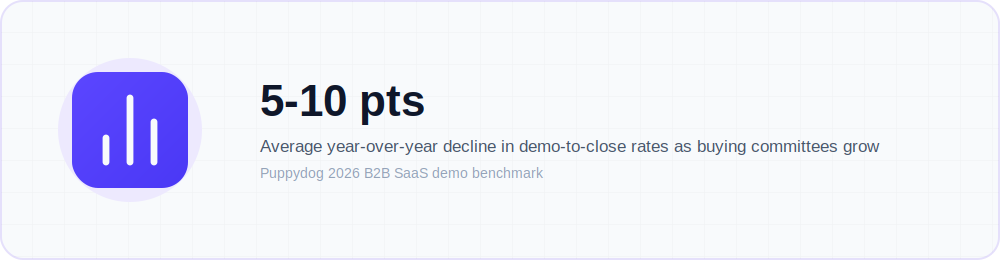
Demo to close rates have been slipping across the B2B SaaS industry, with some benchmark analysis pointing to a 5 to 10 percentage point year-over-year decline. The most-cited driver is consensus drag: bigger buying groups need more internal alignment before anyone signs, so even a great demo has more places to lose momentum on the way to a decision.
Puppydog's 2026 B2B SaaS benchmark work ties this decline directly to expanding buying committees and rising buyer caution, noting that the trend has pushed demo-to-close rates down across the board rather than in any one segment. That lines up with what shows up anecdotally in most CRMs: deals that used to move from demo to signature in a few weeks now sit in a "let me check with my team" holding pattern for months. The demo itself hasn't gotten worse. The number of people who have to say yes has gone up.
What's Actually Killing Your Demo to Close Rate?
The most common causes of a weak demo to close rate are poor pre-demo qualification, single-threaded deals with no internal champion, and stale CRM data that leaves reps walking into meetings without full context. Each of these inflates the number of demos you run without adding deals you can actually win.
Puppydog's benchmark diagnostics call out weak qualification specifically: when SDRs get rewarded for meeting volume instead of meeting quality, unqualified leads flood the calendar, which drags the close rate down even if the reps themselves are performing well. The same source flags single-threading, one contact carrying the entire deal internally, as a reliable predictor that a demo will stall rather than convert, since that one champion often can't answer every objection raised by finance, security, or a skeptical VP who wasn't in the room. And stale CRM data compounds both problems: a rep who doesn't know a prospect already evaluated a competitor, or already had a budget conversation with a different stakeholder, ends up re-covering ground in the demo instead of pushing the deal forward.
A tighter qualification bar before a demo gets booked, better visibility into who else is involved in a deal, and CRM records that stay current between touches are the three levers that show up again and again across this research. None of them require a better slide deck. They require better information flowing to the rep before they open their mouth.
Where Pixelwand CRM fits in
Fixing a weak demo to close rate is mostly an information problem, not a pitch problem, and that's exactly where a CRM earns its keep. Pixelwand automatically unifies leads and deals from calls, WhatsApp, web forms, and email into one pipeline, so a rep prepping for a second or third meeting with an enterprise buying committee can see every prior touch on the deal record instead of digging through a personal inbox. Native two-way WhatsApp messaging and Gmail/Outlook sync mean follow-up threads after a demo get logged automatically rather than living in a rep's head, which directly attacks the "stale CRM data" problem that benchmark research flags as a top cause of stalled deals. Google Calendar sync with meeting-prep summaries gives reps the context they need walking into a second demo with a different stakeholder, and custom fields and statuses let a team track exactly where a deal sits between "demo complete" and "closed," instead of lumping every post-demo deal into one vague stage. Teams weighing CRM options for exactly this kind of visibility, or checking current pricing before rolling it out to a full sales team, can see how the pipeline view maps to a real post-demo follow-up process.
Quick answers
A good rate is 15 to 20%. That is roughly one closed deal per four to six demos, higher for qualified inbound and lower for enterprise.
Qualification moves the number most. Weak pre-demo filters, single-threaded deals, and stale CRM data drag the rate down.
Fix post-demo follow-up first. Most leakage happens in the weeks after the demo, not in the meeting itself.
*Sources: Walnut, getmonetizely, Daydream, Zenitdata, Prospeo, Puppydog
Proposal win rate stats: winners sign within two days and close at 36% with process versus a 20% average, yet most pipelines still stall.
Closed-lost leads statistics: up to 80% of prospects marked dead still buy within 18-24 months, often from a competitor who stayed in touch.
Average sales cycle length statistics: the median B2B deal takes 84 days, up 22% since 2022, and deal size explains only 27% of the variance.
Frequently asked questions
What is a good demo to close rate?
Most B2B SaaS benchmarks put a good demo to close rate between 15% and 20%, meaning about one in five completed demos ends in a closed deal. Some sources put the healthy range as high as 20-30% for well-qualified, inbound-sourced demos.
How many demos does it take to close one deal?
On average, B2B SaaS reps need four to six completed demos to close a single deal, according to Walnut's benchmark data. That ratio gets worse for enterprise deals and better for tightly qualified, inbound-sourced pipeline.
Why is my demo to close rate lower than the benchmark?
Low demo to close rates usually trace back to weak pre-demo qualification, single-threaded deals with no internal champion, and stale CRM data that leaves reps unprepared. Fixing qualification criteria before booking a demo is the highest-leverage fix.
Does demo to close rate differ between SMB and enterprise deals?
Yes. Low-touch, SMB-focused SaaS companies see demo to close rates of 15-25%, while enterprise SaaS with $25k+ ACV typically converts only 5-15% of demos, reflecting longer cycles and more stakeholders in the buying decision.