WhatsApp for Sales: 98% Open Rates Change Response
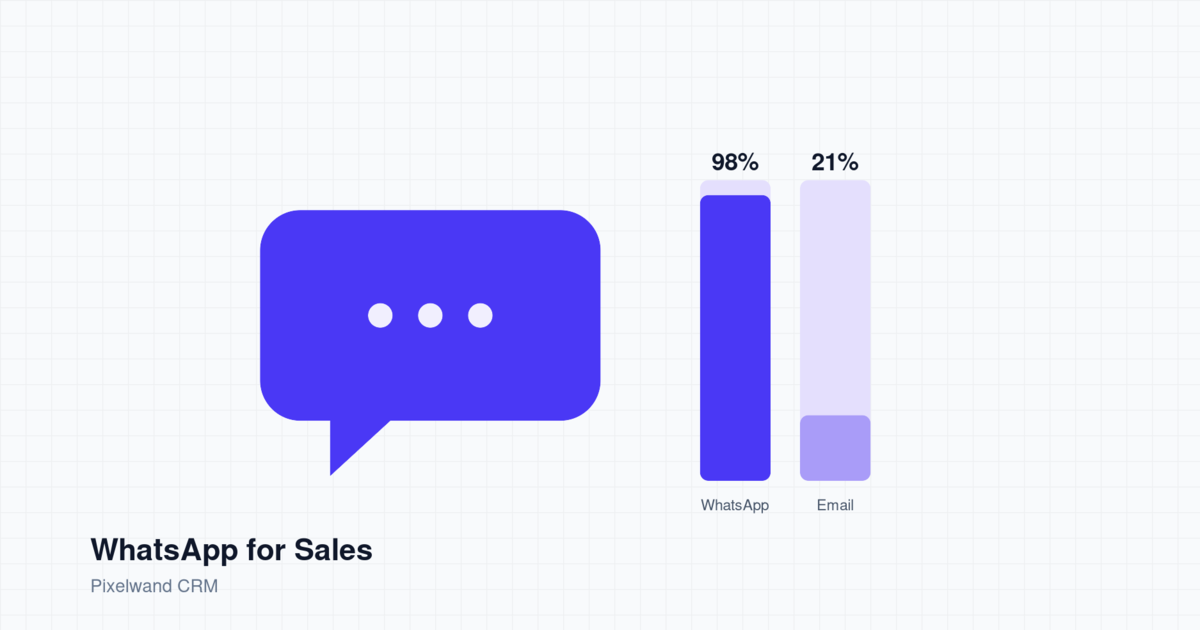
WhatsApp messages open 98% of the time versus 20-25% for email, and get read within 90 seconds. Here's how sales teams use it.
TL;DR: WhatsApp messages get opened 95 to 98 percent of the time and read within 45 to 90 seconds, compared to a 20 to 25 percent open rate and multi-hour response time for email. For sales teams competing on speed to lead, that gap alone is a reason to move at least the first response into WhatsApp rather than an inbox.
Email still has a role in sales, especially for long B2B cycles that need a paper trail and a place for detailed proposals. But if the question is simply "will this message get seen," WhatsApp isn't close.
How big is the WhatsApp vs email gap?
The numbers here are unusually consistent across independent studies:
- WhatsApp open rates sit at 95 to 98 percent, against 20 to 25 percent for email.
- Messages are typically read within 45 to 90 seconds, compared to 6 or more hours for the average email.
- WhatsApp click-through rates range from 15 to 60 percent depending on the type of message, versus 2 to 6 percent for email.
- 28 percent of B2B salespeople in emerging markets already treat WhatsApp as their primary channel with prospects, not a side channel.
None of this means email is obsolete. It means the channel you use for the first response to a hot lead matters, and right now most teams are defaulting to the slower one out of habit rather than choice.

Where does WhatsApp win in your sales process?
The first response to a new lead. Combined with a fast speed-to-lead process, WhatsApp gives a rep a channel where the message is almost certainly going to be seen in minutes, not sitting unread in a promotions tab.
Quick scheduling and reminders. "Are we still good for 3pm?" gets answered on WhatsApp in a way it often doesn't over email, simply because people check it more often and reply faster out of habit.
Follow-ups after a call. A short WhatsApp recap with a next step keeps momentum going without waiting for someone to open their inbox.
Where email still holds up better: long-form proposals, anything that needs a formal record, and slower-moving enterprise cycles where a message every few days is appropriate rather than an intrusion.
Curious how this looks with your own pipeline?
15-minute walkthrough, no pressure, cancel anytime.
Why WhatsApp inside a CRM beats WhatsApp on its own?
Using WhatsApp Business on a phone, separate from the CRM, creates the same problem speed-to-lead automation is supposed to fix: the conversation lives somewhere the rest of the team can't see it. If a rep is out sick or a lead gets reassigned, the entire message history has to be manually forwarded or is simply lost.
A CRM with native WhatsApp integration keeps every message attached to the lead or deal record, alongside calls, emails, and notes, so any rep can pick up a conversation with full context instead of starting over.

How do you get WhatsApp compliance right?
WhatsApp for sales only works if it's set up properly, and a few teams get this wrong in ways that cost them the channel entirely.
Use the WhatsApp Business API, not a personal number. Messaging prospects from a personal WhatsApp account is fragile: it doesn't scale past one phone, there's no shared history, and mixing personal and business messages on one number is against WhatsApp's own terms. The Business API is built for exactly this, and it's what most CRM integrations connect to.
Get consent before the first message. A lead who filled out a form and gave a phone number has usually opted into contact, but cold outreach to a number you scraped or bought is a fast way to get a business account flagged or banned. WhatsApp actively monitors for unsolicited bulk messaging.
Keep templates approved and conversational. WhatsApp requires pre-approved templates for the first message in a 24-hour window with a customer, then allows free-form replies after that. Reps who understand this distinction avoid messages getting blocked, and conversations read like a person wrote them rather than a script.
Teams that skip these steps tend to see WhatsApp get restricted within weeks. Teams that treat it as seriously as email deliverability keep the channel working long-term, and that's usually the difference between a CRM integration that gets used every day and one that gets abandoned after a bad first month.
Where Pixelwand CRM fits in
Pixelwand CRM has WhatsApp built directly into the lead and deal pages, alongside Twilio calling, so a rep can send a WhatsApp message from the same screen where they're tracking the rest of the relationship. Nothing lives in a separate app that the rest of the team can't see.
If your team is still managing WhatsApp conversations outside the CRM, it's worth seeing what it looks like when it's all in one place.
Sources: Zixflow, D7 Networks, Searchlab, Martal.
Add a floating WhatsApp click-to-chat button with a number and opening message, then copy the generated snippet into your website.
Improve website lead capture with a focused WhatsApp click-to-chat flow, clear prompts, ownership rules, and a fast follow-up handoff.
Most companies take 29 hours to respond to a lead, while 5-minute replies are 21x more likely to qualify it. Here's how to fix it.
Frequently asked questions
What is the open rate for WhatsApp Business messages?
WhatsApp Business messages see open rates of 95 to 98 percent, compared to roughly 20 to 25 percent for email. Most messages are also read within 45 to 90 seconds, versus several hours for a typical email.
Is WhatsApp good for B2B sales, not just consumer messaging?
Yes. Around 28 percent of B2B salespeople in emerging markets already use WhatsApp as their primary channel with prospects, and it works well for fast, high-intent moments like lead response, scheduling, and follow-ups, alongside email for longer nurture sequences.
How do I add WhatsApp to my CRM instead of using it separately?
Look for a CRM with native WhatsApp Business API integration, so messages appear directly on the lead or deal record instead of a separate app. This keeps the conversation history attached to the deal and lets any rep pick it up with full context.