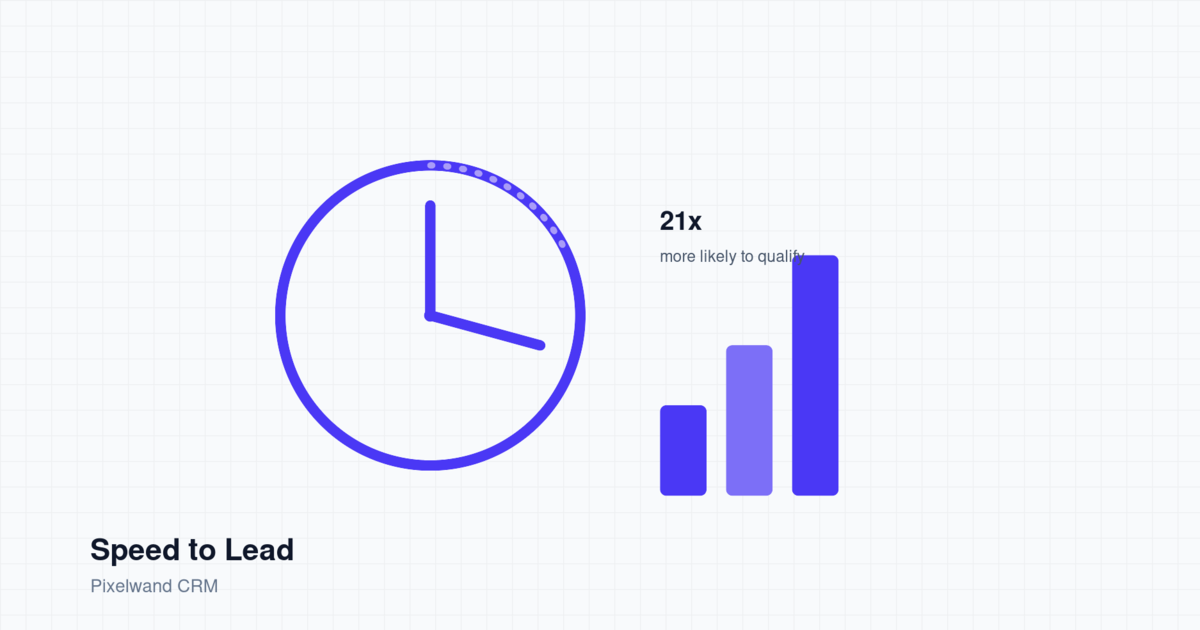
Speed to Lead: 5-Minute Replies Qualify 21x More
Most companies take 29 hours to respond to a lead, while 5-minute replies are 21x more likely to qualify it. Here's how to fix it.
TL;DR: Speed to lead, meaning how fast you respond to a new lead, is one of the strongest predictors of whether it converts. The average company takes 29 hours to respond, while leads contacted within 5 minutes are 21x more likely to qualify than those contacted after 30 minutes. Most of the gap comes from systems, not effort: leads scattered across channels, manual routing, and no visibility into response time as a metric.
If you had to pick one number that predicts whether a lead turns into revenue, it wouldn't be lead score, deal size, or even the channel it came from. It would be speed to lead, the time between a prospect raising their hand and a human actually responding.
Most sales teams get this badly wrong, and the gap between "badly wrong" and "excellent" is worth more pipeline than almost any other fix on this list.
What speed to lead actually measures?
Speed to lead is the elapsed time from when a lead is created (a form fill, a WhatsApp message, an inbound call, a demo request) to the first meaningful response from your team. Not an autoresponder. Not a "thanks, we'll be in touch" email. A real reply from a real rep.
It matters because interest decays fast. A prospect who just filled out a pricing form is comparing you to two or three competitors in the same browser tab. Whoever replies first usually wins the mental real estate, if not the deal outright.
Curious how this looks with your own pipeline?
15-minute walkthrough, no pressure, cancel anytime.
How bad are speed-to-lead numbers really?
The research on this is consistent and, frankly, a little alarming:
- 78% of customers buy from whichever company responds first, not the cheapest, not the best product on paper, the fastest.
- The average company takes 29 hours to respond to a new lead. Only 4.7% of companies hit the 5-minute window that's widely considered the gold standard.
- 63.5% of companies never respond to a lead at all, and 81% of slow responders lose the lead entirely.
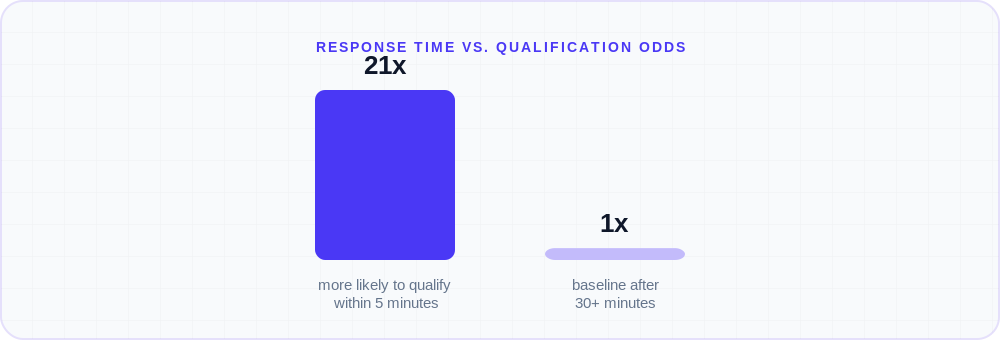
- Leads contacted within 5 minutes are 21x more likely to qualify than leads contacted after 30 minutes.
- Teams that respond within the first hour are 7x more likely to have a meaningful conversation with the actual decision-maker.
Put together, that means most of the industry is sitting on a 29-hour average while the leads that convert are the ones answered in single-digit minutes. That's not a small optimization. It's the difference between a pipeline that fills itself and one that leaks from the top.
Why teams miss the window even when they want to hit it?
It's rarely a motivation problem. It's a systems problem. A few patterns show up over and over:
Leads land in the wrong place first. A WhatsApp message, a missed call, and a web form all need to become the same object, a lead in the CRM, within seconds, not after someone manually checks four different inboxes.
Routing is manual. If a lead has to sit in a shared inbox until someone "gets to it," you've already lost the 5-minute window before a human even looks at it.
Reps spend more time on admin than on selling. Industry data puts the number as low as 30% of an SDR's day spent actually selling. The other 70% goes to CRM data entry, internal meetings, and chasing down context on a lead before they can even respond intelligently.
There's no visibility into response time as a metric. Most CRMs will tell you deal value, stage, and close rate. Very few surface "how long did this lead sit before first contact" as a number your team is actually managed against.

How to actually close the gap?
- Capture every channel into one pipeline automatically. Calls, WhatsApp, web forms, and email enquiries should all create a lead in your CRM the moment they happen, not after someone remembers to log it.
- Route the instant a lead is created, not on a schedule. Round-robin or skill-based routing that fires immediately beats any manual triage queue.
- Make the first response one click, not one search. If a rep has to go find the lead's context before replying, you've added minutes you don't have. Click-to-call and WhatsApp reply from directly inside the lead record removes that friction.
- Track speed to lead as a team metric, the same way you'd track close rate. What gets measured gets improved, and teams that put a dashboard on this number consistently see it drop within weeks.
- Use automation for the first touch, not to replace the human one. An instant acknowledgment buys you time. It doesn't replace the real conversation that needs to happen within minutes, not hours.
Where Pixelwand CRM fits in
This is the exact problem Pixelwand CRM was built around. Calls, WhatsApp messages, and web leads land in the same pipeline the moment they come in, and built-in Twilio calling means reps can respond without leaving the lead record.
Every deal also shows exactly how long it's been sitting since last contact, so slow responses are visible before they become lost deals, not after.
If speed to lead is a number your team has never actually measured, that's usually the first sign it's worse than you'd guess.
Sources: Apten, RevenueHero, LeadAngel, Demand Local.
A practical lead management workflow for agencies: capture, qualify, assign, follow up and report, with setup tips for any CRM.
Build an email list cleaning workflow that combines verification, consent, suppression, segmentation, and a downloadable audit report.
After-hours lead response stats: 39% of B2B conversations happen outside 9-to-5, yet slow replies cut qualification odds by up to 60x.
Frequently asked questions
What is speed to lead?
Speed to lead is the elapsed time between a prospect creating a new lead, such as a form fill, WhatsApp message, inbound call, or demo request, and a real, human response from your team. It excludes autoresponders and generic acknowledgment emails.
What is a good speed-to-lead benchmark?
Under 5 minutes is considered the gold standard. Leads contacted within 5 minutes are 21x more likely to qualify than those contacted after 30 minutes. In practice, the average company takes about 29 hours, and only 4.7% of companies hit the 5-minute window.
How can a CRM improve speed to lead?
By capturing every channel (calls, WhatsApp, web forms, email) into one pipeline automatically, routing new leads to a rep the instant they're created, surfacing lead context in one click instead of requiring manual lookup, and tracking response time as a visible team metric.