Follow-Up Cliff: 92% of Reps Quit Before the Close
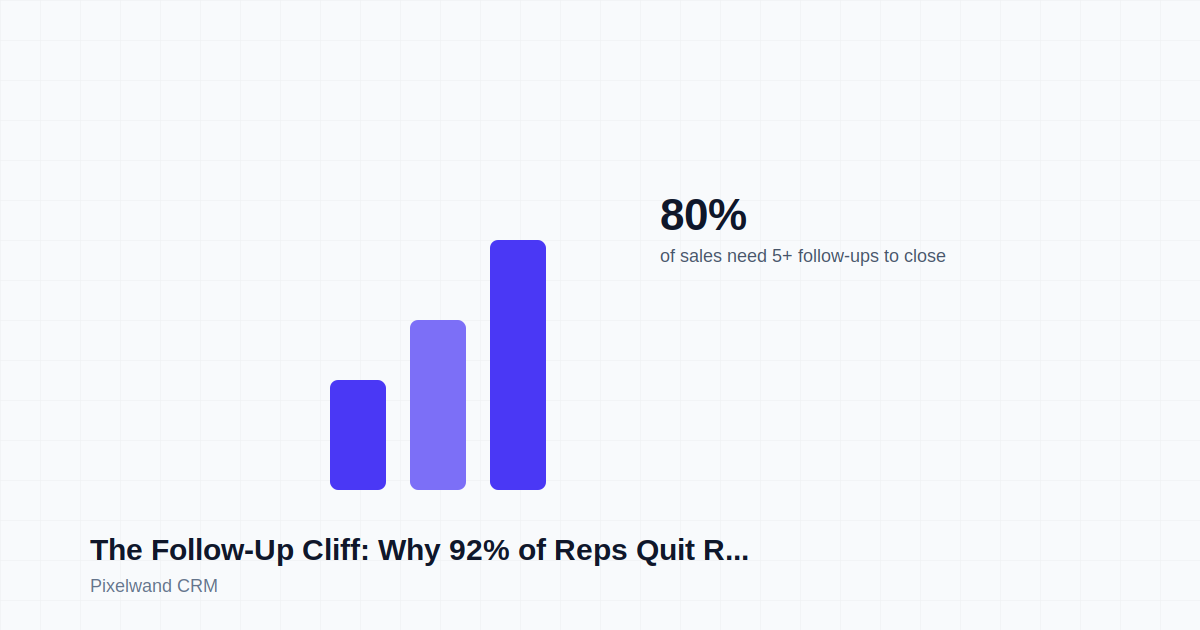
80% of sales need five or more follow-ups, yet 92% of reps give up after four. Here's the persistence gap and how automation closes it.
TL;DR: Roughly 80% of sales require five or more follow-ups to close, but 44% of salespeople give up after just one attempt and 94% have quit entirely by the fourth. Nearly half of all reps (48%) never even try a second touch. The gap between what closing actually requires and what reps actually do is not a talent problem, it is a systems problem, and it is exactly the kind of gap a CRM with automated reminders, unified channels, and assignment rules is built to close.
Why do 44% of reps quit after one follow-up?
The data on sales follow-up behavior tells a strikingly consistent story across more than a decade of research. A study by Brevet found that 80% of sales require an average of five follow-ups in order to close the deal, yet 44% of sales reps follow up with a prospect only once before giving up. Push the timeline out one more step and the picture gets worse: after four follow-ups, 94% of salespeople have given up.
That means the overwhelming majority of the sales force stops trying at almost exactly the point where the data says most deals actually get won. It is not a small minority missing the mark, it is the norm. The original articulation of the persistence principle holds that only about 2% of sales happen at a first meeting, roughly 80% of non-routine sales require at least five follow-ups, and only about 20% of leads are ever followed up at all.
The abandonment does not even wait for a second contact. Nearly half of all salespeople, 48%, never make any follow-up attempts at all. And rejection compounds the problem: 60% of customers reject an offer four times before buying, which means a huge share of "lost" deals were never actually lost, they were just abandoned one or two touches too early. Persistence beyond that point is rare enough to be a genuine differentiator: just 12% of salespeople demonstrate persistence by making three or more follow-ups.

Why reps stop when the data says keep going?
The most common explanation is not laziness, it is a misread signal. Reps interpret silence as rejection when it is usually something far more mundane. The number one reason a prospect will not get back to you is not that they are uninterested, it is that they are busy, with decision makers juggling a lot of conflicting priorities and demands on their time. A rep working from memory and a messy inbox has no way to distinguish "busy and still interested" from "not interested," so the safer emotional choice, stopping, wins by default.
There is also a structural reason this keeps happening at scale. Sales organizations have historically treated follow-up cadence as a matter of individual discipline rather than as a process to be engineered and tracked. Without a system logging every touch and prompting the next one, the fifth follow-up simply never gets remembered, let alone attempted.
Curious how this looks with your own pipeline?
15-minute walkthrough, no pressure, cancel anytime.
What the persistence gap actually costs?
Run the numbers and the revenue implication is significant. If 80% of eventual sales require five-plus touches, and the large majority of reps stop well before touch five, then a meaningful share of a company's addressable pipeline is being abandoned mid-conversation, not lost to a competitor or a genuine no. The prospects were never converted to "closed lost" in any real sense, they were simply never followed up with again.
This is also where CRM data quality and follow-up persistence intersect. A rep cannot reliably execute a five-touch cadence across dozens of open deals using memory and sticky notes. The problem scales with pipeline size: the more leads a rep juggles, the more the fourth and fifth touches quietly fall through the cracks, and the harder it becomes to even know how many deals died from neglect versus a genuine no.

Can automation close the persistence gap?
The fix is not asking reps to try harder, it is removing the dependency on memory entirely. According to Martal, 80% of B2B deals require five or more follow-ups to close, yet 92% of reps stop after four or fewer attempts. The systems argument backs this up in hard hours: data from Freshworks shows businesses leveraging CRM systems find it saves employees 5 to 10 hours per week and shortens the average sales cycle by 8 to 14 days.
That time savings matters because the underlying capacity problem is real. Sales reps are already stretched thin across non-selling work. Reps spend just 28% of their week actually selling, with the majority of their time consumed by other tasks like deal management and data entry, according to Salesforce's State of Sales research. Every minute spent manually tracking who needs a fifth follow-up call is a minute not spent on the call itself. Automated cadence reminders do not add more work to a rep's plate, they take the tracking burden off it, freeing capacity for the actual conversation.
Where Pixelwand CRM fits in
Pixelwand CRM is built around the idea that follow-up persistence should be a property of the system, not a test of a rep's memory. Every lead and deal, whether it arrives through a call, WhatsApp, a web form, or email, lands automatically in one pipeline record instead of scattered across inboxes and notebooks where the fourth touch quietly disappears.
Custom statuses and assignment rules mean a stalled deal does not just sit silently, it can trigger a Slack notification the moment it has gone quiet, prompting the next touch before it crosses into "give up" territory. Gmail and Outlook sync auto-logs every email thread directly on the record, so a rep (or their manager) can see at a glance exactly how many follow-ups have actually gone out, not how many the rep thinks they sent. Native two-way WhatsApp messaging and click-to-call via Twilio let reps execute that fifth or sixth touch on whichever channel the prospect actually responds to, without leaving the deal record to switch apps. Custom list actions and saved views also make it simple to build a working list of every deal sitting at two or three touches, the exact segment the data says is most likely to still close if someone just follows up one more time.
If your pipeline is quietly losing deals to abandoned follow-up rather than genuine rejection, it is worth seeing what a unified, automated cadence looks like in practice, one that keeps every deal on a real follow-up schedule.
Sources: HubSpot, The Brevet Group, Invesp, Cirrus Insight, Apollo, Salesforce
Rep turnover stats: reps leave at 35% a year, nearly triple the average, and each departure can cost $115,000 to $150,000 in pipeline.
Quota attainment stats: average B2B reps hit just 42.69% of quota in 2025, down from 53% in 2022. Here's what moves the number.
Demo to close rate statistics show just 15-20% of B2B sales demos become closed deals, and enterprise conversion runs as low as 5%.
Frequently asked questions
How many follow-ups does it actually take to close a B2B sale?
Research from The Brevet Group found that 80% of sales require an average of five follow-ups to close, while most sales professionals give up on a prospect after just one or two attempts. The exact number varies by deal complexity and buyer seniority, but the pattern holds across studies: closing takes persistence well beyond the first no-response.
Why do so many salespeople stop following up so early?
Fear of seeming pushy is the most cited reason, but the more common explanation is far simpler. HubSpot's research notes that when a prospect does not respond, it is usually not disinterest, it is because they are busy and juggling competing priorities, not a hard no.
What percentage of leads never get a single follow-up at all?
According to Invesp's research on sales follow-up behavior, 48% of salespeople never attempt a follow-up after the initial interaction, meaning nearly half of all leads are abandoned before persistence even becomes a factor.
Can CRM automation actually fix the follow-up gap?
Data cited by Apollo shows that businesses using CRM systems save employees 5 to 10 hours per week and shorten the average sales cycle by 8 to 14 days. Automated reminders and multi-channel logging do not replace the rep's judgment, they just make sure the fourth and fifth touch happen at all.