Meeting No-Shows: Up to 40% of Demos Never Happen
Meeting no-show stats: demos average 20-40% no-shows, but next-day bookings drop that under 10%, a fixable, high-ROI pipeline leak.
TL;DR: Real benchmark data puts the average sales meeting no-show rate somewhere between 20% and 40%, though it varies wildly by industry, from under 2% in healthcare and developer tools to over 15% in real estate and education. The single biggest lever isn't charisma or persistence, it's booking delay: demos scheduled 8+ days out no-show at roughly 23%, versus 9.6% for next-day meetings. Fixing the gap between "meeting booked" and "meeting held" is one of the cheapest ways to grow pipeline without spending another dollar on lead generation.
Why does the average no-show rate mislead?
Ask five sales leaders what a "normal" no-show rate looks like and you'll get five different answers, and all of them are technically right. Demodesk pegs the typical range at 20-30% for sales meetings, with best-in-class B2B teams getting as low as 2%. Meera.ai and Chili Piper both put the common range at 20-35%, and Concept LTD's appointment-setting data lands right in the middle, noting that the average B2B no-show rate hovers around 30%, meaning nearly one-third of scheduled meetings simply never happen. Walnut's analysis adds an important nuance: enterprise deals with longer sales cycles tend to have lower no-show rates, while high-velocity SMB sales often see higher ones, because the buyer's urgency and vetting process are so different.
The most granular data comes from RevenueHero, which analyzed 6,428 meetings across 15 industries and found an overall no-show rate of 6.5%, but that headline number masks enormous spread. Healthcare came in at 0%, Developer Tools at 1.2%, IT & Security at 1.8%, and Data & Analytics at 2.8%. On the other end, Real Estate hit 15.1% and Education/E-Learning hit 18.1%. The pattern is consistent across the dataset: technical buyers evaluating an urgent, specific problem show up. Buyers earlier in their journey, or less technically motivated, don't. Based on that spread, best-in-class teams keep their no-show rate between 8-12%, and anything above 15% signals a structural problem that more reminder emails won't fix.
Why prospects ghost scheduled sales meetings?
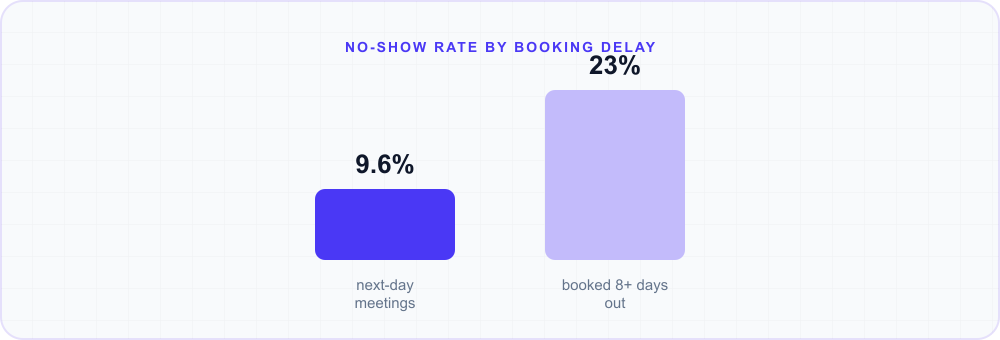
The most actionable finding in this whole category is about timing, not persuasion. Reply.io's analysis of demo bookings found that when a meeting happens the next day, the no-show rate is about 9.6%. For meetings booked 0-7 days out, the average no-show rate is 12.4%. Push the booking window to 8 or more days, and it climbs to 23%. The lesson is blunt: the further out you schedule a meeting, the more time life has to get in the way, and the less urgent your solution feels by the time the call actually arrives.
That timing effect compounds with a second, more human problem: forgetting. Concept LTD's breakdown of no-show causes lists simply forgetting as the most common reason prospects skip appointments, and also the easiest to fix, followed by fading urgency between the moment they booked and the moment the meeting was supposed to happen. Neither of those is a sign of a bad lead. They're symptoms of a scheduling and reminder process that isn't doing enough work between "booked" and "held."
What does each no-show really cost you?
No-shows don't just waste a rep's calendar slot, they quietly distort pipeline forecasting and inflate customer acquisition cost. Prospeo's modeling makes the dollar impact concrete: a team booking 100 B2B sales appointments a month with a 25% meeting-to-SQL conversion rate, a 20% close rate, and a $20K average deal size will close about 3.25 deals a month ($65K in revenue) at a 65% attendance rate. Improve attendance to just 80%, using the exact same leads, reps, and product, and that becomes 4 closed deals and $80K a month, a swing of roughly $180K a year with zero additional spend on lead generation.

Walnut's version of the same math tells a similar story at a different deal size: 100 demos booked with a 30% no-show rate and a 25% demo-to-close rate on a $50,000 average deal can represent well over $375,000 in lost potential monthly revenue. Whatever your numbers look like, the conclusion is the same: reducing no-shows is functionally the same as generating more qualified pipeline, except it's cheaper and faster than adding more top-of-funnel spend.
What actually reduces no-show rates for sales meetings?
The good news is that this is a well-studied, fixable problem, and the fixes are consistent across every source. Calendly reports that its sales users have decreased no-show rates by 28% simply by turning on automated reminders. RevenueHero's own customer data shows a mid-market company cutting a 400-demo, 30%-no-show quarter down to an 18% no-show rate after implementing automated reminders and easier rescheduling, recovering 48 additional sales conversations without a single new lead. The common threads across Demodesk, Calendly, and RevenueHero's playbooks are the same three things: shrink the gap between booking and meeting time, send reminders that reinforce value rather than just confirming a time slot, and make rescheduling frictionless so a missed slot becomes a moved meeting instead of a dead one.
Where Pixelwand CRM fits in
No-show math is really a data-visibility problem wearing a scheduling costume. Reps miss the moment to intervene because the meeting is sitting on a calendar that isn't talking to the rest of their pipeline. Pixelwand CRM's Google Calendar sync attaches meeting-prep summaries directly to the lead or deal record, so a rep walks into (or follows up on) every meeting with context instead of a blank slate, which matters given how much a fading sense of urgency contributes to no-shows in the first place. Because Pixelwand unifies calls, WhatsApp, web forms, and email into one pipeline automatically, a rep can send a same-day WhatsApp confirmation or make a click-to-call reminder straight from the deal record using native Twilio calling, rather than jumping between four different apps to chase a confirmation. And when a prospect does no-show, custom statuses and assignment rules mean that meeting doesn't just vanish, it automatically flags for a same-day recovery follow-up instead of quietly rotting in a forgotten calendar slot.
If your team is booking plenty of demos but closing fewer than the pipeline suggests you should, the no-show rate is one of the first numbers worth pulling.
Curious how this looks with your own pipeline?
15-minute walkthrough, no pressure, cancel anytime.
Demo to close rate statistics show just 15-20% of B2B sales demos become closed deals, and enterprise conversion runs as low as 5%.
Closed-lost leads statistics: up to 80% of prospects marked dead still buy within 18-24 months, often from a competitor who stayed in touch.
Proposal win rate stats: winners sign within two days and close at 36% with process versus a 20% average, yet most pipelines still stall.
Frequently asked questions
What is a good no-show rate for sales meetings?
Based on RevenueHero's analysis of over 6,400 meetings, best-in-class B2B teams keep their no-show rate between 8-12%, and a rate above 15% usually signals a structural problem in booking, qualification, or reminder process rather than just unlucky prospects. Broader industry averages cited by Demodesk and Chili Piper sit closer to 20-35% for teams that haven't optimized their scheduling flow.
How do I reduce no-show rate for sales meetings?
The data points to three consistent fixes: book meetings as close to the same day as possible (next-day meetings no-show at roughly 9.6% versus 23% for bookings 8+ days out, per Reply.io), send automated reminders that reinforce value rather than just confirming time (Calendly's sales users cut no-shows by 28% doing this), and make rescheduling frictionless so a missed slot doesn't disappear entirely.
Does the demo no-show rate really vary that much by industry?
Yes. RevenueHero's benchmark data found no-show rates as low as 0% in healthcare and 1.2% in developer tools, compared with 15.1% in real estate and 18.1% in education, suggesting that buyers evaluating urgent, technical problems show up far more reliably than earlier-stage or less technically motivated prospects.
How much revenue do sales meeting no-shows actually cost?
It depends on deal size and conversion rates, but the modeling is significant either way. Prospeo's example shows a team improving meeting attendance from 65% to 80% on the same leads and reps can add roughly $180,000 a year in closed revenue, while Walnut's modeling on a larger $50,000 average deal size puts monthly lost potential revenue from no-shows well over $375,000 for a 100-demo month.