Sales Activity Logging: 79% of Data Never Hits CRM
Sales activity logging stats: up to 79% of deal data never reaches the CRM, costing reps a quarter of their week in manual entry.
TL;DR: Sales activity logging statistics point to a bigger problem than low CRM adoption. Even on teams that log in every day, an estimated 79% of opportunity related data gathered by reps never makes it into the CRM record, and the reps who do log activity spend up to a quarter of their workweek doing it by hand. The pipeline you see is not the pipeline that actually exists. It is a smaller, staler, more optimistic version of it, built from whatever a rep remembered to type between calls.
Is your pipeline what really happened?
Most conversations about CRM problems focus on adoption: do reps log in, do they update deal stages, do they use the tool at all. That framing misses a bigger issue. Even reps who genuinely try to keep their CRM current cannot manually capture everything that happens in a sales relationship. A call runs long, a WhatsApp thread goes back and forth for two days, a stakeholder is CC'd on an email chain, and none of it gets typed into a notes field before the next meeting starts.
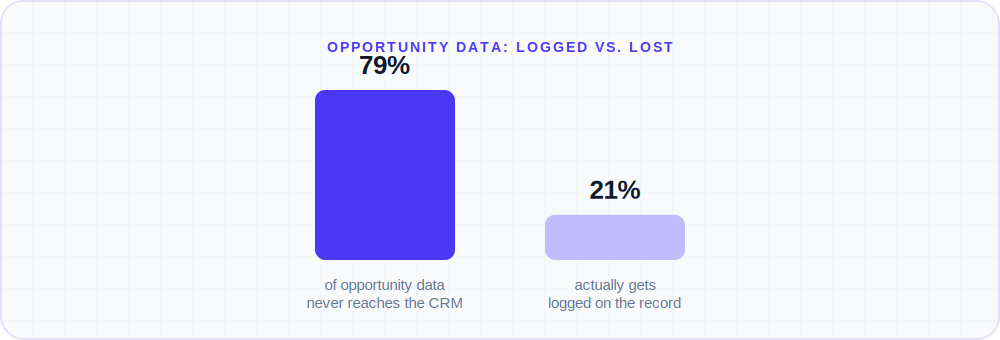
The research on this gap is consistent and uncomfortable. According to data cited by CRM vendor Nutshell, a 79% share of opportunity related data gathered by sales reps is never entered into their CRMs at all. That is not a rounding error. It means the vast majority of what a rep actually learns about a deal, the objection raised on a call, the budget hint dropped in an email, the competitor mentioned in passing, simply evaporates the moment the conversation ends.
How much of a rep's week goes to typing, not selling?
The logging gap exists because manual entry is expensive in time reps don't have. Salesforce's State of Sales research found sellers spend well under a third of their week on activities that actually involve selling, with the rest absorbed by admin, internal meetings, and data entry. In that same research, 68% of reps identified note taking and data input as their single most time consuming task, ahead of prospecting or building proposals.
Other studies land on similar territory from different angles. Analysis from Everready AI found that 32% of sales reps spend more than an hour a day on manual data entry alone, and older HubSpot research put a similar one hour a day figure on roughly a quarter of salespeople. Zippia's review of CRM adoption challenges found manual data entry is the single most cited frustration businesses report with their CRM systems. Stack those numbers up and a clear pattern appears: the tool built to capture what happened in sales is also the task reps resent most, which is exactly the condition under which logging quietly stops happening.
Why this is a pipeline problem, not just a productivity problem?
It's tempting to file this under "reps should be more disciplined," but the downstream effect is a data integrity problem, not a work ethic one. A deal with three unlogged calls and two unlogged email threads looks, on paper, like a cold, stalled opportunity. In reality it might be moving faster than any deal in the pipeline. Forecasts built on that record will be wrong in a specific direction: they will underestimate how close warm deals are to closing and overestimate how healthy stale looking deals actually are, because the system has no way to see activity that was never recorded.
That distortion has a real price tag. Gartner estimates poor data quality costs the average organization $12.9 million a year once you count forecast misses, missed follow ups, and the duplicated effort of chasing information that should already be on the record. None of that cost shows up as a single line item. It shows up as a sales manager who trusts pipeline reports less each quarter, and a rep who stops bothering to update fields nobody seems to act on anyway.
Curious how this looks with your own pipeline?
15-minute walkthrough, no pressure, cancel anytime.
Why is capture, not compliance, the fix?
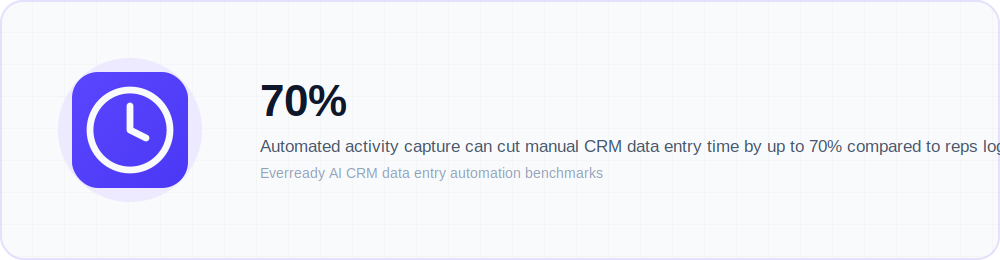
Almost every credible study on this topic reaches the same conclusion: reminding reps to log more, or adding mandatory fields, does not close a 79% gap. The fix that actually moves the number is removing the manual step entirely. When calls, emails, and messages are captured automatically at the point they happen, instead of relying on a rep to remember and retype them later, industry benchmarks on automated activity capture show data entry time dropping by as much as 70%. That is not a small optimization. It is the difference between a CRM that reflects reality and one that reflects whatever a tired rep managed to jot down at 6pm.
Where Pixelwand CRM fits in
This is precisely the gap Pixelwand is built to close, by making activity capture automatic instead of optional. Calls placed through native Twilio calling are attached to the lead or deal record without anyone opening a notes field. WhatsApp Business conversations live natively on the record as two way threads, not in a separate app a rep has to remember to check and summarize. Gmail and Outlook sync auto-logs email threads and calendar events directly onto the record, so a five email back and forth doesn't rely on someone copying it over manually. Facebook and Instagram lead ads sync straight into the pipeline the moment a form is submitted, and Slack notifications keep the team aware of deal and task activity in real time without a manager having to go digging for it. Custom fields and custom statuses mean the structured data that does get captured maps to how your team actually sells, not a generic template. The goal isn't to guilt reps into typing more. It's to make sure the 79% doesn't happen in the first place.
Quick answers
Roughly 79% of deal data never reaches the CRM. About four in five meaningful touches leave no trace in the pipeline.
Manual entry eats the week. Around 68% of reps call data input their most time-consuming task, at 20 to 30% of the week.
Capture beats compliance. Automatic call, email, and message sync cuts entry time by up to 70%, closing most of the gap.
*Sources: Nutshell, Salesforce State of Sales Report, this+that CRM data decay statistics, Everready AI, Zippia, SuperOffice
Which AI features in a CRM genuinely save agency sales teams time in 2026, which are hype, and how to evaluate AI CRMs like HubSpot, Attio, Close and Pixe…
Find a realistic CRM payback period by modeling admin savings, recovered deals, implementation cost, adoption, and sensitivity instead of guesswork.
A practical CRM ROI formula using time saved, recovered deals, software cost, payback period, and a free calculator for your business case.
Frequently asked questions
How much sales activity actually gets logged into a CRM?
Not much, by most estimates. Research cited by Nutshell puts the figure at 79% of opportunity related data gathered by reps that never gets entered into the CRM at all. That means for every five meaningful touches a rep has with a prospect, roughly four leave no trace in the pipeline.
Why don't sales reps log activities in CRM consistently?
It comes down to time and incentive. Salesforce's State of Sales research found 68% of reps identify note taking and data input as their most time consuming task, and other studies put manual entry at 20 to 30% of the workweek. Reps are asked to do unpaid administrative work immediately after the moment they should be moving to the next call.
What does unlogged CRM data actually cost a sales team?
Beyond the lost hours, unlogged activity creates forecasting blind spots, since deals with missing history look colder and more stalled than they really are. Gartner estimates poor data quality costs the average organization 12.9 million dollars a year once forecasting errors, missed follow ups, and duplicated work are counted.
Does automatic activity logging actually fix the gap?
It closes most of it. When calls, emails, and messages sync to the record automatically instead of requiring manual entry, sales teams report data entry time dropping by as much as 70%, according to vendor benchmarks, because the rep is no longer the single point of failure for whether an interaction gets recorded.