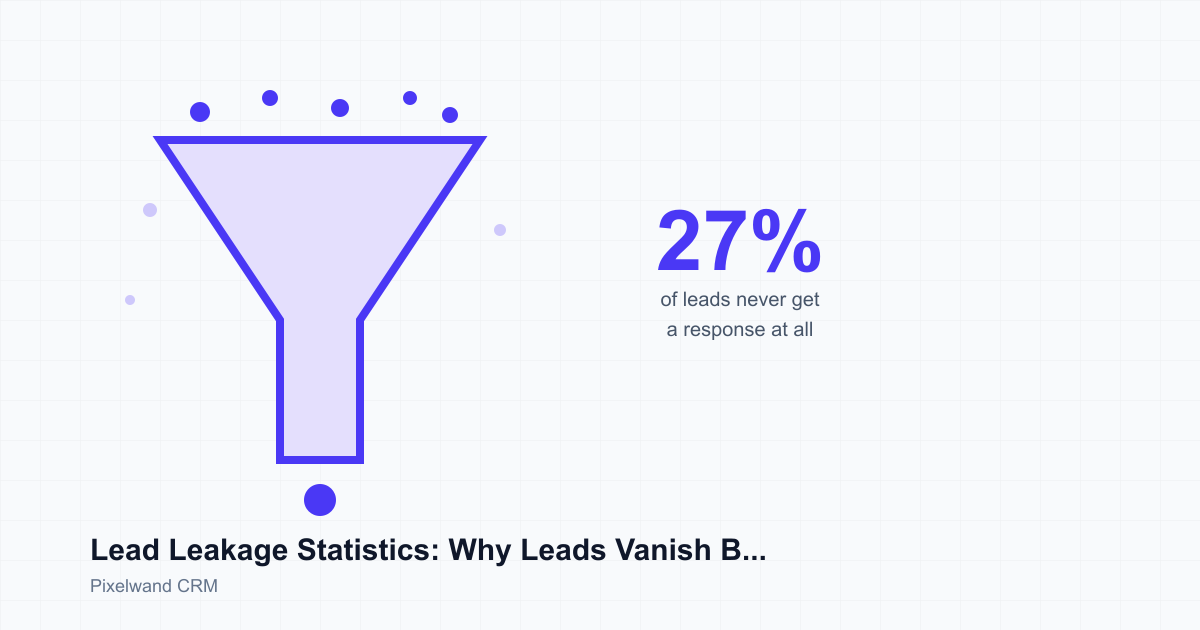
Lead Leakage: 27% of Leads Never Get a Response
Lead leakage statistics: up to 27% of leads never get a response and unmanaged leakage can hit 80%. Fragmented channels are usually the cause.
TL;DR: Lead leakage statistics point to a problem that has nothing to do with rep effort and everything to do with plumbing. Research puts the share of leads that never get any response at roughly 27%, and unmanaged lead flows have been measured leaking as high as 80% before a real tracking system exists. The common cause is fragmentation: leads now arrive through four or more channels (calls, WhatsApp, web forms, email, social DMs), each often sitting in its own disconnected tool. Sixty-eight percent of organizations now call data silos their top data management concern, up 7 points from the year before. Close the gaps between channels and you close the leak.
What is lead leakage, if not a follow-up problem?
"Lead leakage" gets used loosely, but the useful definition is narrow: a real lead with real intent enters your pipeline and drops out before converting because of a process failure, not because the lead was bad. The intent was there. The budget might have been there. Somewhere between the form fill, the phone call, or the WhatsApp message and the first real conversation, the system lost them.
That distinction matters because most teams misdiagnose the problem as a discipline issue: reps not calling back fast enough, or not trying hard enough. In practice, the more common failure mode is architectural. Leads get created in one tool, assigned in another, and contacted (or not) based on whichever inbox a rep happened to check that day. Nobody decided to ignore the lead. There was simply no single place where anyone could see it needed attention.
How does channel fragmentation leak leads?
The number of channels a typical business now uses to capture leads has grown fast, and each one tends to live somewhere different. A 2024 lead capture survey found marketers using a genuine mix of channels for follow-up and nurturing beyond the initial touch, with email used by 39% of respondents, phone calls by 29%, social media direct messages by 11%, and SMS by 7%. That same research flagged a quieter problem: many marketers reported limited or no visibility into what actually happens to a lead once it moves from initial capture into the sales process.
That visibility gap is the real story behind lead leakage. A call that comes in after a web form was submitted, a WhatsApp follow-up after an unanswered email, a Facebook lead ad that never gets merged with an existing contact record: none of these are edge cases anymore. They're the default shape of how B2B and local-service leads actually behave. If each channel reports into a separate system, someone has to manually stitch the picture together, and manual stitching is exactly where leaks start.
Which lead-leakage stats should worry you most?
The numbers back this up from multiple angles. Research aggregated across sales and marketing teams consistently finds that 27% of leads are never responded to at all, meaning roughly one in four inquiries a business generates goes permanently uncontacted, not slowly, just never.
Routing failures compound the problem. Lead operations vendor LeanData has reported that before centralizing lead routing, customers were losing 10% to 30% of leads annually purely to inaccurate routing, on top of whatever was already lost to non-response. Using standard Gartner sales development benchmarks (a 21% lead-to-opportunity conversion rate and a 22% opportunity win rate) as a baseline, even a 10% routing leak on 1,000 annual leads works out to roughly 20 fewer closed deals a year before you've accounted for anything else going wrong.
Real-world audits show how bad unmanaged leakage can get. One real estate firm found that before it centralized lead tracking, its lead leakage rate ran at 80%, tracked through spreadsheets with no automated disposition. After implementing a proper tracking system, it cut that leakage by 70%. That gap, between an 80% loss rate and a system that catches most of it, is the entire argument for treating lead flow as infrastructure rather than an admin task.
None of this is cheap to ignore. The average cost to generate a single software lead runs around $595. Multiply that by however many leads are quietly disappearing in your pipeline each month, and lead leakage stops looking like a minor operational nuisance and starts looking like a line item.

Why data silos in sales are getting worse, not better?
If lead leakage is the symptom, data silos are usually the cause, and they're not improving. DATAVERSITY's 2024 Trends in Data Management survey found that 68% of respondents now cite data silos as their top data management concern, up 7 percentage points from the previous year, even as companies pour money into new analytics and automation tools. The irony the report highlights is that new AI and automation investments are often creating fresh silos rather than closing existing ones.
The infrastructure side tells the same story. A Salesforce connectivity benchmark cited by Cherry Bekaert found that 72% of IT leaders describe their current infrastructure as "overly interdependent," while 80% separately reported that data silos are actively hindering their digital transformation efforts. When calls, messages, forms, and emails about the same lead sit in four different systems that don't talk to each other, "overly interdependent but still disconnected" is exactly the trap teams fall into: too tangled to easily replace, too fragmented to trust.

Curious how this looks with your own pipeline?
15-minute walkthrough, no pressure, cancel anytime.
What omnichannel done right looks like?
The upside case is just as well documented as the downside. Research from Aberdeen Group, cited across dozens of customer experience studies since, found that companies with strong omnichannel engagement strategies retain an average of 89% of their customers, compared with just 33% retention among companies with weak omnichannel engagement. That gap isn't about having more channels. It's about whether those channels feed one connected view of the customer or four separate, half-updated ones.
For sales teams specifically, that means the fix for lead leakage rarely starts with hiring more reps or writing a stricter follow-up policy. It starts with making sure a lead only has to exist in one place, no matter which channel they used to show up.
Where Pixelwand CRM fits in
This is the exact problem Pixelwand CRM is built to close. It automatically unifies leads and deals coming in from calls, WhatsApp, web forms, and email into a single pipeline, so a lead that calls after filling out a form doesn't become two disconnected records in two different tools. Native calling through Twilio puts click-to-call directly on the lead record, native two-way WhatsApp Business API messaging attaches straight to that same record instead of living in a separate app, and Gmail and Outlook sync auto-logs every email thread and calendar event where reps can actually see it. Facebook and Instagram lead ads sync directly into the CRM too, closing off one more channel where leads commonly go quiet. Add assignment rules and custom statuses on top, and a lead has a much harder time disappearing between the cracks of four different tools, because there's only one tool.
Sources: Everycatch, LeanData, LeadSquared case study, CallTrackingMetrics, DATAVERSITY, Cherry Bekaert, Digital Commerce 360
Response time statistics by channel: email averages 12 hours against a 1-hour expectation, while chat and WhatsApp demand replies in minutes.
After-hours lead response stats: 39% of B2B conversations happen outside 9-to-5, yet slow replies cut qualification odds by up to 60x.
Lead nurturing statistics: nurtured leads make 47% larger purchases and convert 20% more often, yet 65% of marketers skip nurture programs.
Frequently asked questions
What is lead leakage?
Lead leakage is when a real, interested lead enters a company's pipeline through a call, form, message, or email but never gets tracked, contacted, or worked before going cold. It is a process failure, not a lead quality problem. Research shows roughly 27% of leads generated by sales and marketing teams are never responded to at all, and some unmanaged lead flows leak at rates as high as 80% before a tracking system is put in place.
Why do leads fall through the cracks between channels?
Most businesses now take leads through four or more channels at once, including phone calls, WhatsApp, web forms, and email, but each channel often lives in a separate inbox or tool with no shared view. When nobody owns stitching those channels together, a lead that calls after filling out a form, or messages on WhatsApp after an email goes unanswered, is easy to lose. Surveys of marketers confirm this gap directly, with many reporting limited or no visibility into what happens to a lead once it moves from one channel or team to the next.
How much does lead leakage cost a business?
It depends on lead volume and value, but the math is straightforward: missed leads multiplied by average deal value equals monthly revenue leakage. For context, the average cost to generate a single software lead is about $595, and lead management research has found companies lose well into six figures annually from missed or mishandled follow-ups. Real-world cases are stark too. One real estate firm found its lead leakage rate was running at 80% before it centralized lead tracking.
What are data silos in sales, and how do they cause lost leads?
A data silo is when lead or customer information gets trapped in one system, inbox, or team's tool and isn't visible anywhere else. In sales, this typically means calls, WhatsApp threads, web form submissions, and emails about the same lead never get merged into one record. DATAVERSITY's 2024 Trends in Data Management survey found 68% of respondents now cite data silos as their top concern, up 7 percentage points from the year before, and a Salesforce connectivity benchmark found 80% of IT leaders say silos are actively hindering their digital transformation efforts.