Customer Response Time Statistics by Channel: Why Email, Phone, and WhatsApp Play by Different Rules
Customer response time statistics by channel show a 12-hour email average against a 1-hour expectation, while chat and WhatsApp demand replies in minutes. Here's what the data means for your pipeline.
TL;DR: Customer response time statistics by channel reveal a huge mismatch between what businesses deliver and what buyers expect. The average company takes 12 hours and 10 minutes to answer a service email, according to SuperOffice's benchmark study of 1,000 companies, while separate research from Toister Performance Solutions found 88% of consumers want a reply within an hour. Phone and chat carry even tighter expectations, measured in seconds, and Harvard Business Review found that companies contacting a web lead within an hour are nearly 7 times more likely to qualify it than those who wait even a little longer. The channel a customer picks changes the clock they're running on, and most CRMs, and most sales teams, still treat every channel like it's email.
The expectation gap starts with email
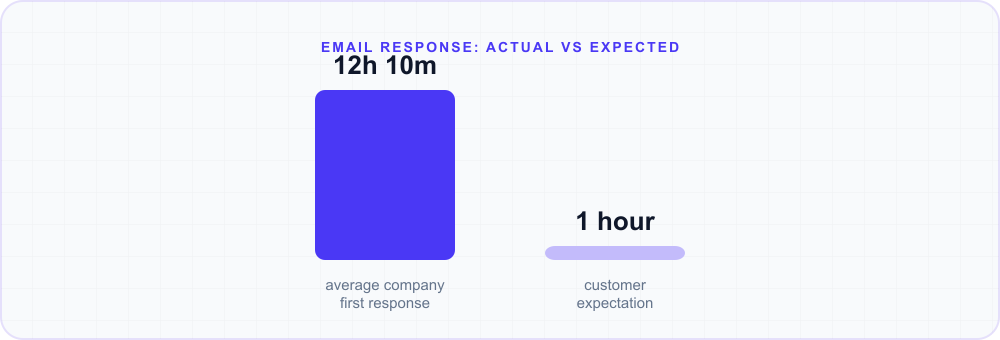
Email is the channel where the gap between what businesses do and what customers want is widest and most measurable. SuperOffice studied 1,000 companies across industries by sending each one a real customer service email and timing the response. The average first response time came back at 12 hours and 10 minutes. Worse, 62% of the companies in the study never responded to the email at all, and only 20% were able to fully answer the customer's question in their first reply. Ninety percent didn't even send an acknowledgment that the email had arrived.
Compare that to what customers actually say they expect. Jeff Toister's research at Toister Performance Solutions, which surveyed more than 3,200 consumers, found that 88% expect a business to respond to email within one hour, and the recommended standard his research points to is exactly that: one hour. A meaningful group wants a reply in 15 minutes, though that segment has shrunk in more recent survey years as customers have shifted their fastest expectations toward chat and messaging. Either way, a 12-hour average against a 1-hour expectation is not a small miss. It's an 11-hour gap that shows up as lost deals, frustrated customers, and duplicate follow-up emails that eat even more of a rep's day.
Why speed to first contact changes the outcome, not just the mood
The starkest evidence on why response speed matters comes from a Harvard Business Review study by James Oldroyd, Kristina McElheran, and David Elkington. The researchers audited 2,241 U.S. companies by submitting a test web lead to each one and timing the response. Only 37% responded within an hour. Sixteen percent took between one and 24 hours, 24% took more than a full day, and 23% never responded at all. Among the companies that did eventually respond, the average response time was 42 hours, nearly two full days.
In a related analysis of 1.25 million sales leads across 29 B2C and 13 B2B companies, the same researchers found that firms that tried to contact a prospect within an hour of the inquiry were nearly seven times more likely to qualify that lead than firms that waited even just a bit longer, and more than sixty times more likely to qualify it than firms that waited 24 hours or more. That isn't a satisfaction metric. It's a straight-line difference in whether the deal exists at all, because prospects who fill out a form or send a message are frequently doing the same thing with two or three other vendors at once, and the first company to have a real conversation usually wins the business.

Every channel runs on its own clock
The reason a single response-time SLA rarely works is that customers hold different channels to completely different standards. Phone support has operated for decades on the classic 80/20 rule: answer 80% of calls within 20 seconds. Live chat and messaging apps push that further, with most benchmarks putting an acceptable first reply somewhere between 30 and 60 seconds, because a customer who opens a chat window is choosing the fastest option available and expects to be treated accordingly.
Social media sits in the middle. The Sprout Social Index has found consistently across multiple years that nearly three-quarters of consumers expect a brand to respond within 24 hours or sooner on social, and 73% say that if a brand doesn't respond on social, they'll simply buy from a competitor next time. That's a longer runway than chat, but a much shorter one than the 12-hour reality most companies deliver on email.
This is also where the broader shift in customer expectations shows up. Salesforce's State of the Connected Customer research has tracked a steady rise in the share of customers who expect real-time interaction, with recent editions putting that figure at 71%, alongside findings that nearly 80% of customers expect consistent experiences no matter which department or channel they use to reach a company. The same research has flagged that the average enterprise runs roughly 900 different applications, with only a small fraction of them actually connected to each other, which is precisely the structural reason so many teams can't hit the response times their customers expect. The tools are scattered, so the reply is late no matter how hard any individual rep is trying.
The real problem is fragmentation, not effort
Put these numbers side by side and a pattern emerges. It isn't that reps are lazy or that companies don't care about response time. It's that a lead or customer message can land in five different places, a shared inbox, a personal phone's WhatsApp, a Facebook DM, a missed call log, a webform notification, and someone has to notice it, open the right tool, and reply, all before the customer's patience runs out. Every one of those handoffs adds minutes a fast-moving channel like chat or WhatsApp simply doesn't allow for. A rep can be diligent all day and still blow a WhatsApp response time expectation because the message sat in a personal phone that three teammates assumed someone else was watching.
That's also why the gap tends to be worst exactly where volume is highest. Teams fielding leads across calls, web forms, WhatsApp, and email at the same time are the ones most likely to let something slip past the window where it still had a real chance of converting, precisely the window the Harvard Business Review data shows matters most.
Where Pixelwand CRM fits in
Pixelwand CRM was built around the idea that response time is a pipeline problem, not just a customer service problem. It unifies leads and deals from calls, WhatsApp, web forms, and email into a single pipeline automatically, so nothing is waiting in a separate inbox or a rep's personal phone while the clock the customer is watching keeps running.
Native calling through Twilio or Exotel puts click-to-call directly on the lead record, so a phone follow-up doesn't require switching tools. Two-way WhatsApp Business API messaging is attached to the lead or deal record itself rather than living in a separate app, which matters given how much tighter WhatsApp response expectations are than email's. Gmail and Outlook sync auto-logs every email thread on the record, so a rep can see exactly how long a customer has been waiting without hunting through a mailbox. Slack notifications flag new leads and messages in real time, and Facebook and Instagram lead ads sync directly into the CRM so a social inquiry doesn't sit unnoticed in an ads manager account. Assignment rules make sure the right person is notified the moment something new comes in, instead of relying on someone happening to check the right channel first.
If your team is losing deals to the clock rather than to the competition, that's usually a signal worth acting on.
Curious how this looks with your own pipeline?
15-minute walkthrough, no pressure, cancel anytime.
Sources: SuperOffice Customer Service Benchmark Report, Toister Performance Solutions, Harvard Business Review, "The Short Life of Online Sales Leads", Sprout Social Index, Salesforce State of the Connected Customer
Frequently asked questions
What is a good customer response time by channel?
It depends entirely on the channel. Live chat and WhatsApp carry expectations measured in seconds to minutes, phone support runs on the classic 80/20 rule of answering 80% of calls within 20 seconds, email is judged on an hour-or-less standard by most consumers, and social media gives brands roughly 24 hours before nearly three-quarters of consumers consider it too slow, according to the Sprout Social Index. The mistake most teams make is applying one internal SLA, usually an email-based one, across every channel.
What is the average email response time for businesses?
SuperOffice's benchmark study of 1,000 companies found the average first response time to a customer email is 12 hours and 10 minutes, and 62% of companies never respond to a service email at all. That sits far outside what customers say they want. Toister Performance Solutions' survey of over 3,200 consumers found 88% expect a reply within an hour.
How much does slow lead response time actually cost in sales?
A lot. Harvard Business Review's audit of 2,241 companies found firms that contacted a web lead within an hour were nearly 7 times more likely to qualify it than those that waited even a little longer, and more than 60 times more likely than companies that waited 24 hours or more. The same research found the average company that eventually responds takes 42 hours to do it.
Do customers expect the same response speed on every channel?
No, and treating every channel like email is one of the biggest mistakes in customer response management. Salesforce's State of the Connected Customer research found 71% of customers now expect real-time interaction, but that expectation is sharpest on chat and messaging apps and comparatively more relaxed on channels like email, where a same-day reply is still broadly acceptable.