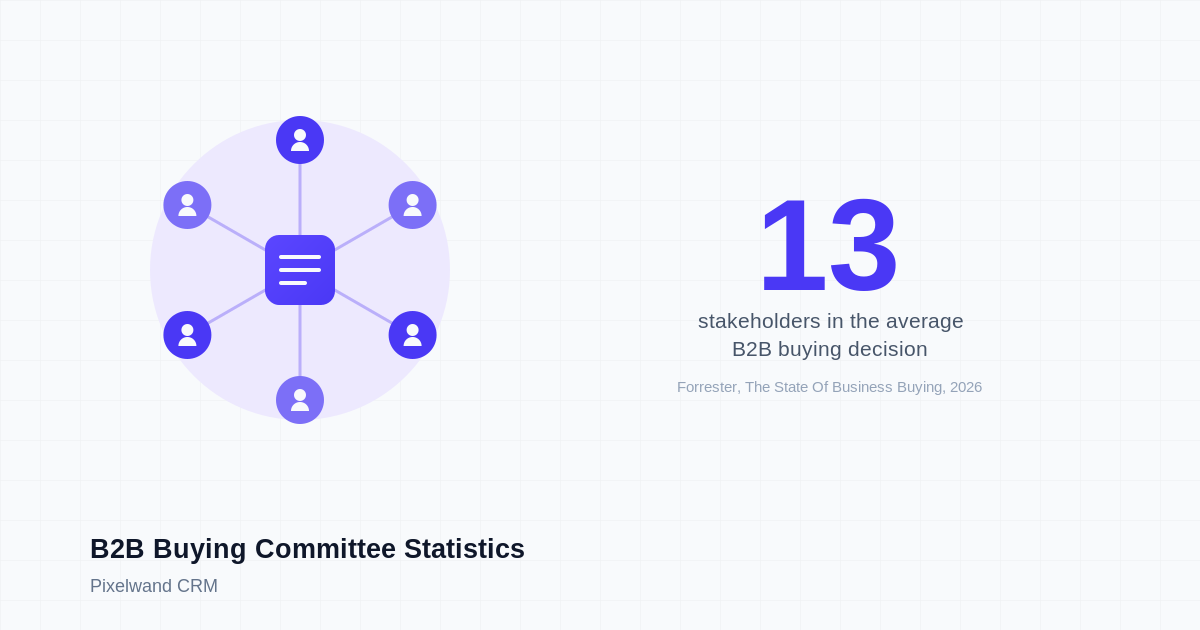
B2B Buying Committee: 13 Stakeholders Per Deal
Forrester's 2026 report puts the average B2B deal at 13 stakeholders and 9 external influencers. Here's what it means for multi-threading deals.
TL;DR: Forrester's State of Business Buying, 2026 report puts the average B2B purchase decision at 13 internal stakeholders and 9 external influencers, and Gartner separately finds buying groups now run 5 to 16 people across up to four functions, with 74% showing "unhealthy conflict" along the way. The sales data backs up why that matters: Gong's analysis of more than 10 million sales conversations found winning deals average 8 points of contact by email, versus just 3 for losing deals, and reps who engage four or more contacts win 58% of the time. A deal built on one relationship isn't really a deal in progress anymore. It's a bet that one person never goes quiet.
How big has the B2B buying committee gotten?
For years, "the buyer" was shorthand for one person: a champion who liked the product, found budget, and got a signature. That mental model is increasingly out of date. Forrester's State of Business Buying, 2026 report, published in January 2026, found the typical B2B purchase decision now involves 13 internal stakeholders and 9 external influencers, a figure that climbs even higher for complex or strategic purchases. Procurement isn't a rubber stamp at the end either: Forrester found procurement professionals act as decision-makers in 53% of business buying cycles, engaging from the start of the process rather than showing up only at the contract stage.
None of that shows up as a single line item in most CRMs. A deal record often has one primary contact and a stage, while the actual buying committee, the champion's manager, the technical evaluator, the procurement lead, the eventual end users, exists only in a rep's memory or scattered across separate email threads and calls. The gap between how buying decisions actually get made and how sales teams track them is where a lot of "surprise" losses come from.
Why single-threaded deals lose, in the data?
Gong Labs, the research arm of the revenue intelligence platform Gong, analyzed more than 10 million sales conversations and 500,000 sales emails specifically to measure the effect of engaging multiple buyer-side contacts, a practice generally called multi-threading. The pattern was stark. Winning deals average at least 3 people from the buyer's side attending meetings across the sales cycle, while losing deals often never get past a single point of contact. Gong's data also showed that in winning deals, the number of buyer-side attendees in the second meeting nearly triples compared to the first, a jump that essentially never happens in deals that end up lost.
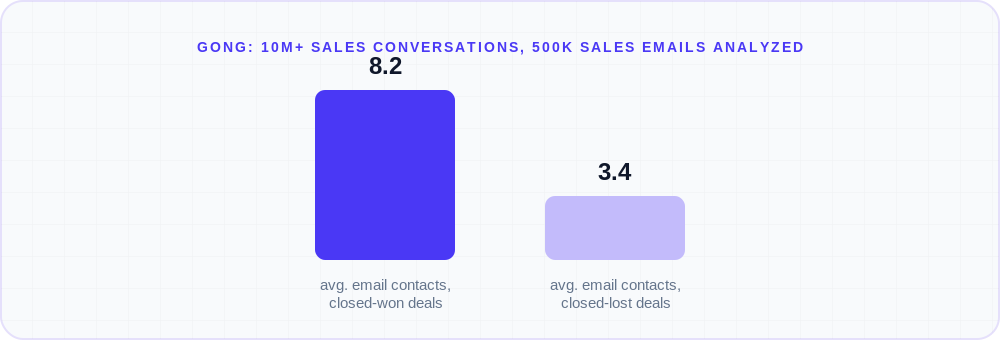
Email tells the same story with a bigger gap. Winning deals average 8 points of contact by email, while losing deals average just 3, a 243% difference. Gong's broader win-rate research adds a sharper number to that pattern: deals where the actual decision-maker never gets involved are 233% less likely to close. A single-threaded deal isn't just riskier in theory. In this dataset, it's close to a predictor of loss on its own.
Why does consensus decide B2B deals now?
A bigger buying committee doesn't just mean more people to convince individually, it means those people have to agree with each other, and Gartner's research suggests that's where most of the friction actually lives. In a Gartner survey of 632 B2B buyers conducted in August and September 2024, 74% of buyer teams showed "unhealthy conflict" during their decision process, meaning members had genuinely competing objectives or got overruled by other decision-makers rather than reaching agreement smoothly. Gartner found these buying groups now range from 5 to 16 people spread across as many as four functions, which is plenty of surface area for disagreement.
The payoff for solving that friction is real. Buying groups that reach internal consensus are 2.5 times more likely to report their deal was high-quality, according to the same research. Gartner also tested what actually builds that consensus: content tailored for the whole buying group's shared priorities improved consensus by 20%, while content tailored to one individual's specific concerns had a 59% negative impact on group consensus, and buyers who experienced that group-level relevance were 3 times more likely to describe their deal as high-quality. In other words, winning over the champion with a message built just for them can actively work against closing the deal if the rest of the committee never sees themselves in it.

How many contacts actually move the needle?
The encouraging part of this data is that multi-threading has a fairly clear payoff curve. According to figures Gong shares from its own sales team's pipeline, reps win 58% of deals where at least four contacts are actively involved, and that win rate climbs to 61% with five to nine logged calls on the account and 63% with ten or more. Gong's broader research puts a number on team selling too: deals where the seller's own team engages multiple stakeholders in a coordinated way are up to 258% more likely to close than deals worked by a single rep alone.
Forrester's data suggests sales teams shouldn't treat a large buying committee as purely a burden either. 94% of buyers in groups of six or more report clear benefits from that size, including broader perspective, shared effort validating the solution, and an easier path to securing budget and approval. A crowded buying committee isn't automatically a slower deal. Left unengaged, it's a deal quietly deciding without you.
Curious how multi-threaded your open deals actually are?
15-minute walkthrough of stakeholder visibility inside the pipeline, no pressure.
Why multi-threading breaks down in practice?
If the data is this consistent, why do so many deals still run on one contact? Mostly because multi-threading requires proactive effort before there's any visible payoff, and most CRM setups make it easy not to bother. A rep gets introduced to a senior stakeholder, gets handed off to someone on their team to work out details, and quietly stops copying the original contact on updates. Weeks later, that senior stakeholder's interest has cooled and there's no one left championing the deal internally if the newer contact goes quiet too.
The failure is rarely a lack of effort on the first call. It's that nobody, not the rep and not their manager, has an easy way to see how many people are actually engaged on a given deal, on which channel, and how recently. Without that visibility, a deal can look "on track" in a pipeline view right up until the one person who was ever really engaged stops responding.
Where Pixelwand CRM fits in
Pixelwand CRM treats a deal as more than one contact by default. Every Deal record supports multiple linked contacts, each with their own email, phone, and activity history, with one marked as primary so it's still clear who's driving the relationship day to day. Because calls run natively through Twilio, WhatsApp conversations sync through the WhatsApp Business API, and email threads log automatically against the record, every one of those contacts' interactions lands in the same unified timeline on the deal, not scattered across a rep's personal inbox and phone.
That matters most for exactly the blind spot the data points to: knowing whether a deal is actually multi-threaded or quietly resting on one relationship. A manager reviewing a deal can see at a glance how many contacts are attached, who's been active recently across calls, WhatsApp, and email, and who's gone quiet, instead of relying on a rep's memory or a single "last activity" date that only reflects one person.
If your pipeline reviews are full of deals with a single contact and an optimistic stage, that's exactly the blind spot visible stakeholder tracking is built to close.
Sources: Forrester, The State Of Business Buying, 2026 (press release), Gartner, Gartner Sales Survey Finds 74% of B2B Buyer Teams Demonstrate "Unhealthy Conflict" During The Decision Process, Gong, Building an army of champions: why it's essential to closing more deals, Gong, Understanding Win Rates
Upsell and cross-sell statistics show existing customers convert 60-70% of the time, versus just 5-20% for new prospects, per Marketing Metrics research.
Multichannel sales outreach statistics show social beats email 42% to 26%, and buyers now use 10 channels per deal, per HubSpot and McKinsey.
Lead nurturing statistics: nurtured leads make 47% larger purchases and convert 20% more often, yet 65% of marketers skip nurture programs.
Frequently asked questions
How many stakeholders are typically involved in a B2B buying decision?
Forrester's State of Business Buying, 2026 report found the typical buying decision now includes 13 internal stakeholders and 9 external influencers, a number that climbs higher for large or strategic purchases. Gartner's separate research puts the range at 5 to 16 people across as many as four functions, so even the low end of the range is well past a single decision-maker.
What's the win rate difference between single-threaded and multi-threaded deals?
Gong's analysis of more than 10 million sales conversations and 500,000 sales emails found winning deals average at least 3 buyer-side attendees in meetings and 8 points of contact by email, compared to losing deals that often never get past one contact and average just 3 email touches, a 243% gap. Separately, Gong found reps win 58% of deals where at least four contacts are engaged, rising to 63% with 10 or more calls logged on the account.
Does a bigger buying committee actually hurt a deal's chances?
Not when it's engaged properly. Forrester found 94% of buyers in groups of six or more report clear benefits, like broader perspective and easier budget approval, and Gartner found buying groups that reach internal consensus are 2.5 times more likely to report a high-quality deal. The risk isn't the size of the committee, it's leaving most of it untouched.
How can a sales team actually keep track of every stakeholder in a deal?
The practical fix is keeping every contact tied to the same deal record instead of scattered across individual inboxes and phones, so a manager can see at a glance who's actually been engaged: how many contacts, on which channel, and how recently. Once that visibility exists, multi-threading becomes a reviewable habit instead of a single rep's private call.