Sales Cycle Length: Median B2B Deal Takes 84 Days
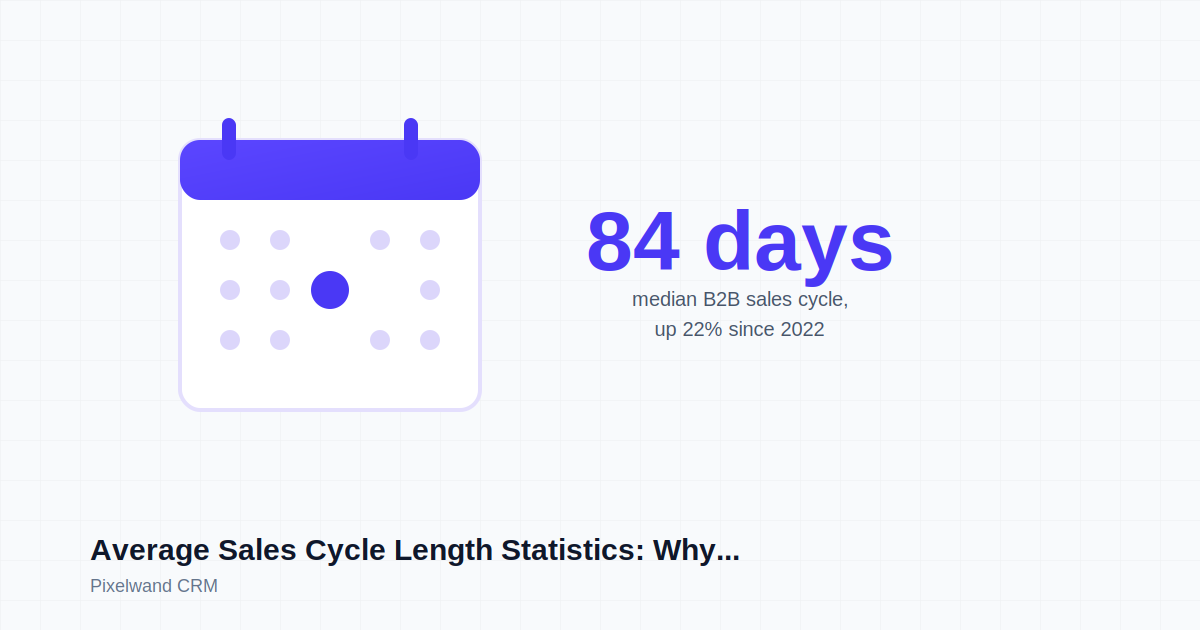
Average sales cycle length statistics: the median B2B deal takes 84 days, up 22% since 2022, and deal size explains only 27% of the variance.
TL;DR: Average sales cycle length statistics from 2025 and 2026 benchmark studies put the median B2B deal at 84 days, up 22% since 2022. But that single number hides a real range of 25 to 270+ days depending on deal size, industry, and how the lead was sourced. The more surprising finding: deal size itself explains only about 27% of the variance in cycle length. Stakeholder count, process complexity, and lead source do most of the work, which means most "we sell enterprise so our cycle is long" explanations are only a quarter true.
Why is the 84-day average mostly noise?
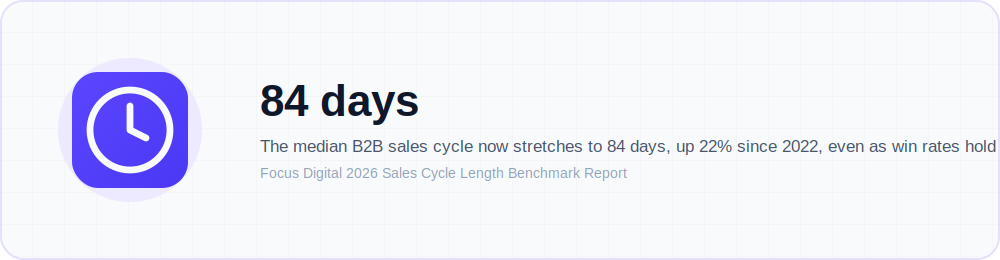
If you search for average sales cycle length, you will land on the same figure everywhere: 84 days. A 2026 industry benchmark report found that the median B2B sales cycle now sits at 84 days, up from a shorter baseline in 2022, a lengthening of roughly 22% in four years. The same research breaks that median into 20 industries and finds non-profit organizations carrying the longest average cycles at 162 days, while retail closes in as little as 70 days, largely because retail deals involve fewer stakeholders and simpler decisions.
The problem with quoting 84 days as your target is that it blends radically different businesses into one line. A separate analysis of the same underlying data found the true range runs from about 25 days for deals under $1,000 to 270 days for deals over $500,000, a 10x spread hiding inside a single median. Gong's data across its own customer base tells a similar story at a more moderate scale: the average deal size on the platform is $97,000, and the sales cycle at that price point runs 69 days, faster than the blended median despite a fairly substantial contract value.
Why deal size isn't the main driver?
The instinct is to assume bigger deals automatically take longer, and smaller deals automatically close fast. HockeyStack Labs tested that assumption directly, running a regression across 54 B2B SaaS companies. The result: sales cycle length explains only 26.8% of the variance in deal size, meaning deal size alone doesn't have a massive impact on how long a deal takes to close. Some companies with above $100,000 ACV were closing in 60 days, a result HockeyStack's own analysts called surprising given how strongly the industry assumes the opposite.
What fills the other 73%? Mostly process complexity and stakeholder count. The average B2B deal now involves close to 7 decision makers, up from about 5 in 2020, and for deals over $50,000 that figure climbs into the double digits. Each additional stakeholder does not add a fixed number of days, it adds calendar coordination, internal review cycles, and approval layers that compound at every stage of the pipeline, which is exactly the kind of drag that shows up as "long sales cycle" on a dashboard but is really a scheduling and follow-through problem.
Why do industry and lead source matter more than price?
Segment the same benchmark data by industry and a clearer pattern appears. Software deals average around 90 days full-cycle, but that hides wide variance by deal size within the category. Manufacturing organizations face some of the longest cycles because complex B2B transactions require extended relationship-building. And the channel a lead came through matters just as much as the industry it landed in.
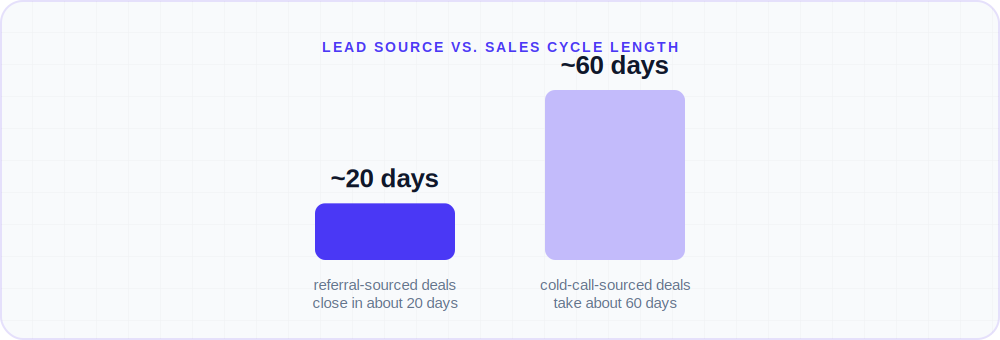
Inbound-sourced deals (SEO, referrals) consistently close 2 to 3x faster than outbound-sourced deals at comparable product complexity, according to the same 2026 industry benchmark analysis. That gap shows up again in more granular data on individual lead sources, where referral-driven deals close in around 20 days on average versus roughly 60 days for cold-call-sourced deals, a 3x difference driven almost entirely by how much trust already exists before the first conversation. None of that is about price. It's about how much convincing has to happen from a cold start versus a warm one.
What "good" actually means in 2025 and 2026?
HubSpot's 2025 State of Sales report offers a useful reality check on how teams are actually performing against these lengthening cycles. Despite longer average timelines, 91% of sellers report win rates are stable or improving, 93% say deal sizes are holding steady or growing, and 59.9% of sales teams say they are on track to meet or beat their revenue targets this year. Read together with the cycle-length data, the picture is not that sales is getting harder in absolute terms, it's that the same number of wins now takes more calendar days and more coordinated touchpoints to produce, which puts a premium on not losing time to internal friction rather than on discounting or rushing the buyer.
Curious how this looks with your own pipeline?
15-minute walkthrough, no pressure, cancel anytime.
Where Pixelwand CRM fits in
Almost none of the drag documented above comes from the buyer being slow. It comes from the seller's own process losing hours or days between steps, a missed callback, an email thread that never made it into the deal record, a meeting that got scheduled without the context from the last conversation. Pixelwand CRM is built around closing exactly that gap. Calls, WhatsApp messages, web form submissions, and email all land automatically on the same lead or deal record instead of scattered across four different apps, so a rep never has to reconstruct where a stalled deal left off.
Native two-way WhatsApp messaging and click-to-call through Twilio mean a rep can respond to a stakeholder the moment a question comes in rather than losing a day to channel-switching, which matters most in the negotiation and procurement stages where HockeyStack's data shows most of the extra days actually accumulate. Gmail and Outlook sync auto-logs every email thread and calendar event directly on the record, Google Calendar sync adds meeting-prep summaries so nobody walks into a stakeholder call cold, and Slack notifications keep the whole team aware the moment a deal moves or stalls. None of that shortens a genuinely complex enterprise procurement process, but it removes the self-inflicted delay that quietly stretches every other cycle.
Sources: HubSpot 2025 State of Sales Report, Focus Digital: Average Sales Cycle Length by Industry 2026, HockeyStack Labs: ACV, Sales Cycles, and Sales Reps, SaaStr: What's a Good Benchmark for B2B Sales Cycles, B2B Sales Training: Average Sales Cycle Length by Industry and Deal Size
Upsell and cross-sell statistics show existing customers convert 60-70% of the time, versus just 5-20% for new prospects, per Marketing Metrics research.
Multichannel sales outreach statistics show social beats email 42% to 26%, and buyers now use 10 channels per deal, per HubSpot and McKinsey.
Demo to close rate statistics show just 15-20% of B2B sales demos become closed deals, and enterprise conversion runs as low as 5%.
Frequently asked questions
What is a good sales cycle length benchmark?
There isn't one universal number. The commonly cited median for B2B SaaS is 84 days, but the real range runs from about 25 days for deals under $1,000 to 270 days or more for deals above $500,000. The more useful benchmark is your own trailing four-quarter average, segmented by deal size and lead source, compared against itself over time rather than against an industry-wide figure that blends every company size and product category together.
Why are sales cycles getting longer?
Sales cycles have lengthened roughly 22% since 2022. The main drivers are bigger buying committees (the average B2B deal now involves close to 7 decision makers, up from about 5 in 2020), tighter budget scrutiny, and mid-market companies adopting enterprise-style procurement steps like security questionnaires and compliance reviews without the dedicated staff to move them quickly.
Does deal size actually determine sales cycle length?
Less than most people assume. A HockeyStack analysis of 54 B2B SaaS companies found that deal size explains only about 27% of the variance in sales cycle length. Process complexity, stakeholder count, and how a deal was sourced matter more than the dollar amount on the contract, which is why two $100,000 deals can close 100 days apart.
How can a sales team actually shorten its sales cycle?
The biggest documented lever is lead source and response speed rather than discounting or rushing the buyer. Referral and inbound deals close markedly faster than cold-sourced ones, and centralizing every channel (calls, email, WhatsApp, web forms) into one pipeline so reps respond within minutes instead of hours removes the dead time that quietly stretches most cycles.