CRM Integration: 70% of Sales Stacks Don't Sync
70% of companies fail to integrate sales plays into CRM and revenue tech, and 99% of RevOps teams fight data issues. Here's what the data shows.
TL;DR: 70% of companies fail to effectively integrate their sales plays into their CRM and revenue technology, and only about 20% realize the full value of the tools they've already bought, according to Bain & Company's 2025 Commercial Excellence and Revenue Growth Agenda survey of 1,200+ senior executives. The downstream damage shows up in RevOps Co-op's 2025 State of RevOps Survey, where 99% of RevOps professionals report fighting technical data issues and 71% say poor data quality is actively hurting go-to-market execution. Buying more integrations doesn't fix this. Most teams already have the tools connected; what's missing is data that actually arrives, correctly, on the record where a rep needs it.
Every sales team eventually asks some version of the same question: why does the CRM still feel out of date when we've paid for integrations to keep it current? The honest answer, backed by three separate 2024 and 2025 surveys, is that connecting two tools and keeping their data in sync turn out to be very different engineering problems, and most companies are only solving the first one.
How disconnected the average sales tech stack really is?
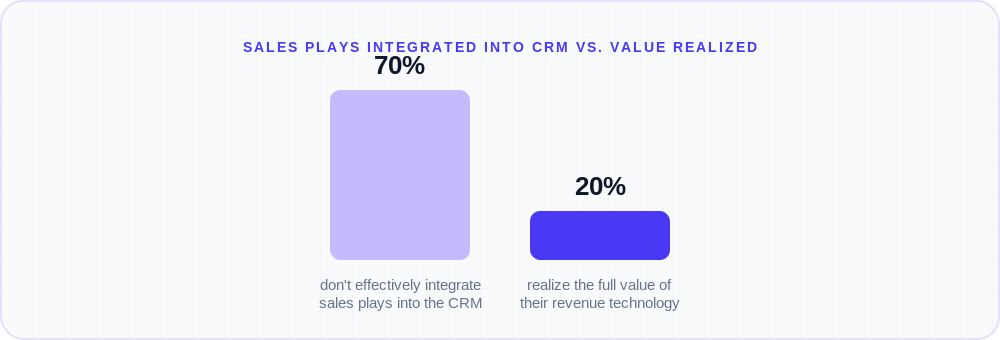
Bain & Company surveyed more than 1,200 senior commercial executives across 18 industries worldwide for its 2025 Commercial Excellence and Revenue Growth Agenda report, and the headline finding is blunt: while more than 80% of companies say they run structured, repeatable sales plays, 70% of them don't effectively integrate those plays into their CRM and revenue technology. The direct consequence is that only about 20% of companies realize the full value of the technology they've already purchased.
That's not a story about companies refusing to buy integration tools. Most of them have. It's a story about integration being treated as a one-time setup task, a checkbox next to "connected to CRM," rather than an ongoing reliability problem that needs the same attention as uptime or security. A tool can be technically connected to the CRM and still leave a rep looking at a record that's hours or days behind what actually happened with a prospect.
What broken sync does to sales data specifically?
The Bain numbers describe the strategic gap. RevOps Co-op's 2025 State of RevOps Survey, which polled more than 600 RevOps professionals in partnership with Openprise and Marketing Ops, describes what that gap feels like day to day. 99% of respondents say they struggle with technical data issues in their stack. Only 11% rate their data as excellent, while 42% describe it as merely "good enough," a category the survey's own authors note is quietly undermining go-to-market performance rather than actually supporting it.
The business impact isn't abstract. 71% of RevOps teams in the same survey say poor data quality is actively hurting their go-to-market execution, and 70% say it prevents them from making confident strategic decisions in the first place. When the underlying question is "which leads are real, which deals are stalled, which accounts already have an open case," and the answer depends on data that two-thirds of the people managing it don't fully trust, every decision built on top of that data inherits the same uncertainty.
Gartner's research puts a dollar figure on the same problem: poor data quality costs the average organization $12.9 million a year, a number built from wasted analyst and rep time, delayed or reversed decisions, and the ordinary cost of chasing down which version of a record is actually correct. That figure predates the current wave of AI-assisted sales tools, and it arguably understates the current cost, since feeding an AI forecasting or scoring model data that's out of sync across systems doesn't produce a cautious answer, it produces a confidently wrong one, faster than a human would have gotten there.

Why silos keep reappearing even after tools get "integrated"?
This is the part that surprises sales leaders most: data silos aren't going away as integration tooling improves, they're getting worse in relative terms. DATAVERSITY's 2024 Trends in Data Management survey found that 68% of respondents cite data silos as their top data management concern, a 7 percentage point increase over the prior year, despite most organizations reporting they have some form of data governance or integration program already in place.
The reason is structural, not a lack of effort. A "connected" integration is often a scheduled batch sync, not a live one, running every 30 minutes or every hour rather than the instant a record changes. In that gap, a lead can be called by two reps who each think they own it, a WhatsApp reply can sit unlogged until the next sync cycle, or a deal stage update made in one tool simply doesn't exist yet in the tool a manager is looking at. Multiply that lag across every tool in a stack, calling app, messaging app, web form handler, calendar, and the CRM stops being a single source of truth and becomes one of several partially-overlapping ones, each slightly out of date with the others.
Curious how this looks with your own pipeline?
15-minute walkthrough, no pressure, cancel anytime.
What actually closes the gap?
The instinct to fix this is usually to add another layer: a middleware tool, a data warehouse, a dedicated sync platform sitting between the CRM and everything else. Sometimes that's the right call for a large, complex stack. But for most sales teams, the more direct fix is reducing how many places data has to travel through a sync job at all. Every integration hop, source system to middleware to CRM, is another point where a field mapping breaks, an API rate limit gets hit, or a webhook silently fails without anyone noticing until a rep points out a lead that never showed up.
The alternative is native capture: a call, a WhatsApp message, or a web form submission writes directly to the CRM record the moment it happens, rather than being synced there on a schedule from a separate system. That doesn't eliminate every integration a sales team needs, calendar and email sync still matter, but it removes the sync step entirely for the highest-volume, highest-urgency data: the conversations that determine whether a lead gets worked in the next five minutes or the next five hours.
Where Pixelwand CRM fits in
This is the specific problem Pixelwand CRM is built around. Instead of connecting a separate calling app, a separate WhatsApp client, and a separate lead capture tool to the CRM and relying on a sync job to move that data over, Pixelwand captures calls, WhatsApp messages, and web form leads directly onto the pipeline as they happen.
Native calling runs through Twilio with click-to-call built into the lead or deal record, so a call and its outcome land on that record immediately rather than waiting for a call log to sync in from a third-party dialer. Two-way WhatsApp Business API messaging is attached directly to the lead or deal, not routed through a separate messaging platform that has to push updates back to the CRM on its own schedule. Facebook and Instagram lead ads sync straight into the CRM as leads are generated, and Google Calendar and Gmail or Outlook sync keep meetings and email threads current on the same record. Because the calling and messaging layers are native rather than bolted on, there's no batch job, webhook, or third-party API in between that can lag or quietly fail.
If your team's integrations are technically "connected" but the CRM still feels a step behind what's actually happening with a lead, that gap is usually the sync layer, not the reps. Pixelwand's team can walk through how calls, WhatsApp, and web forms land on one record in real time, no separate sync required. Take a look at the full feature set or the current integrations list to see what's native versus what still runs through a connector.
Why doesn't another integration close the gap?
The data across Bain, RevOps Co-op, Gartner, and DATAVERSITY tells a consistent story from four different angles: most sales tech stacks are technically connected but not actually synced, and the resulting data gap costs real money and real deals. Buying another integration tool rarely closes that gap, because every additional hop between systems is one more place for a sync to lag or fail silently. The teams that have actually fixed this didn't add more connectors. They removed as many sync steps as possible for the data that matters most, the calls and messages that decide whether a lead gets worked now or gets worked never.
Sources: Bain & Company: 70% of companies struggle to integrate their sales plays into CRM and revenue technologies, RevOps Co-op: 2025 State of RevOps Survey, Gartner: Data Quality, DATAVERSITY: Data Strategy Trends in 2025
CRM data breach statistics show third-party involvement doubled to 30% in 2025, and breaches now cost $4.44 million on average.
CRM data decay rate statistics: B2B databases lose roughly 22.5% of accuracy yearly, costing an average of $12.9 million in wasted effort.
Find a realistic CRM payback period by modeling admin savings, recovered deals, implementation cost, adoption, and sensitivity instead of guesswork.
Frequently asked questions
How common are CRM integration failures at B2B companies?
Very common. Bain & Company's 2025 Commercial Excellence and Revenue Growth Agenda report, based on a survey of more than 1,200 senior commercial executives across 18 industries, found that 70% of companies don't effectively integrate their sales plays into their CRM and revenue technology, and as a result only about 20% realize the full value of that technology.
What does poor data sync actually cost a sales organization?
Gartner research puts the average cost of poor data quality at $12.9 million per organization per year, driven by wasted analyst time, delayed decisions, and deals built on records nobody fully trusts. RevOps Co-op's 2025 State of RevOps Survey of 600+ RevOps professionals found 71% say poor data quality is actively hurting their go-to-market execution.
Why do sales tools keep falling out of sync even after they're connected?
Mostly because 'connected' and 'synced' aren't the same thing. DATAVERSITY's 2024 Trends in Data Management survey found 68% of respondents cite data silos as their top concern, up 7 percentage points from the year before, even as more companies report having some integration in place. A one-way or batch sync between two tools still leaves a lag where a lead, call, or message exists in one system and not the other.
How can a sales team reduce integration and sync problems?
The most durable fix is capturing data natively at the source instead of relying on a sync job to move it later. If calls, WhatsApp messages, and web form leads all write directly to the CRM record the moment they happen, there's no separate integration step that can lag, break, or silently fail.