CRM Data Breach Statistics: What Sales Teams Must Know
CRM data breach statistics show third-party involvement doubled to 30% in 2025, and breaches now cost $4.44 million on average.
TL;DR: CRM data breach statistics tell a blunt story. Third-party involvement in confirmed breaches doubled from 15% to 30% in a single year, and a wave of 2025 to 2026 attacks tied to Salesforce-connected CRM data hit Google, Cisco, Farmers Insurance, and Allianz Life. The average breach now costs $4.44 million globally, and as many as 70% of customers say they will walk away from a company after their data leaks. For sales teams, that makes CRM security a revenue problem, not just an IT problem.
How Common Are CRM Data Breaches Right Now?
CRM platforms, especially Salesforce-connected systems, have become one of the most frequently named single points of failure in recent breach disclosures. At least half a dozen major companies reported CRM-linked breaches within roughly a year, and the pattern keeps repeating because CRM systems concentrate exactly the data attackers want in one place.
Cisco disclosed that attackers stole over three million Salesforce records containing personal data and internal corporate information after a voice phishing campaign against its employees. Around the same time, the same hacking group accessed over 2.5 million customer records from a Google database run through Salesforce, and Farmers Insurance confirmed a breach of a third-party database that affected 1.1 million customers. Allianz Life, meanwhile, saw the personal information of the majority of its roughly 1.4 million US customers exposed after an unauthorized actor accessed a third-party CRM system the company relied on. Separately, a supply chain attack linked to the Salesloft platform is estimated to have affected over 700 organizations that had connected it to their CRM environments.
None of these companies were breached because their own CRM software was inherently weak. They were breached because of the connections around it: a vishing call to an employee, a compromised OAuth token, a vulnerable integration. That is exactly what the broader breach data confirms.
What Actually Causes Most CRM Data Breaches?
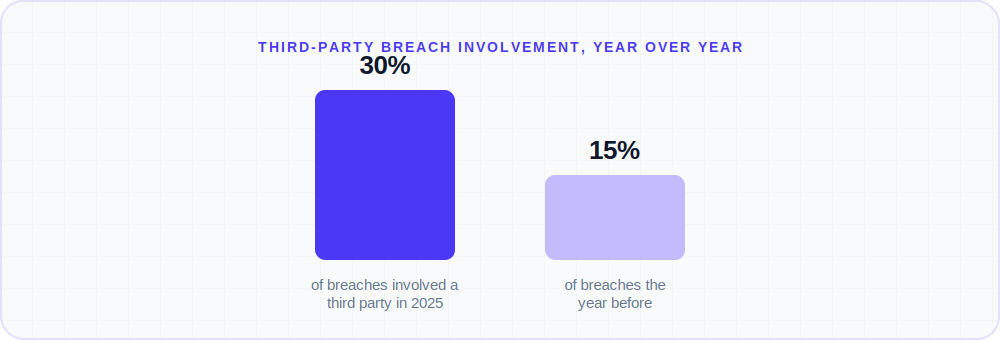
Most CRM breaches trace back to people and connections, not raw software flaws. Verizon's 2025 Data Breach Investigations Report found that 60% of confirmed breaches involved a human element such as phishing or social engineering, and that third-party involvement in breaches doubled from 15% to 30% in a single year as CRM and SaaS integrations multiplied.
Credential abuse was the single leading initial attack vector, present in 22% of breaches, followed by phishing at 16% and exploited vulnerabilities at 20%, up 34% year over year. The Cisco and Google incidents both followed the same playbook: attackers called employees while posing as IT or HR staff and talked them into installing a fake connected app, which then handed over access to real Salesforce data. That is a human-element breach and a third-party breach at the same time, which is why the two categories are climbing together rather than separately. Every additional disconnected tool a sales team plugs into its CRM is, in effect, one more vendor that has to be trusted, patched, and monitored.
How Many Customers Leave After a Data Breach?
Customer patience for breached companies is thin and getting thinner. A global consumer survey conducted for Gemalto (now Thales) found that 70% of consumers would stop doing business with a company after it suffered a data breach, and a separate PCI Pal survey found that 83% of US consumers would pause spending at a breached business for several months, with 21% saying they would never return at all.
That matters for sales leaders specifically, not just security teams, because the records sitting in a CRM are the same records reps are actively working to close. A breach does not just trigger a cleanup project. It puts live pipeline and renewal relationships directly at risk, right at the moment prospects and customers are deciding whether they still trust the company enough to keep buying.
How Much Does a CRM Data Breach Actually Cost?
IBM's 2025 Cost of a Data Breach Report puts the global average at $4.44 million per incident, which is actually a 9% drop from the year before and the first decline in five years. In the United States specifically, the average climbs to $10.22 million, more than double the global figure, driven by regulatory fines and slower detection.
Costs vary sharply by cause and industry. Breaches caused by malicious insiders were the most expensive per incident at $4.92 million, and supply chain style compromises, the same pattern behind several of the recent CRM incidents, averaged $4.91 million and took the longest to detect and contain at roughly 267 days. Healthcare remained the single costliest industry for the fifteenth consecutive year at $7.42 million per breach. Detection speed itself is a major cost lever: the average global breach lifecycle dropped to 241 days in 2025, the shortest in nine years, and organizations using AI and automation extensively identified and contained breaches roughly 80 days faster while saving about $1.9 million per incident compared to peers without those tools.

What CRM Security Habits Actually Reduce Risk?
The data points to a short list of habits that move the needle: fewer disconnected tools touching customer data, tighter access controls, and faster detection. Organizations with mature, automated monitoring consistently detect and contain breaches faster and cheaper than those relying on manual review, and every third-party integration added to a CRM is another link that needs the same scrutiny as the core system.
In practice that means enforcing multi-factor authentication for anyone with CRM access, using role-based permissions and field-level restrictions so reps only see what they need, keeping an audit trail of who touched which record, and, critically, reducing the number of separate apps and vendors that each hold a copy of the same lead or customer data. Consolidating channels into fewer, more tightly controlled systems is one of the simplest ways to shrink the attack surface that third-party involvement exploits. Teams evaluating vendors on this basis often start by comparing how different CRM platforms handle native integrations versus bolted-on third-party apps.
Curious how this looks with your own pipeline?
15-minute walkthrough, no pressure, cancel anytime.
Where Pixelwand CRM fits in
Pixelwand was built around the idea that fewer disconnected tools touching your lead and customer data means fewer places for something to go wrong. It automatically unifies leads and deals from calls, WhatsApp, web forms, and email into one pipeline, rather than scattering that same data across a patchwork of separate apps each needing its own security review. Calling runs natively through Twilio, and WhatsApp Business messaging is attached directly to the lead or deal record instead of living in a standalone app outside the CRM's visibility. Gmail and Outlook sync auto-log email threads straight onto the record, and Slack notifications keep the team aware of pipeline activity without exporting data into yet another disconnected system. Custom fields, custom statuses, assignment rules, and pinned or public views also give admins granular control over who sees what, which is exactly the kind of access discipline the breach data says matters. Teams that want to see how the pipeline, calling, and messaging pieces fit together can look through the full feature set or compare it against other platforms before deciding what to consolidate.
Plan availability: native WhatsApp messaging, the Slack integration and assignment rules start on the Growth plan. See pricing for details.
Sources: Verizon 2025 Data Breach Investigations Report, IBM Cost of a Data Breach Report 2025, Kiteworks analysis of IBM 2025 breach data, Thales/Gemalto global consumer survey, Bitdefender coverage of PCI Pal consumer survey, CX Today on the Cisco Salesforce breach, CX Today on the Google and Farmers Insurance CRM breaches, PKWARE 2025 data breach roundup
CRM data decay rate statistics: B2B databases lose roughly 22.5% of accuracy yearly, costing an average of $12.9 million in wasted effort.
70% of companies fail to integrate sales plays into CRM and revenue tech, and 99% of RevOps teams fight data issues. Here's what the data shows.
Average CRM return fell from $8.71 to $3.10 per dollar. See where the return goes, why ROI jumps after 71% adoption and how long break-even takes.
Frequently asked questions
How many data breaches now involve a third party like a CRM vendor?
Verizon's 2025 Data Breach Investigations Report found third-party involvement in confirmed breaches doubled from 15% to 30% in a single year, driven largely by chained attacks through connected CRM and SaaS integrations.
What is the average cost of a CRM or customer data breach?
IBM's 2025 Cost of a Data Breach Report puts the global average at $4.44 million per incident. In the United States specifically, the average climbs to $10.22 million, more than double the global figure.
What percentage of customers stop buying after a data breach?
A global Gemalto (Thales) survey found 70% of consumers say they would stop doing business with a company after a data breach. A separate PCI Pal survey found 83% of US consumers would pause spending for months, and 21% would never return.
How long does it take companies to detect a data breach?
IBM's 2025 report found the average global breach lifecycle, from first intrusion to full containment, was 241 days, the shortest it has been in nine years, though healthcare breaches still take 279 days on average.